Golden Age of Athens, Pericles and Greek Culture | World History | Khan Academy
TL;DR
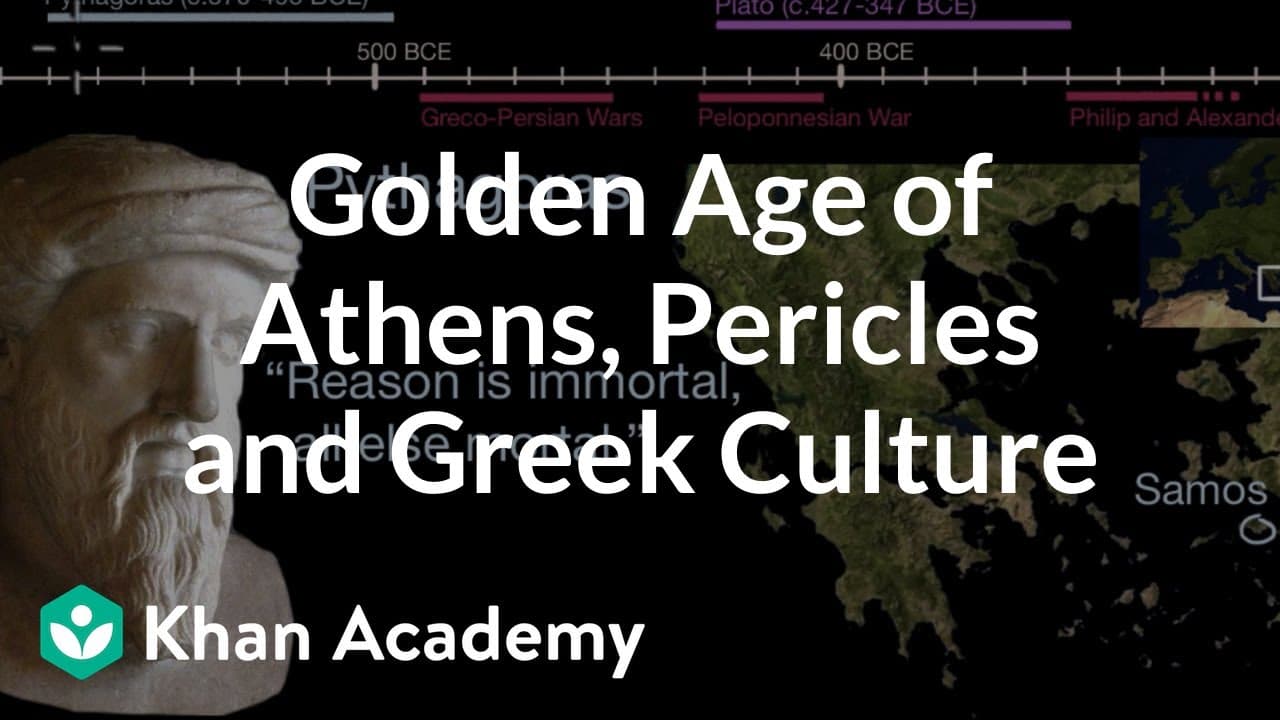
The Golden Age of Athens witnessed significant contributions in philosophy, mathematics, arts, and government, which had a lasting impact on Western civilization.
Transcript
- [Instructor] In other videos, we've already talked about how Classical Greece has had an immeasurable impact not just on Western civilization, but on civilization as a whole. In order to understand the period that we call Classical Greece, it's valuable to place it in context on a timeline, so I have significant conflicts or events that happened ... Read More
Key Insights
- 🥺 Classical Greece experienced significant conflicts, including the Greco-Persian Wars and internal city-state wars, which shaped its history and led to its eventual conquest by the Macedonians.
- 🥰 The Golden Age of Athens saw remarkable contributions in various fields, such as philosophy, mathematics, arts, and architecture.
- 💭 Greek philosophy, with its emphasis on reason and questioning, had a profound impact on Western thought and continues to influence modern views.
- 💦 Euclid's Elements remains a foundational work in modern geometry, and Pythagoras' discoveries continue to be relevant today.
- ❓ Greek Democracy, the government system introduced in Athens, became the basis for democratic principles in many modern societies.
- 🥰 The arts flourished in ancient Greece, with renowned playwrights, historians, and scientific contributions from figures like Hippocrates in medicine.
- 🧑🏭 The Roman Empire absorbed and preserved Greek culture, acting as a bridge to transmit it to the European Renaissance and Enlightenment.
Install to Summarize YouTube Videos and Get Transcripts
Explore YouTube Video Summarizer or Get YouTube Transcript Extractor
Questions & Answers
Q: Who were the key figures in Greek philosophy during the Classical period?
The key figures in Greek philosophy during the Classical period were Socrates, Plato, and Aristotle. Socrates was known for his Socratic method and questioning, Plato was his student and developed the concept of ideal forms, and Aristotle further expanded on their ideas.
Q: How did Pythagoras contribute to mathematics?
Pythagoras made significant contributions to mathematics, particularly with his discovery of the Pythagorean Theorem. He founded a philosophical and mathematical school known as Pythagoreanism, which emphasized the mystical and religious aspects of mathematics.
Q: Who is considered the Father of Geometry?
Euclid, who lived during the Hellenistic Period in Alexandria, is considered the Father of Geometry. His most renowned work, Elements, described many foundational concepts in modern geometry.
Q: What was the impact of Greek culture on the Roman Empire?
Greek culture greatly influenced the Roman Empire, especially in the fields of mathematics, philosophy, architecture, and arts. The Romans became the custodians of Greek culture and helped spread it throughout Europe during the decline of the Western Roman Empire.
Summary & Key Takeaways
-
During the fifth and fourth centuries BCE, Greece experienced significant conflicts and events, including the Greco-Persian Wars, internal city-state wars, and the conquest by Macedonians.
-
The Classical period in Greece saw notable contributions in philosophy from figures such as Socrates, Plato, and Aristotle, as well as in mathematics from Pythagoras and Euclid.
-
The arts flourished during this time, with groundbreaking playwrights like Aeschylus and Sophocles, while the government witnessed the establishment of Greek Democracy and leadership by Pericles.
Read in Other Languages (beta)
Share This Summary 📚
Summarize YouTube Videos and Get Video Transcripts with 1-Click
Try YouTube Summary with ChatGPT & Claude or YouTube Transcript Generator
Explore More Summaries from Khan Academy 📚



Summarize YouTube Videos and Get Video Transcripts with 1-Click
Try YouTube Summary with ChatGPT & Claude or YouTube Transcript Generator