TE Modes In Rectangular Waveguides - Microwave Transmission with Rectangular Waveguide
TL;DR
This video provides a detailed analysis of the transverse electric (TE) mode of wave propagation in a rectangular waveguide.
Transcript
click the Bell icon to get latest videos from akira hello friends I welcome you all to this video we are with the chapter where we see the micro view transmission with the help of a waveguide device a passive device having a metallic hollow tube the cross-section is rectangular hence the name rectangular waveguide so far in this chapter after the k... Read More
Key Insights
- 👋 The transverse electric mode of wave propagation in a rectangular waveguide is achieved by having the electric field vector perpendicular to the wave propagation direction.
- 🏑 The analysis involves deriving equations for the components of electric and magnetic fields, considering boundary conditions, and solving for characteristic parameters such as cutoff frequency, cutoff wavelength, phase velocity, and characteristic impedance.
- ❓ The cutoff frequency and wavelength depend on the dimensions of the waveguide and the operating frequency.
- 🛩️ Different combinations of small M and small N values result in different modes of propagation, and the dominant mode has the lowest cutoff frequency.
Install to Summarize YouTube Videos and Get Transcripts
Explore YouTube Video Summarizer or Get YouTube Transcript Extractor
Questions & Answers
Q: What is the main difference between transverse electric and transverse electromagnetic modes of wave propagation?
The main difference is that in the transverse electric mode, the electric field vector is perpendicular to the direction of wave propagation, while in the transverse electromagnetic mode, both the electric and magnetic field vectors are perpendicular to the direction of wave propagation.
Q: How are the components of the electric and magnetic fields represented in the rectangular waveguide for TE mode?
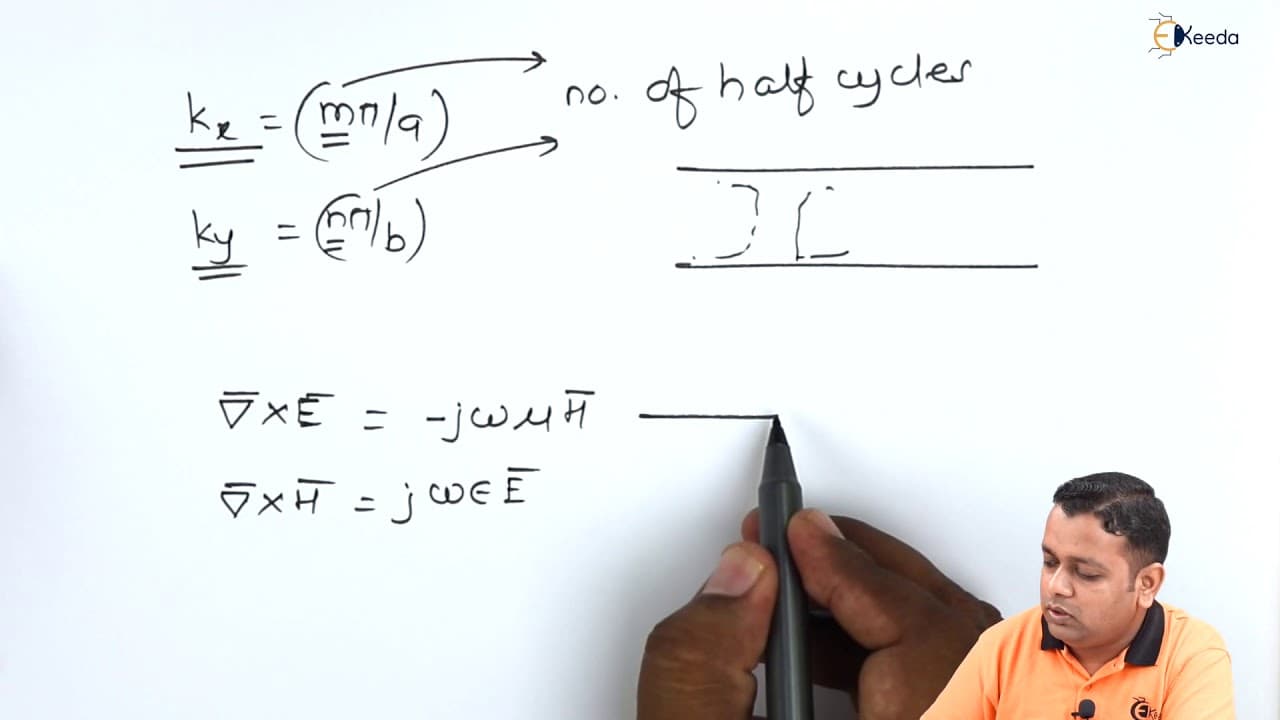
The electric and magnetic field components are represented as complex sinusoidal functions in terms of the position coordinates (x, y) inside the waveguide. The solutions involve M PI X and N PI Y terms, where M and N are integers.
Q: How is the cutoff frequency of the TE mode calculated in the rectangular waveguide?
The cutoff frequency (FC) is determined by the formula 1/(2√(με))√(M^2/a^2 + N^2/b^2), where a and b are the dimensions of the rectangular cross-section, μ is the permeability of the medium, and ε is the permittivity of the medium.
Q: What is the characteristic impedance of the TE mode in the rectangular waveguide?
The characteristic impedance (ZG) is the ratio of the magnitude of the electric field component to the magnitude of the magnetic field component. It is given by μc/√(1 - FC/F)^2, where F is the operating frequency.
Summary & Key Takeaways
-
The video explains the concept of transverse electric mode in a rectangular waveguide, where the wave propagation direction and electric field vector are mutually perpendicular.
-
The analysis includes deriving equations for the components of electric and magnetic fields in the waveguide, considering boundary conditions and solving for the waveguide's characteristic parameters.
-
The cutoff frequency, cutoff wavelength, phase velocity, and characteristic impedance are determined for the TE mode in the rectangular waveguide.
Read in Other Languages (beta)
Share This Summary 📚
Summarize YouTube Videos and Get Video Transcripts with 1-Click
Try YouTube Summary with ChatGPT & Claude or YouTube Transcript Generator
Explore More Summaries from Ekeeda 📚






Summarize YouTube Videos and Get Video Transcripts with 1-Click
Try YouTube Summary with ChatGPT & Claude or YouTube Transcript Generator