Why Do Boats Make This Shape?
TL;DR
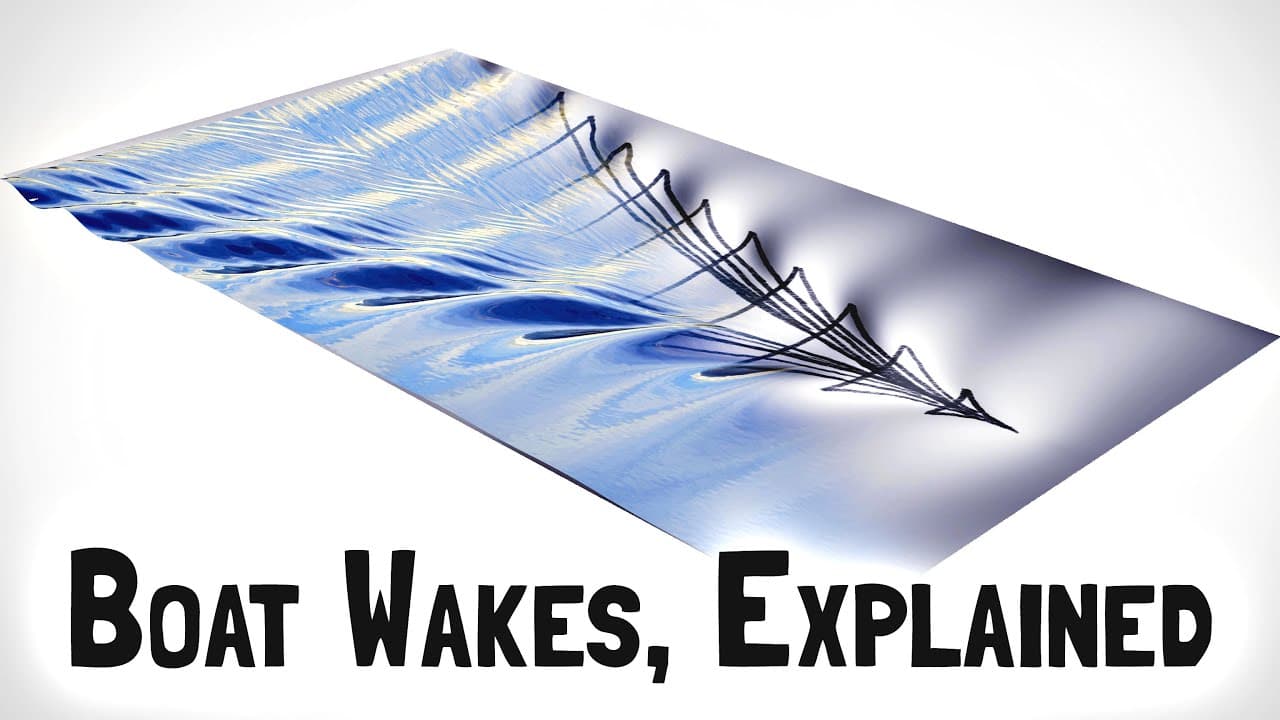
Water waves travel at different speeds and create feathery, ripple-y patterns that form the unique shape of boat wakes.
Transcript
If you look at the wake behind a duck, or a kayak, or a ship, you might notice two unusual things: first, the wake isn’t simple (like the perfectly straight shock wake of a supersonic projectile is) - it’s a fascinating, feathery, ripple-y pattern. And second, that feathery pattern looks the same - same angle, same repeating pattern of ripples alon... Read More
Key Insights
- 🌊 Water waves travel at different speeds, with longer waves traveling faster and shorter waves traveling slower.
- 🚤 The shape and pattern of a boat wake are determined by the combination of waves of different wavelengths and speeds.
- 👋 Slower waves create narrower, closely spaced wakes, while faster waves create wider wakes that are further apart.
- 🚂 Boat wakes appear as a train of v-shaped wakes, with each wake being one wavelength apart.
- 🫥 Realistic boat wakes can be created by replacing sharp lines with smooth waves at appropriate angles and spacings.
- 🌊 The dispersion of water waves is responsible for the unique shape and pattern of boat wakes.
- 🌊 Boat wakes are a result of the fascinating physics of water waves.
Install to Summarize YouTube Videos and Get Transcripts
Explore YouTube Video Summarizer or Get YouTube Transcript Extractor
Questions & Answers
Q: Why do boat wakes have the same feathery, ripple-y pattern regardless of the speed or size of the boat?
Boat wakes have the same pattern because water waves travel at different speeds. The unique shape of the wake is a result of the combination of waves of different wavelengths and their corresponding speeds, creating the feathery, ripple-y pattern.
Q: How does the speed of water waves affect the width and spacing of boat wakes?
Slower water waves create narrower wakes that are closely spaced, while faster water waves create wider wakes that are further apart. This is because slower waves have shorter wavelengths and faster waves have longer wavelengths, resulting in different wake shapes.
Q: Why do boat wakes appear as a train of v-shaped wakes instead of a single v-shaped wake?
Boat wakes appear as a train of v-shaped wakes because water waves repeat themselves. Each circular wave created by the boat is the start of a series of circular waves, which then combine to form a train of v-shaped wakes that are each exactly one wavelength apart.
Q: How can we create a realistic-looking boat wake?
To create a realistic-looking boat wake, we can replace the sharp lines of the wake with smooth waves at appropriate angles and spacings. This takes into account the dispersion relation of water and the varying speeds at which different wavelengths of waves travel.
Summary & Key Takeaways
-
Water waves have a feathery, ripple-y pattern, regardless of whether they are created by a duck, kayak, or ship.
-
The shape and pattern of boat wakes are determined by the surprising physics of water waves, specifically dispersion and the different speeds at which waves of different wavelengths travel.
-
Slower waves create narrower, closely spaced wakes, while faster waves create wider wakes that are further apart.
Read in Other Languages (beta)
Share This Summary 📚
Summarize YouTube Videos and Get Video Transcripts with 1-Click
Try YouTube Summary with ChatGPT & Claude or YouTube Transcript Generator
Explore More Summaries from minutephysics 📚



Summarize YouTube Videos and Get Video Transcripts with 1-Click
Try YouTube Summary with ChatGPT & Claude or YouTube Transcript Generator