How to Implement an Iterative Fibonacci Function in Python
TL;DR
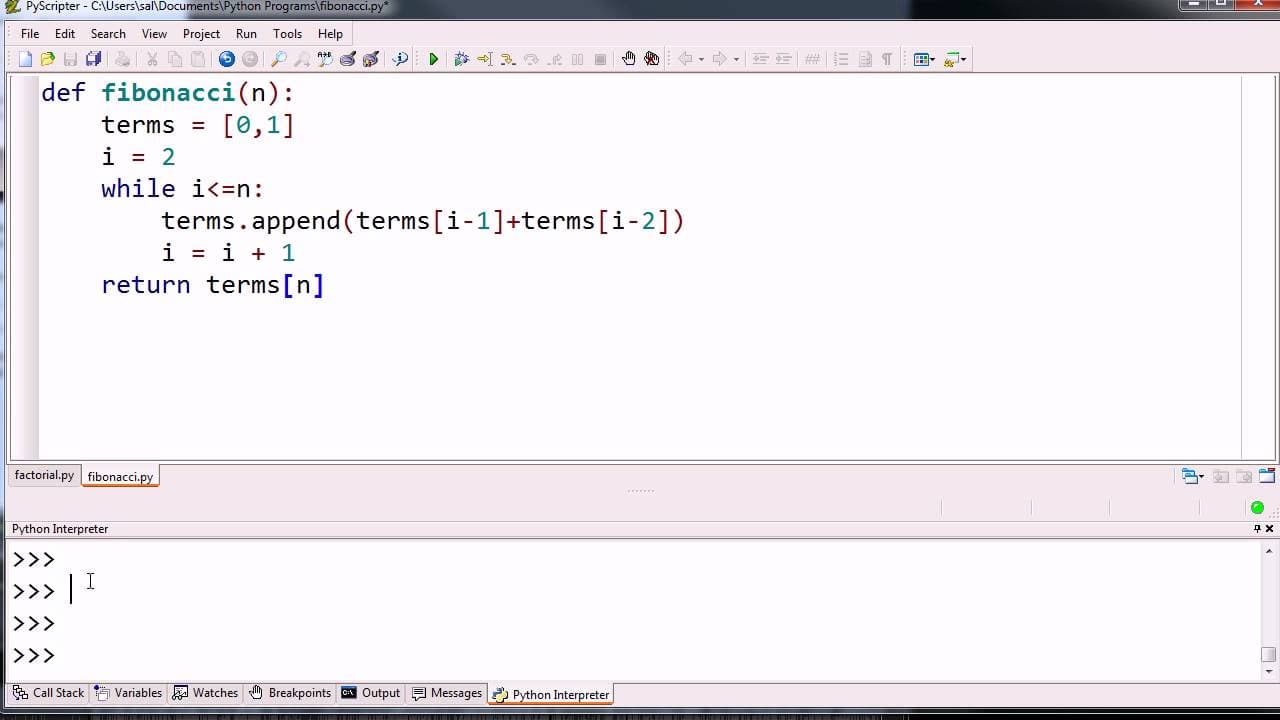
To implement an iterative Fibonacci function in Python, start by defining a list with the initial terms 0 and 1. Use a while loop to append the next term as the sum of the last two terms until reaching the nth term, which the function then returns.
Transcript
In the last video I challenged you to write multiple Fibonacci functions, ones that could calculate the nth term of the Fibonacci sequence either iteratively or recursively. And I'll do the first shot right over here. And I'll show you over the next few videos that there's really multiple ways of even doing this just iteratively. So let's define ou... Read More
Key Insights
- 👂 The Fibonacci function in Python can be implemented iteratively using a while loop and list manipulation.
- 🍉 The first two terms of the Fibonacci sequence are defined as 0 and 1.
- 👂 By iterating over the list and appending the next term, the Fibonacci sequence can be constructed.
- 👻 The implementation allows for efficient computation of Fibonacci numbers by saving the terms in a list.
- 🍉 The while loop in the implementation ensures that the next term is only added until the nth term is reached.
- 💭 The function returns the nth term of the Fibonacci sequence.
- 🫰 The implementation can be used for calculating Fibonacci numbers of any desired index.
Install to Summarize YouTube Videos and Get Transcripts
Explore YouTube Video Summarizer or Get YouTube Transcript Extractor
Questions & Answers
Q: What is the purpose of the Fibonacci function?
The Fibonacci function is used to calculate the nth term of the Fibonacci sequence.
Q: How does the Fibonacci function start building the sequence?
The function starts with a list containing the first two terms, 0 and 1, as these are defined by the Fibonacci sequence.
Q: How does the while loop in the Fibonacci function work?
The while loop iterates until the value of the variable i is not less than or equal to n. In each iteration, a new term is added to the list by summing the previous two terms.
Q: Why is the iterative implementation of the Fibonacci sequence helpful?
The iterative implementation allows for building a list of Fibonacci numbers, which can be used to compute each incremental Fibonacci number efficiently.
Summary & Key Takeaways
-
The Fibonacci function calculates the nth term of the Fibonacci sequence iteratively.
-
The function starts with a list containing the first two terms, 0 and 1, and continues adding terms until it reaches the nth term.
-
The implementation uses a while loop to iterate over the list and append the next term, which is the sum of the previous two terms.
Read in Other Languages (beta)
Share This Summary 📚
Summarize YouTube Videos and Get Video Transcripts with 1-Click
Try YouTube Summary with ChatGPT & Claude or YouTube Transcript Generator
Explore More Summaries from Khan Academy 📚



Summarize YouTube Videos and Get Video Transcripts with 1-Click
Try YouTube Summary with ChatGPT & Claude or YouTube Transcript Generator