Lift and Drag Problem 2 - Boundary Layer Flow - Fluid Mechanics 1
TL;DR
This content provides formulas and concepts for solving real-life problems related to lift and drag forces, using a kite as an example.
Transcript
hello students as we have seen in the previous sections what is lift force and drag force and a factor responsible for left and right so now by understanding all these concepts we have deduced few formulas let us apply those formulas and concepts to solve real life problems on lift and drag so we have a problem which is given to us which is related... Read More
Key Insights
- 🏋️ Understanding lift and drag forces is essential for solving real-life problems related to objects in motion.
- 💨 The angle of inclination and wind velocity can affect the direction and magnitude of drag and lift forces.
- 🏋️ Calculating the coefficients of drag and lift helps in analyzing the aerodynamic properties of various objects.
- 👱 The formulas for drag force and lift force involve parameters such as air density, area, and velocity.
- 🏋️ Solving problems involving lift and drag forces requires applying these formulas and considering the given parameters accurately.
- 💨 The direction of the forces can be determined based on the relationship between the wind velocity and the force applied by the individual.
- 🏋️ The weight of the object and the angles of inclination also play a role in determining the lift and drag forces.
Install to Summarize YouTube Videos and Get Transcripts
Explore YouTube Video Summarizer or Get YouTube Transcript Extractor
Questions & Answers
Q: What are the given parameters for the problem related to the kite?
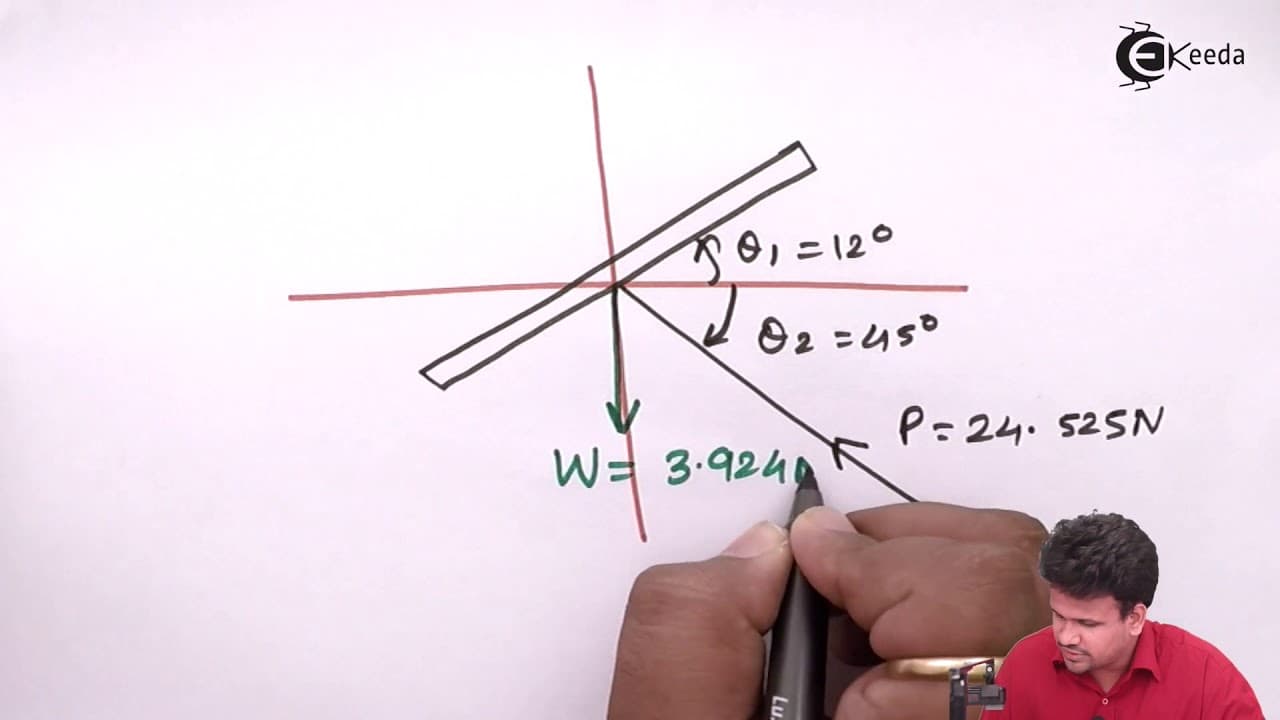
The given parameters include the dimensions of the kite (0.8 by 0.8 meters), weight of the kite (0.4 kg or 3.924 newtons), angles of inclination (12 degrees and 45 degrees), force applied by the individual (24.525 newtons), wind speed (30 kilometers per hour), and air density (1.25 kg per meter cube).
Q: How can the drag force and lift force be calculated for the inclined kite?
The drag force is calculated using the formula Fd = Cd * rho * A * u^2 / 2, where Cd is the coefficient of drag, rho is the air density, A is the area of the kite, and u is the wind velocity. The lift force is calculated using the formula Fl = Cl * rho * A * u^2 / 2, where Cl is the coefficient of lift.
Q: What is the direction of the drag and lift forces for the inclined kite?
The drag force can be applied in the opposite direction of the wind velocity, while the lift force can be applied upwards or downwards depending on the force applied by the individual.
Q: How do you calculate the coefficients of drag and lift for the kite?
The coefficients of drag and lift can be calculated by substituting the values of air density, area, wind velocity, lift force, and drag force into the formulas Cd = Fd / (rho * A * u^2 / 2) and Cl = Fl / (rho * A * u^2 / 2).
Summary & Key Takeaways
-
The content introduces a problem related to a kite, with given dimensions, weight, and angles of inclination.
-
It outlines the forces acting on the kite, such as the force applied by the individual and the weight of the kite.
-
The content explains how to calculate the drag force, lift force, and coefficients of drag and lift for the inclined kite.
Read in Other Languages (beta)
Share This Summary 📚
Summarize YouTube Videos and Get Video Transcripts with 1-Click
Try YouTube Summary with ChatGPT & Claude or YouTube Transcript Generator
Explore More Summaries from Ekeeda 📚





Summarize YouTube Videos and Get Video Transcripts with 1-Click
Try YouTube Summary with ChatGPT & Claude or YouTube Transcript Generator