Basic English: The 8 Parts of Speech
TL;DR
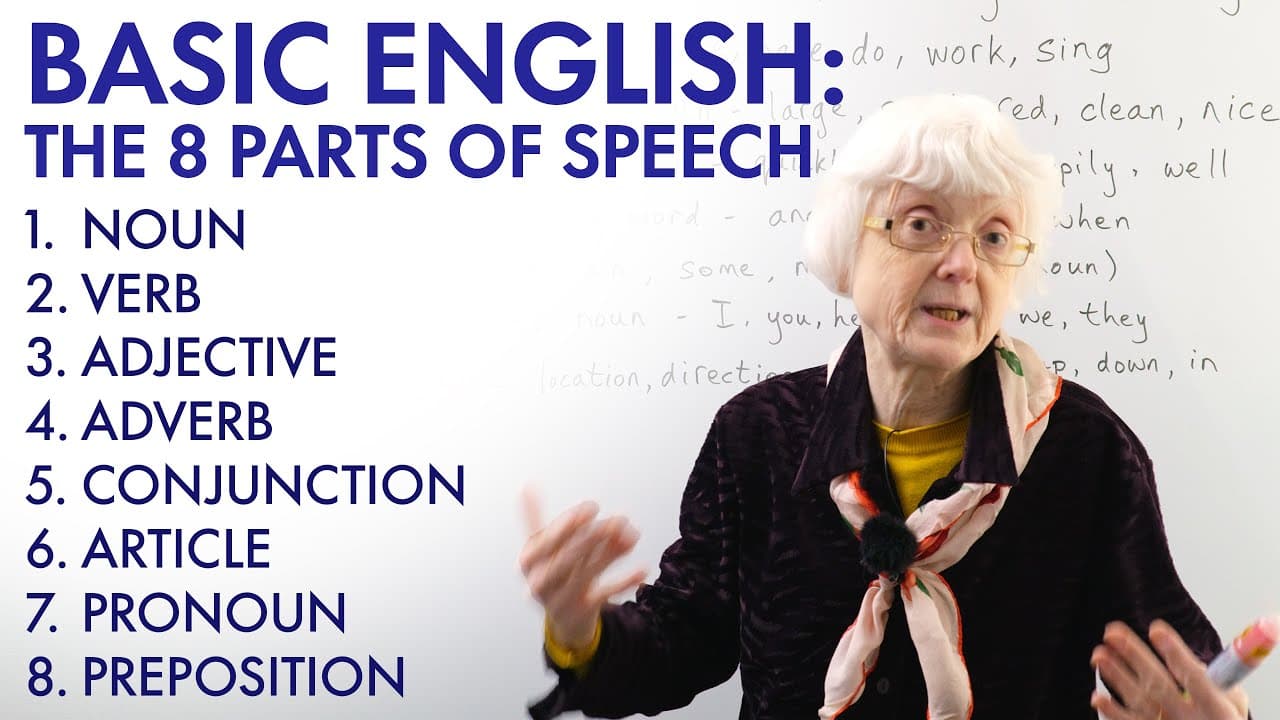
This lesson provides a comprehensive overview of the different parts of speech in English, including nouns, verbs, adjectives, adverbs, conjunctions, articles, pronouns, and prepositions.
Transcript
Hello. I'm Gill at engVid, and today's lesson is looking at the parts of speech. Okay? So, grammar and these grammatical terms. So, this is if you're a beginner learning English or you may be a native speaker, you just want to refresh your memory about what the parts of speech are. Or if you were at school at a time when grammar wasn't taught very ... Read More
Key Insights
- 🥳 There are eight main parts of speech: nouns, verbs, adjectives, adverbs, conjunctions, articles, pronouns, and prepositions.
- 👯 Nouns can refer to people, things, or abstract concepts.
- ❓ Verbs denote actions or states of being.
- ☄️ Adjectives describe nouns and come before them in English.
- 🙂 Adverbs describe how actions are done and often end in "ly."
- 🥳 Conjunctions join different parts of a sentence.
- 📢 Articles indicate specificity or generality of a noun.
- 📢 Pronouns replace nouns to make sentences more concise.
Install to Summarize YouTube Videos and Get Transcripts
Explore YouTube Video Summarizer or Get YouTube Transcript Extractor
Questions & Answers
Q: What are the different types of nouns?
There are two types of nouns mentioned in the lesson. Proper nouns are names of specific people or places and start with a capital letter, while common nouns refer to general things or concepts.
Q: How can adjectives be used in a sentence?
Adjectives are used to describe or modify nouns. They come before the noun in English. For example, "a small cat" or "a red dog."
Q: What is the role of adverbs in a sentence?
Adverbs describe how actions are done. They can indicate the manner, time, place, or degree of an action. Adverbs often end in "ly," but not always.
Q: Can you provide examples of conjunctions?
Conjunctions are words that join different parts of a sentence. Examples include "and," "but," "which," and "when." They help connect ideas or clauses.
Q: What do articles indicate in a sentence?
Articles (such as "the," "a," and "an") come before nouns and indicate specificity or generality. "The" refers to a specific noun, while "a" or "an" refer to any one of a group of possible nouns.
Q: How do pronouns work in a sentence?
Pronouns replace nouns, saving us from having to repeat the same noun multiple times. They can refer to people or things and help make sentences more concise.
Q: What do prepositions indicate in a sentence?
Prepositions indicate location, direction, or movement. Examples include "at," "in," "on," "up," and "down." They express relationships between different elements in a sentence.
Summary & Key Takeaways
-
The parts of speech covered in this lesson are nouns (including proper nouns and common nouns), verbs, adjectives, adverbs, conjunctions, articles, pronouns, and prepositions.
-
Nouns refer to people, things, or abstract ideas, while verbs denote actions or states of being.
-
Adjectives describe nouns, while adverbs describe how actions are done.
-
Conjunctions join different parts of a sentence, articles define the specificity or generality of a noun, pronouns replace nouns, and prepositions indicate location or direction.
Read in Other Languages (beta)
Share This Summary 📚
Summarize YouTube Videos and Get Video Transcripts with 1-Click
Try YouTube Summary with ChatGPT & Claude or YouTube Transcript Generator
Explore More Summaries from Learn English with Gill · engVid 📚





Summarize YouTube Videos and Get Video Transcripts with 1-Click
Try YouTube Summary with ChatGPT & Claude or YouTube Transcript Generator