Independence movements in the 20th Century | World History | Khan Academy
TL;DR
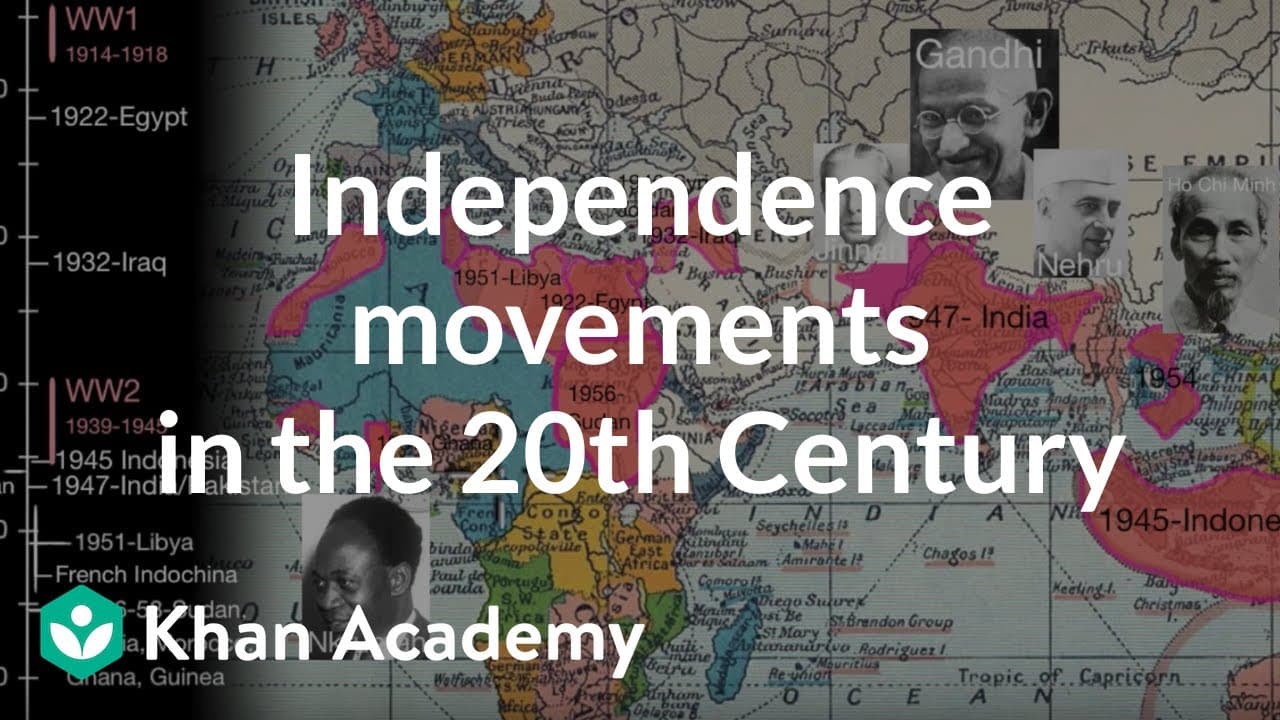
European colonies around the world gained independence throughout the 20th century, sparked by events like World War I and II and successful independence struggles led by figures like Gandhi and Nkrumah.
Transcript
- As we've seen in other videos, this is a map of the European possessions, especially the Western European possessions in much of the world as we enter into the 20th century before World War I. You see significant possessions by the French not just in Africa but also in Indochina. You see the British also have significant possessions in Africa, bu... Read More
Key Insights
- 😮 World War I and II were turning points that weakened imperial powers and fueled the rise of independence movements worldwide.
- 🖐️ Nonviolent and violent resistance played significant roles in achieving independence for various countries.
- 🌍 Independence movements in the Indian subcontinent, Africa, and Southeast Asia led to the formation of new nations.
- 🫱 The desire for autonomy and the atrocities of war contributed to a shift in the psychology of colonial powers.
Install to Summarize YouTube Videos and Get Transcripts
Explore YouTube Video Summarizer or Get YouTube Transcript Extractor
Questions & Answers
Q: What were some major outcomes of World War I that affected imperialism?
World War I led to the breakup of the Austro-Hungarian Empire and the Ottoman Empire, changing the map of Eastern Europe and leaving much of the Middle East under control by the British and French.
Q: How did the independence movement in India led by Gandhi succeed?
Gandhi's nonviolent resistance movement played a significant role in India's independence. His peaceful approach gained international attention and support, putting pressure on the British Empire to grant independence.
Q: How did India's independence impact the partition of the Indian subcontinent?
The partition resulted in the creation of Pakistan and India, with areas that were predominantly Muslim becoming Pakistan and regions with Hindu majorities becoming India. Kashmir remains a point of contention between the two countries.
Q: What was the significance of Kwame Nkrumah and his presidency in Ghana?
Kwame Nkrumah was the first president and prime minister of independent Ghana. He advocated for pan-Africanism and believed that African unity would give the continent more power on the global stage.
Summary & Key Takeaways
-
The map of European possessions changed dramatically during and after World War I, with the Austro-Hungarian Empire and the Ottoman Empire being broken up and control shifting to British and French influence.
-
Momentum for independence movements started gaining after World War I, with countries like Egypt, Iraq, Indonesia, Syria, Jordan, and the Indian subcontinent gaining independence.
-
The late 1940s and 1950s saw increased independence movements in French Indochina, Africa, and other regions, leading to the eventual independence of many countries.
Read in Other Languages (beta)
Share This Summary 📚
Summarize YouTube Videos and Get Video Transcripts with 1-Click
Try YouTube Summary with ChatGPT & Claude or YouTube Transcript Generator
Explore More Summaries from Khan Academy 📚



Summarize YouTube Videos and Get Video Transcripts with 1-Click
Try YouTube Summary with ChatGPT & Claude or YouTube Transcript Generator