Confidence interval for the slope of a regression line | AP Statistics | Khan Academy
TL;DR
The video explains how to construct a 95% confidence interval for the slope of a least-squares regression line.
Transcript
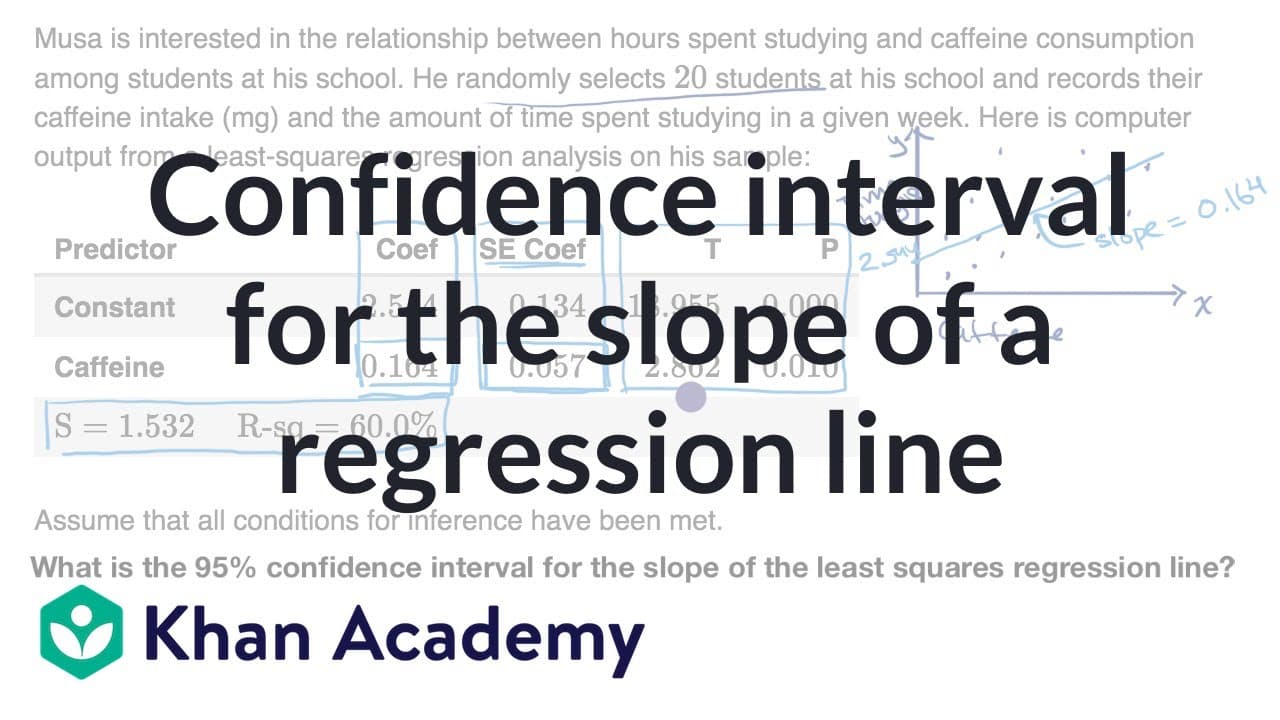
- [Instructor] Musa is interested in the relationship between hours spent studying and caffeine consumption among students at his school. He randomly selects 20 students at his school and records their caffeine intake in milligrams and the amount of time studying in a given week. Here is a computer output from a least-squares regression analysis on... Read More
Key Insights
- ⌛ Musa's study aims to understand the relationship between caffeine intake and time studying.
- 💁♂️ The computer output provides valuable information about the slope, y-intercept, and measures of fit for the regression line.
- 🧡 The standard error of the slope is used to construct a confidence interval, which indicates the range of values that the true slope is likely to fall within.
Install to Summarize YouTube Videos and Get Transcripts
Explore YouTube Video Summarizer or Get YouTube Transcript Extractor
Questions & Answers
Q: What is the purpose of fitting a least-squares regression line?
The least-squares regression line is used to model the relationship between two variables, in this case, caffeine intake and time studying. It allows us to examine how changes in one variable are related to changes in the other.
Q: What does the coefficient on caffeine in the regression output represent?
The coefficient on caffeine represents the slope of the regression line. It tells us the amount of increase in time studying for each incremental increase in caffeine intake.
Q: What does the R-squared value indicate about the fit of the regression line?
The R-squared value represents the proportion of variance in the dependent variable (time studying) that can be explained by the independent variable (caffeine intake). A higher R-squared value indicates a better fit.
Q: Why is a critical t value used instead of a critical z value in constructing the confidence interval?
The critical t value is used because the standard error of the statistic (slope) is an estimate and we do not know the standard deviation of the sampling distribution. Therefore, we need to rely on the t distribution for inference.
Summary & Key Takeaways
-
The video discusses how Musa randomly selected 20 students and recorded their caffeine intake and time studying in order to fit a least-squares regression line.
-
The computer output from the regression analysis provides information on the slope and y-intercept of the line, as well as measures of fit such as R-squared and standard deviation of the residuals.
-
To construct a 95% confidence interval for the slope of the regression line, the video explains that you need to calculate the standard error and use a critical t value based on the degrees of freedom.
Read in Other Languages (beta)
Share This Summary 📚
Summarize YouTube Videos and Get Video Transcripts with 1-Click
Try YouTube Summary with ChatGPT & Claude or YouTube Transcript Generator
Explore More Summaries from Khan Academy 📚



Summarize YouTube Videos and Get Video Transcripts with 1-Click
Try YouTube Summary with ChatGPT & Claude or YouTube Transcript Generator