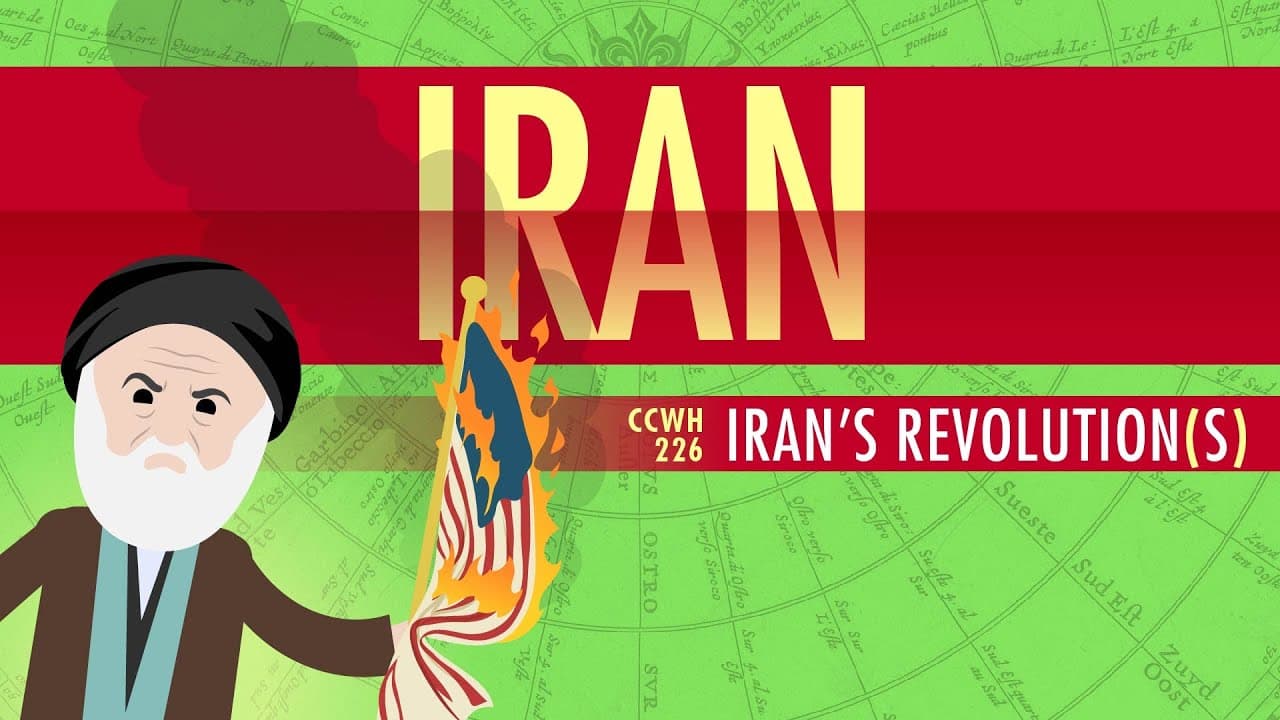
Iran's Revolutions: Crash Course World History 226
TL;DR
The 1979 Iranian Revolution was initially about overthrowing an oppressive regime.
Transcript
Hi, I’m John Green and this is Crash Course World History and today we’re talking about Iran. Oh, Mr. Green? Mr. Green? I know that country. It’s in the Middle East. It’s with Egypt. No, Me from the Past, we’re going to talk about Iran. Now, I used to be you so I remember when you would look at this part of the world and you would be like, “oh yeah... Read More
Key Insights
- The 1979 Iranian Revolution was aimed at overthrowing the Pahlavi Dynasty and was initially not about creating an Islamic state.
- Iran's history of revolutions includes the 1906 Constitutional Revolution, which aimed to limit the monarchy's power and protect minority rights.
- The British and CIA were involved in a 1953 coup that removed Prime Minister Mosaddegh, who had nationalized Iran's oil industry.
- The White Revolution led by the Shah brought economic growth but also dissatisfaction due to political repression and inequality.
- Ayatollah Khomeini opposed the White Revolution, criticizing it for granting more rights to women and neglecting the poor.
- The 1979 revolution began with peaceful protests against the Shah's regime, which later led to the establishment of an Islamic Republic.
- Khomeini's concept of velayat-e faqih established a government where religious leaders held ultimate authority over elected officials.
- Iran's government structure includes elections, but the supreme religious leader has significant power, making it not a true democracy.
Install to Summarize YouTube Videos and Get Transcripts
Explore YouTube Video Summarizer or Get YouTube Transcript Extractor
Questions & Answers
Q: What was the main goal of the 1979 Iranian Revolution?
The primary goal of the 1979 Iranian Revolution was to overthrow the Pahlavi Dynasty, which was seen as oppressive and corrupt. The revolution initially focused on addressing economic inequality and political repression, rather than establishing an Islamic state, which became a significant outcome later.
Q: How did the White Revolution impact Iranian society?
The White Revolution, led by the Shah, aimed at modernizing Iran through economic and social reforms. It resulted in significant economic growth, improvements in education, and industrial development. However, it also led to dissatisfaction due to political repression, increased inequality, and unemployment, contributing to the unrest that fueled the 1979 revolution.
Q: What role did Ayatollah Khomeini play in the 1979 revolution?
Ayatollah Khomeini was a vocal critic of the Shah's policies, particularly the White Revolution. He opposed the reforms for granting more rights to women and neglecting the poor. Khomeini's influence grew as he became a symbol of resistance, and his concept of velayat-e faqih became the foundation for the new Islamic Republic established after the revolution.
Q: How did the 1953 coup affect Iran's political landscape?
The 1953 coup, orchestrated by the British and CIA, removed Prime Minister Mosaddegh, who had nationalized Iran's oil industry. This event marked the end of Iran's democratic experiment and reinforced the Shah's power. It also increased distrust towards Western influence, contributing to the revolutionary sentiments that emerged in 1979.
Q: What is velayat-e faqih and how does it influence Iran's government?
Velayat-e faqih is a principle introduced by Ayatollah Khomeini, asserting that a sharia law scholar should hold ultimate authority in government. This concept underpins Iran's Islamic Republic, where the supreme religious leader has significant power over elected officials, making the government not fully democratic despite having elections.
Q: What were the main grievances leading to the 1979 Iranian Revolution?
The main grievances leading to the 1979 Iranian Revolution included political repression, economic inequality, and dissatisfaction with the Shah's regime. Despite economic growth, many Iranians faced unemployment and poor living conditions. The Shah's autocratic rule and the influence of Western culture further fueled the unrest and desire for change.
Q: How did the 1906 Constitutional Revolution influence Iran's history?
The 1906 Constitutional Revolution aimed to limit the monarchy's power by establishing a constitution and a parliament. It sought to protect minority rights and make Shia Islam the official state religion. Although it ultimately failed, it set a precedent for future movements seeking constitutional governance and liberty in Iran.
Q: Why is the 1979 revolution often associated with Shia Islam?
The 1979 revolution is often associated with Shia Islam due to Ayatollah Khomeini's significant influence and the establishment of the Islamic Republic. Khomeini's leadership and the implementation of velayat-e faqih tied the revolution to religious principles, overshadowing the initial focus on economic and political grievances.
Summary & Key Takeaways
-
The 1979 Iranian Revolution aimed to overthrow the Pahlavi Dynasty, initially focusing on dissatisfaction with political repression and economic inequality. Despite economic growth, many Iranians faced unemployment and poor living conditions, leading to widespread protests.
-
Ayatollah Khomeini's opposition to the Shah's policies, especially the White Revolution, played a significant role in the 1979 revolution. The revolution eventually resulted in the establishment of an Islamic Republic, where religious leaders held significant power.
-
Iran's history of revolutions includes the 1906 Constitutional Revolution and the 1953 coup against Mosaddegh. The 1979 revolution was not initially about creating an Islamic state but became associated with Shia Islam due to Khomeini's influence.
Read in Other Languages (beta)
Share This Summary 📚
Summarize YouTube Videos and Get Video Transcripts with 1-Click
Try YouTube Summary with ChatGPT & Claude or YouTube Transcript Generator
Explore More Summaries from CrashCourse 📚




Summarize YouTube Videos and Get Video Transcripts with 1-Click
Try YouTube Summary with ChatGPT & Claude or YouTube Transcript Generator