Storage of XML - XML Database - Database Management System
TL;DR
This video discusses different ways to store XML data, including storing it in a non-relational format like a flat file or XML database, and storing it in a relational database using string storage or tree representation, with options for publishing and shredding the data.
Transcript
click the bell icon to get latest videos from akira hello friends today we will discuss about the storage of xml data we will see that how to store data in an on relational file in a relational database how to map relational data to the exam or how to store the relational data in relational database and finally the mapping between this shredding an... Read More
Key Insights
- 💁 XML data can be stored in non-relational formats like flat files or XML databases, or in a relational database using string storage or tree representation.
- 🖤 Flat files provide a simple way to store XML data but lack schema support and can be challenging to maintain relationships.
- 💨 XML databases offer object-oriented database capabilities, support XML queries, and provide a more structured way to store XML data.
- 🏪 Storing XML data in a relational database using string storage is possible but can make querying and retrieving specific data more complex.
- 👻 Tree representation allows for easier mapping of XML data to relational tables and direct storage of XML data in a relational format.
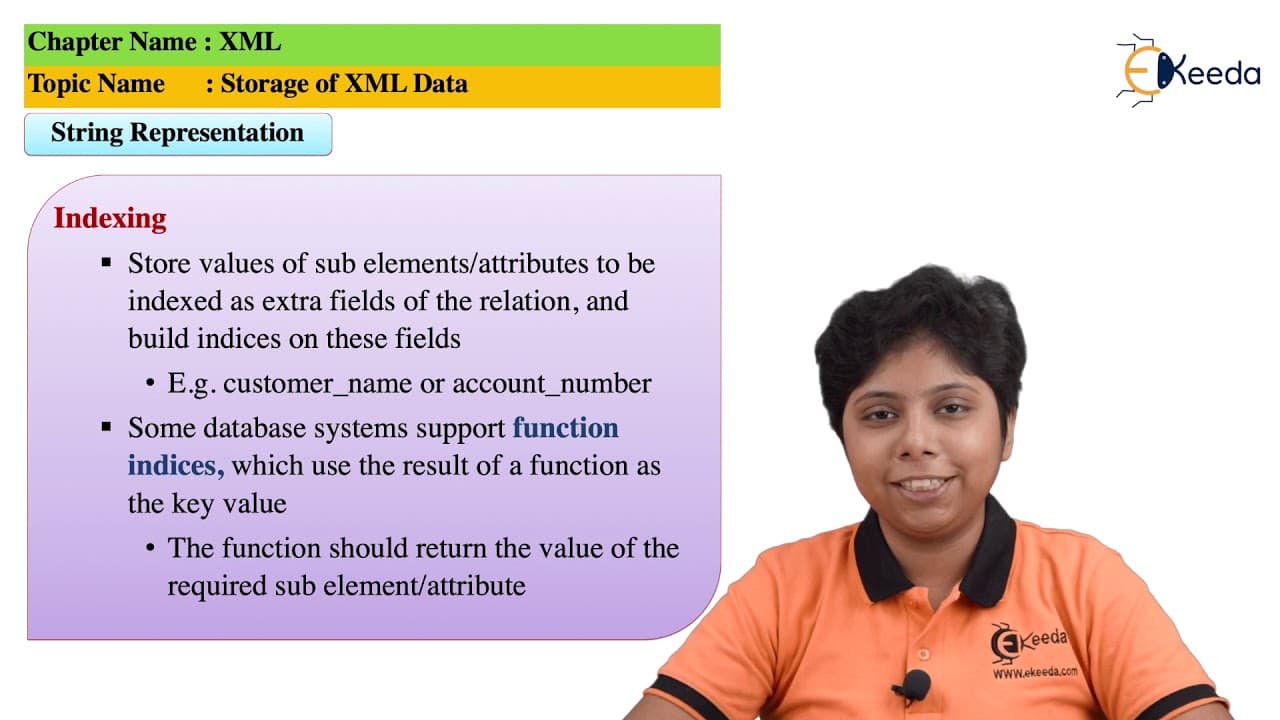
- 🫰 Some database management systems, like Oracle, support function indices for efficient storage and retrieval of XML data.
- 💁 Publishing refers to converting XML data into a format suitable for web interfaces, while shredding refers to converting web interface data into a relational format.
Install to Summarize YouTube Videos and Get Transcripts
Explore YouTube Video Summarizer or Get YouTube Transcript Extractor
Questions & Answers
Q: What are the advantages of storing XML data in a non-relational format like a flat file?
Storing XML data in a flat file is simple and provides a straightforward way to store the data. It allows for easy operations on the XML data and does not require mapping or schema designing. However, it lacks schema support and can be challenging to maintain relationships between tables.
Q: How does storing XML data in an XML database differ from storing it in a flat file?
XML databases are designed specifically for storing XML data and offer object-oriented database capabilities. They support XML queries, provide better encapsulation and abstraction of data, and allow for storing complex types and structures. Unlike flat files, XML databases have better support for maintaining relationships and performing XML-related operations.
Q: How can XML data be stored in a relational database using string storage?
XML data can be stored in a relational database using string storage, where each XML tuple is stored as a single string. This approach uses substring and blob features to store XML data. However, storing XML data as a string can make it difficult to query and retrieve specific data, as each tuple is stored as a separate string.
Q: What is tree representation and how is it used to store XML data in a relational database?
Tree representation involves storing XML data in a hierarchical structure, with root nodes, parent nodes, and leaf nodes. Each node is considered as an element, with attributes representing properties. Storing XML data in a tree representation allows for easier mapping to relational tables and direct storage of XML data in a relational format without the need for explicit conversion.
Summary & Key Takeaways
-
XML data can be stored in a non-relational format, such as a flat file or XML database, or in a relational database with schema mapping.
-
Storing XML data in a flat file provides a simple way to store the data, but it lacks schema support and can be challenging to maintain relationships between tables.
-
XML databases offer object-oriented database capabilities, support XML queries, and provide a more structured approach to storing XML data.
-
Storing XML data in a relational database can be done using string storage or a tree representation, allowing for easier mapping to relational tables.
Read in Other Languages (beta)
Share This Summary 📚
Summarize YouTube Videos and Get Video Transcripts with 1-Click
Try YouTube Summary with ChatGPT & Claude or YouTube Transcript Generator
Explore More Summaries from Ekeeda 📚




Summarize YouTube Videos and Get Video Transcripts with 1-Click
Try YouTube Summary with ChatGPT & Claude or YouTube Transcript Generator