What Are the Connections Between Cosine and Hyperbolic Cosine?
TL;DR
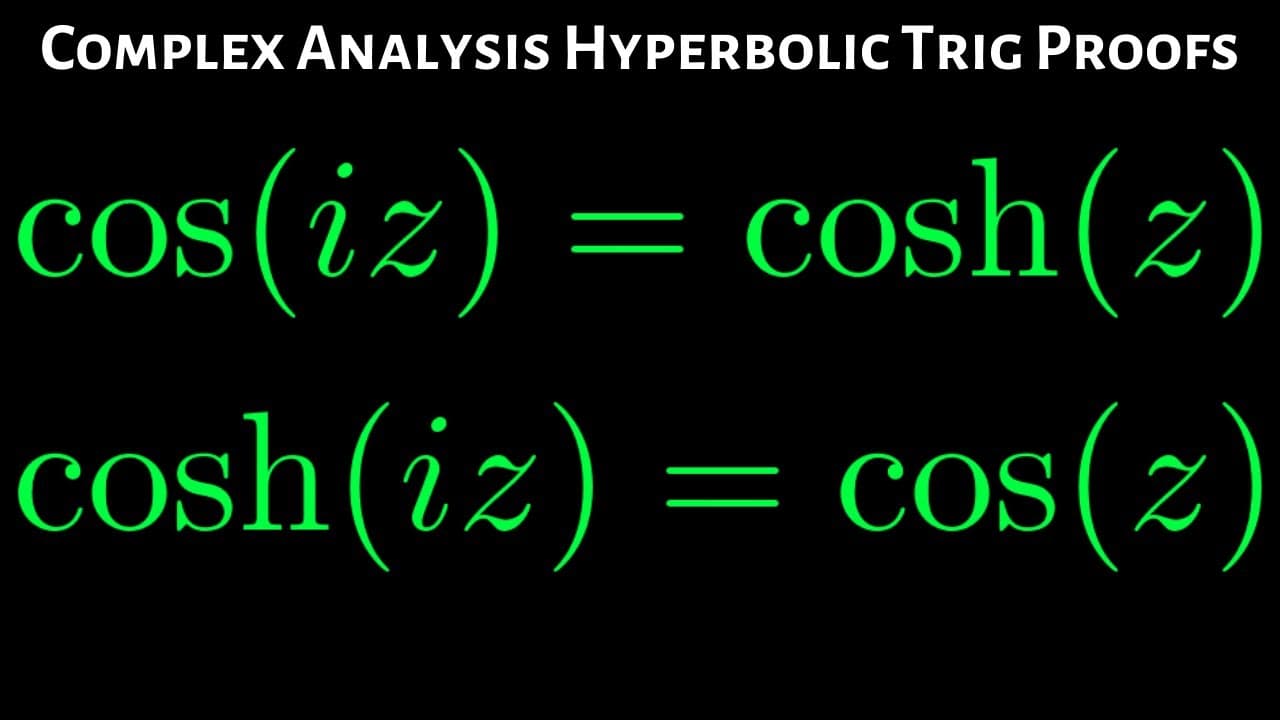
The cosine of an imaginary complex number (cos(iz)) equals the hyperbolic cosine of that number (cosh(z)), while the hyperbolic cosine of an imaginary complex number (cosh(iz)) equals the cosine of the original complex number (cos(z)). These equations illustrate that substituting an imaginary input causes the functions to transform into one another.
Transcript
hey what's ups in this video we're going to prove that the cosine of I Z is equal to Co sin Z and the Constantia by Z is equal to cosine Z so here Z is a complex number so basically these equations relate the hyperbolic cosine to the regular cosine right so these are complex valued functions right so for a complex number the cosine of I Z is equal ... Read More
Key Insights
- #️⃣ The cosine of an imaginary complex number is equal to the hyperbolic cosine of the original complex number.
- #️⃣ The hyperbolic cosine of an imaginary complex number is equal to the cosine of the original complex number.
- 🎁 The equations presented in the video demonstrate how the imaginary component disappears when plugging in IZ into either cosine or hyperbolic cosine.
- ❓ These relationships between complex cosine and hyperbolic cosine are simple yet fascinating.
- 🤑 Simple proofs can be just as beautiful and important as complex ones in mathematics.
- ❓ The definitions of complex cosine and hyperbolic cosine provide the basis for the proofs.
- 🥺 Understanding the connections between different mathematical functions can lead to interesting insights.
Install to Summarize YouTube Videos and Get Transcripts
Explore YouTube Video Summarizer or Get YouTube Transcript Extractor
Questions & Answers
Q: How does the cosine of an imaginary complex number relate to the hyperbolic cosine?
The cosine of IZ is equivalent to the hyperbolic cosine of Z. When we replace Z with IZ in the cosine function, the imaginary component disappears, resulting in the hyperbolic cosine function.
Q: Can the hyperbolic cosine of an imaginary complex number be expressed as the regular cosine?
Yes, the hyperbolic cosine of IZ is equal to the cosine of Z. By replacing Z with IZ in the hyperbolic cosine function, the imaginary component cancels out, leaving us with the regular cosine function.
Q: What are the definitions of complex cosine and hyperbolic cosine?
The complex cosine, cosine Z, is defined as e^(iZ) + e^(-Z)/2. The hyperbolic cosine, cosh Z, is defined as e^Z + e^(-Z)/2.
Q: Why are the proofs for these relationships considered simple?
The proofs are simple because they involve straightforward substitutions of Z with IZ or vice versa in the cosine and hyperbolic cosine functions. These substitutions eliminate the imaginary component and transform one function into another.
Summary & Key Takeaways
-
The video aims to prove that the cosine of IZ is equal to cosh Z and cosh IZ is equal to cos Z.
-
These equations show the connection between hyperbolic cosine and the regular cosine for complex numbers.
-
When an imaginary complex number is plugged into either cosine or hyperbolic cosine, it transforms into the other function.
Read in Other Languages (beta)
Share This Summary 📚
Summarize YouTube Videos and Get Video Transcripts with 1-Click
Try YouTube Summary with ChatGPT & Claude or YouTube Transcript Generator
Explore More Summaries from The Math Sorcerer 📚



Summarize YouTube Videos and Get Video Transcripts with 1-Click
Try YouTube Summary with ChatGPT & Claude or YouTube Transcript Generator