Intersecting functions example
TL;DR
The video explains how to categorize variables in equations based on their intersection points on graphs.
Transcript
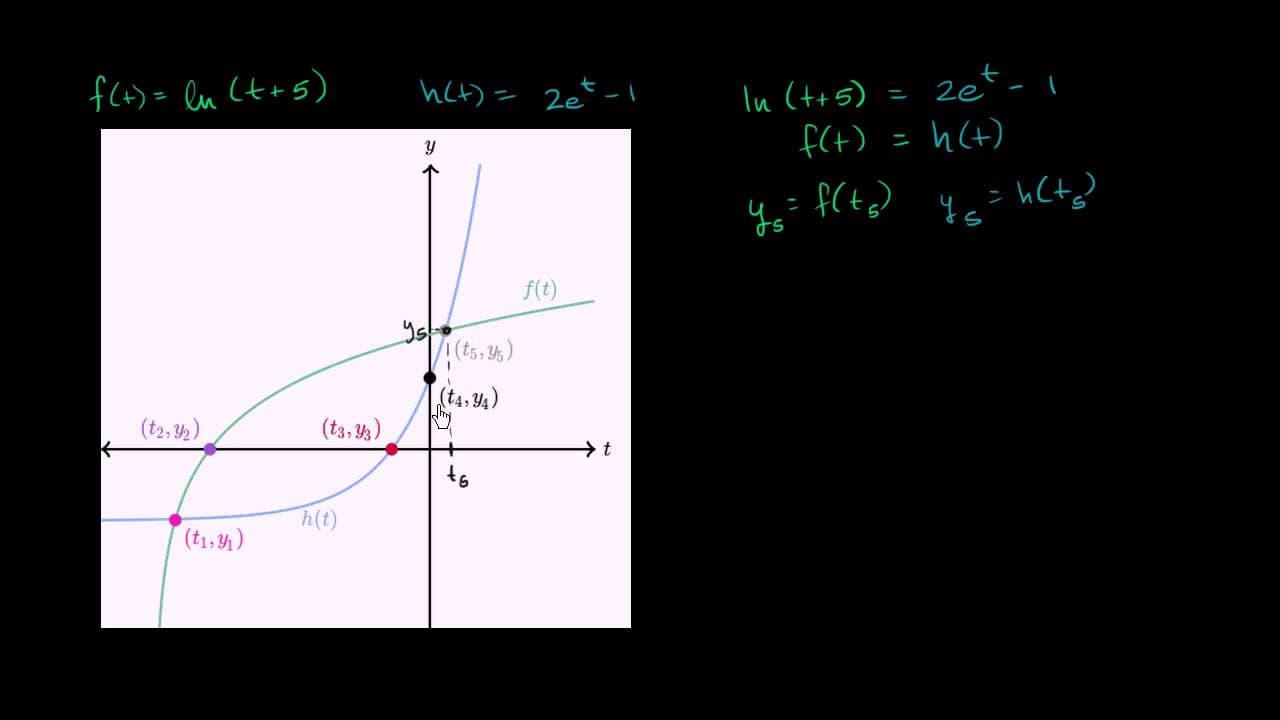
Graphs of f of t is equal to the natural log of t plus 5, and h of t is equal to 2e to the t minus 1 are shown below. So this is f of t right over here. This is h of t right over here. Drag the variables to show which equations they must satisfy. There can be any number of variables per category, and some variables might not go into any category. S... Read More
Key Insights
- 😥 Categorizing variables based on intersection points helps analyze the relationships between functions.
- 😥 Identifying intersection points allows for solving equations and finding solutions.
- 😥 Functions intersect at specific variable values, indicating equality or points of interest.
- ❓ The categorization of variables simplifies the process of finding common solutions to equations.
- ❓ Each variable category represents a different relationship or condition between functions.
- 🆘 The categorization helps visualize the behavior of functions and their dependencies.
- 😥 Intersection points indicate where two functions share the same output value.
Install to Summarize YouTube Videos and Get Transcripts
Explore YouTube Video Summarizer or Get YouTube Transcript Extractor
Questions & Answers
Q: What is the purpose of categorizing variables in equations based on their intersection points?
Categorizing variables helps identify where functions intersect each other, leading to a better understanding of their relationships and possible solutions to equations.
Q: How do we determine which variables fall into each category?
Variables that satisfy the equation f(t) = h(t) fall into the first category. Variables that make h(t) = 0 fall into the second category, and variables that make f(t) = 0 fall into the third category.
Q: Can a variable be part of multiple categories?
Yes, it is possible for a variable to fall into multiple categories if it satisfies the equations for each category.
Q: What is the significance of the intersection points between functions?
Intersection points represent values of variables that make two functions equal to each other, providing possible solutions to equations or points of interest in the context of the functions.
Summary & Key Takeaways
-
The video discusses how to categorize variables based on their intersection points on graphs.
-
The three categories are: variables that make two functions equal to each other, variables that make one function equal to zero, and variables that make another function equal to zero.
-
By categorizing the variables, it becomes easier to understand the relationships between the functions.
Read in Other Languages (beta)
Share This Summary 📚
Summarize YouTube Videos and Get Video Transcripts with 1-Click
Try YouTube Summary with ChatGPT & Claude or YouTube Transcript Generator
Explore More Summaries from Khan Academy 📚



Summarize YouTube Videos and Get Video Transcripts with 1-Click
Try YouTube Summary with ChatGPT & Claude or YouTube Transcript Generator