What is Bearing? Types of Bearings and How they Work?
TL;DR
Bearings are machine elements that reduce friction and enable smooth movement between parts, with different types of bearings used for various applications.
Transcript
bearings are used from a small supermarket trolley to huge power plants a number of light duty as well as industrial equipments could not function without the use of bearings a bearing is a machine element that constrains relative motions and used to reduce the friction between moving parts for an example a sliding door the door cannot be lifted or... Read More
Key Insights
- 🧩 Bearings are essential machine elements that reduce friction and enable smooth movement between parts, enhancing speed and efficiency.
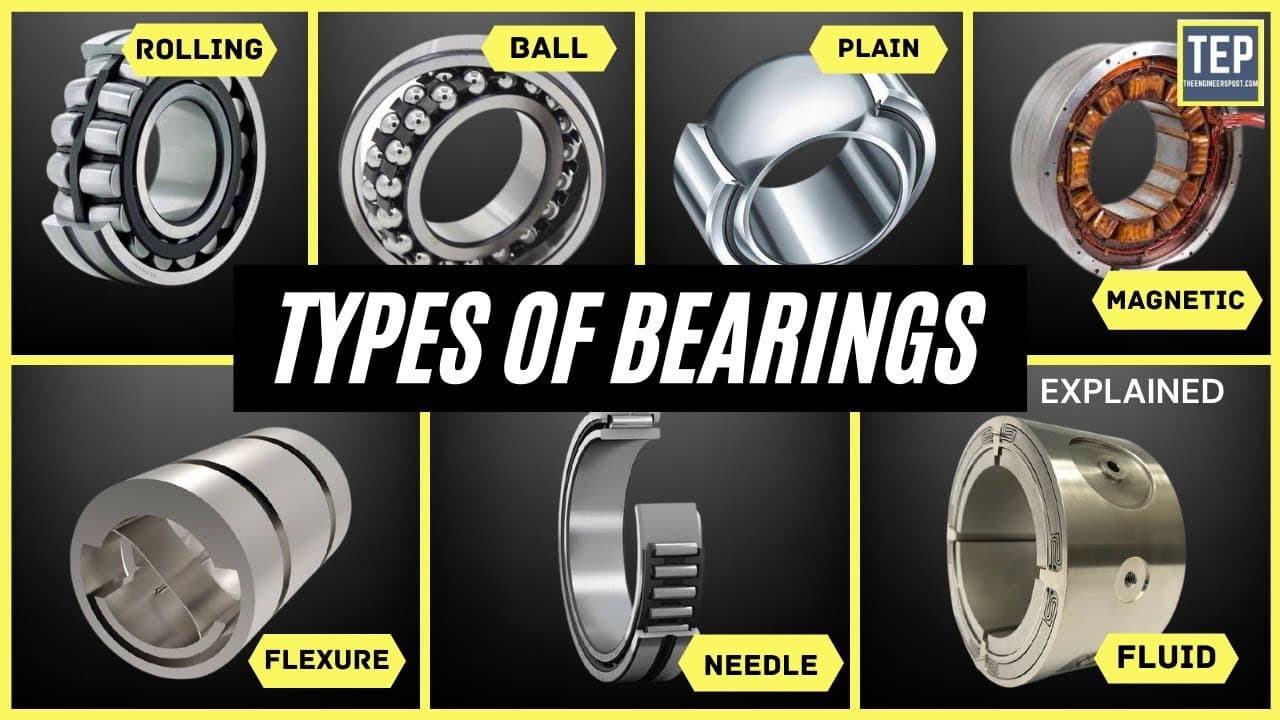
- 🛠️ Different types of bearings are used for various applications, including rolling element bearings, plane bearings, fluid bearings, magnetic bearings, jewel bearings, and flexure bearings.
- ⚙️ The main purpose of bearings is to prevent direct metal-to-metal contact, reducing friction, heat generation, and wear and tear of parts, while also transmitting load to the housing.
- 🚧 Rolling element bearings, such as ball bearings and roller bearings, utilize rolling friction instead of sliding friction, resulting in low friction and high load-carrying capacity.
- 🔴 Ball bearings consist of rows of balls trapped between two annulus-shaped metal races, providing low friction but limited load-carrying capacity.
- 🔵 Roller bearings contain cylindrical rolling elements and maintain accurate alignment, making them suitable for machinery with frequent start and stops and higher axial loads. -> Cylindrical roller bearings optimize stress distribution at contact points, spherical roller bearings support higher radial and axial loads, tapered roller bearings handle higher axial loads, and needle roller bearings are suitable for radial forces only.
- 🔼 Plane bearings are simple and lightweight, used for rotational, sliding, reciprocating, or oscillatory motion, while fluid bearings rely on pressurized gas or liquid to eliminate friction.
- 🧲 Magnetic bearings use magnetic levitation, resulting in zero-wear and the ability to handle high speeds and loads.
- 💎 Jewel bearings, made from synthetic sapphire or ruby, provide low friction, long life, and dimensional accuracy, often used in precision instruments like mechanical watches.
- ➰ Flexure bearings are compliant in angular degrees of freedom, serving the same function as conventional bearings but without the need for lubrication and with low friction.
Install to Summarize YouTube Videos and Get Transcripts
Explore YouTube Video Summarizer or Get YouTube Transcript Extractor
Questions & Answers
Q: What is the purpose of bearings in machines?
The purpose of bearings in machines is to reduce friction and facilitate smooth movement between different parts, preventing direct metal-to-metal contact and minimizing wear and tear.
Q: What are the different types of rolling element bearings?
Rolling element bearings can be subdivided into two major types: ball bearings and roller bearings. Ball bearings contain rows of balls between two races, while roller bearings use cylindrical or tapered rolling elements.
Q: What are the advantages of fluid bearings?
Fluid bearings rely on pressurized gas or liquid to carry the load and eliminate friction. They have longer lifespans and can endure high speeds and loads, making them suitable for tough conditions.
Q: How do magnetic bearings work?
Magnetic bearings utilize magnetic levitation to hold the shaft mid-air without physical contact. They are zero-wear bearings and can handle high relative speeds and accommodate irregularities in shaft design.
Q: What are the applications of jewel bearings?
Jewel bearings are used in precision instruments and mechanical watches where low friction, long life, and dimensional accuracy are essential. They are typically made from synthetic sapphire or ruby and offer excellent performance.
Q: What are the advantages of flexure bearings?
Flexure bearings are compliant mechanisms that exhibit low friction, require no lubrication, and are easy to repair. They are often compact, lightweight, and cost-effective, although they have limited range of motion and load capacity.
Summary & Key Takeaways
-
Bearings are machine elements that facilitate the movement and reduce friction between different parts of a machine.
-
The main purpose of bearings is to prevent direct metal-to-metal contact, reducing friction, heat generation, and wear and tear.
-
There are various types of bearings, including rolling element bearings (ball and roller bearings), plane bearings, fluid bearings, magnetic bearings, jewel bearings, and flexure bearings.
Read in Other Languages (beta)
Share This Summary 📚
Summarize YouTube Videos and Get Video Transcripts with 1-Click
Try YouTube Summary with ChatGPT & Claude or YouTube Transcript Generator
Explore More Summaries from The Engineers Post 📚

Summarize YouTube Videos and Get Video Transcripts with 1-Click
Try YouTube Summary with ChatGPT & Claude or YouTube Transcript Generator