Find the Derivative of f(x) = x^2*sqrt(1 + x^2)
TL;DR
This video explains how to find the derivative of a function using the product rule and chain rule in calculus, with step-by-step explanations and examples.
Transcript
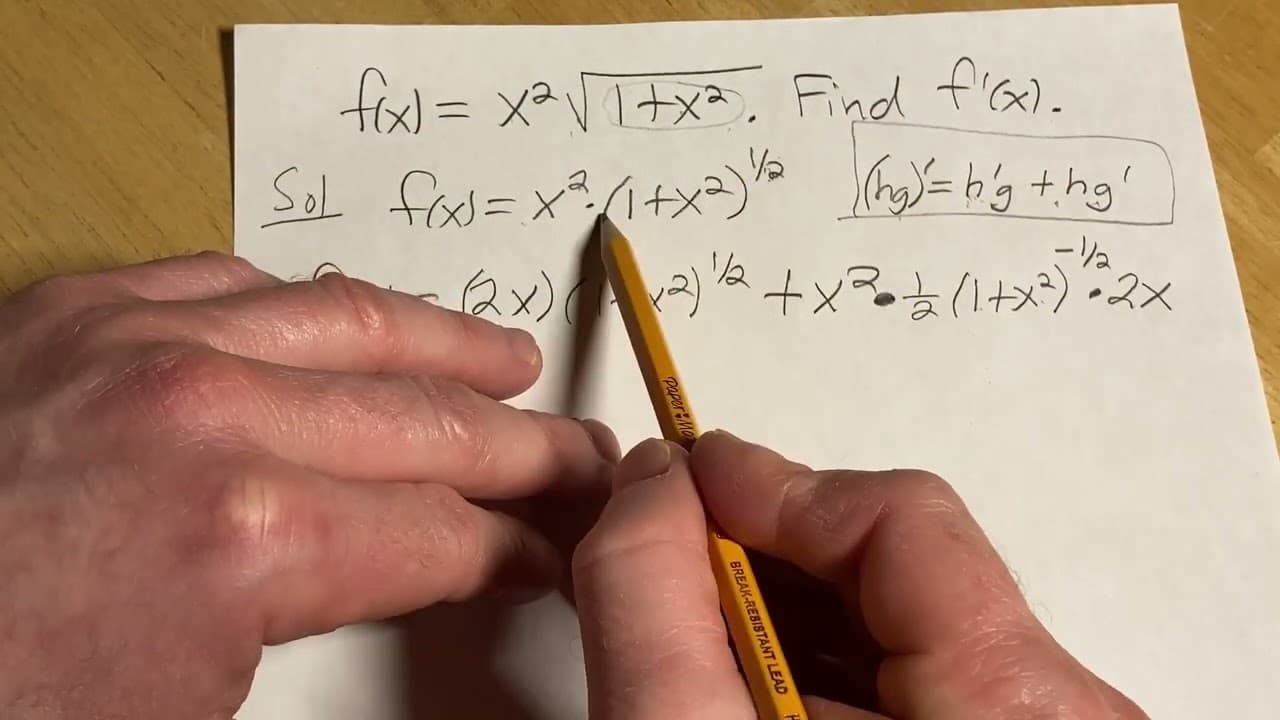
hi in this video we're going to do a math problem where we find a derivative using the product rule and the chain rule so the function we have is f ofx = x^2 * the < TK of 1 + x^2 the question is to find the derivative let's go ahead and go through it solution so first let's rewrite this in a more convenient way let's just write it all down again a... Read More
Key Insights
- 📏 The video teaches how to find derivatives using both the product rule and chain rule in calculus.
- 🆘 The step-by-step explanations help in understanding the concepts and applying them to the given function.
- 🧑🏭 Factoring out common terms with smaller exponents can simplify the expression and make it more efficient to work with.
Install to Summarize YouTube Videos and Get Transcripts
Explore YouTube Video Summarizer or Get YouTube Transcript Extractor
Questions & Answers
Q: What is the product rule for finding derivatives?
The product rule states that when finding the derivative of the product of two functions, we multiply the derivative of the first function by the second function, and add the product of the first function and the derivative of the second function.
Q: How does the chain rule help in finding derivatives?
The chain rule is used when finding the derivative of a function raised to a power or involving a composition of functions. It involves taking the derivative of the outer function and multiplying it by the derivative of the inner function.
Q: What is the advantage of factoring out common terms with smaller exponents?
Factoring out common terms with smaller exponents helps simplify the expression and make it more efficient to work with. This technique is particularly useful when finding critical numbers or possible inflection points in calculus.
Q: Can the final answer be expressed differently, such as in terms of a square root?
Yes, the final answer can be expressed in a different form, such as in terms of a square root. However, it is not necessary to do so, and leaving it in the factored form is also a valid representation of the derivative.
Summary & Key Takeaways
-
The video demonstrates how to find the derivative of a function involving both the product rule and the chain rule in calculus.
-
The product rule states that when taking the derivative of the product of two functions, the derivative is the derivative of the first function multiplied by the second function, plus the first function multiplied by the derivative of the second function.
-
The chain rule states that when taking the derivative of a function raised to a power or involving a composition of functions, the derivative involves both the derivative of the outer function and the derivative of the inner function.
Read in Other Languages (beta)
Share This Summary 📚
Summarize YouTube Videos and Get Video Transcripts with 1-Click
Try YouTube Summary with ChatGPT & Claude or YouTube Transcript Generator
Explore More Summaries from The Math Sorcerer 📚



Summarize YouTube Videos and Get Video Transcripts with 1-Click
Try YouTube Summary with ChatGPT & Claude or YouTube Transcript Generator