GMAT: Data sufficiency 2 | Data sufficiency | GMAT | Khan Academy
TL;DR
The video provides explanations for solving geometry problems and analyzes inequalities in algebraic statements.
Transcript
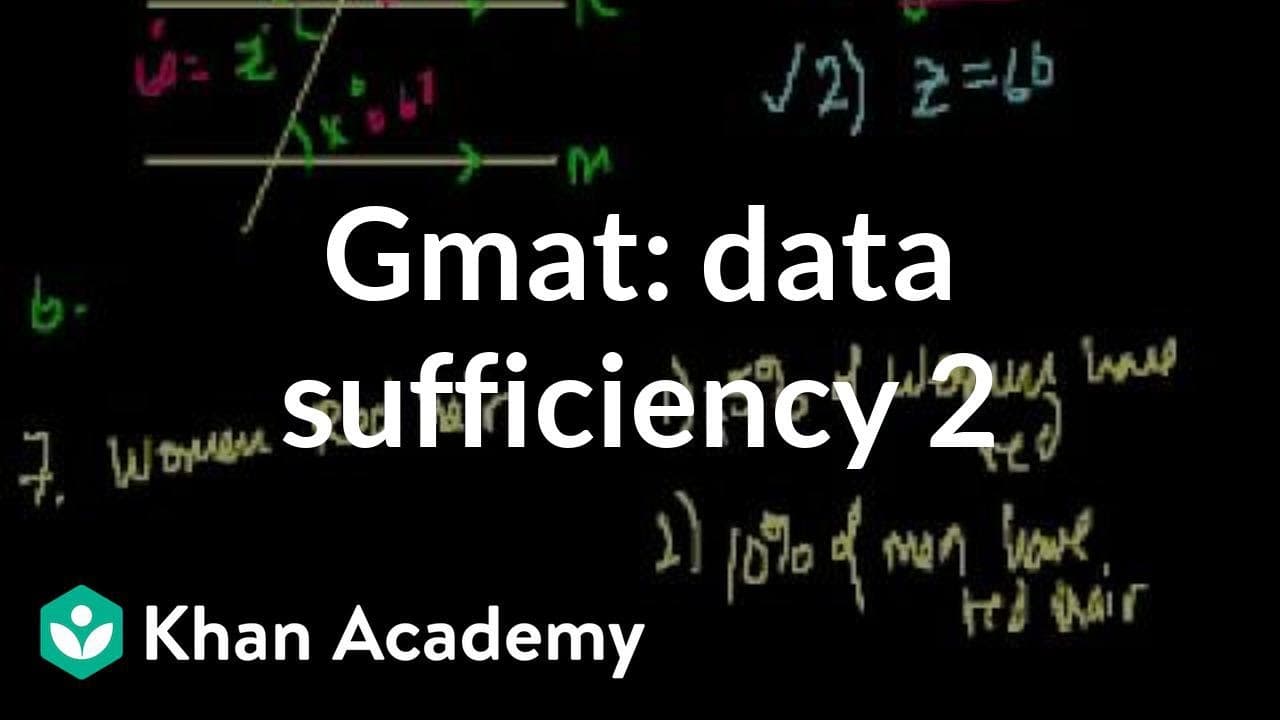
Let's keep going. We're on problem number six on page 278 of the data sufficiency sample questions. So let's see. They've drawn a little figure. And they say, in the figure above, lines k and m are parallel. I guess I better draw lines k and m. That's line k. That's line m. And then they have a transversal line. And we've gone over all of this in t... Read More
Key Insights
- 🫥 Understanding geometry concepts such as supplementary angles and parallel lines is crucial in solving related problems.
- 💁 In order to calculate percentages, it is essential to have information about the total population size.
- ❓ Equations and inequalities can be manipulated using algebraic operations to determine relationships and solve problems.
Install to Summarize YouTube Videos and Get Transcripts
Explore YouTube Video Summarizer or Get YouTube Transcript Extractor
Questions & Answers
Q: How is the value of angle x determined in the first problem?
By knowing that angle y is supplementary to angle z, we can determine that x is equal to 60 degrees using this information.
Q: Why do neither of the statements in the second problem provide enough information to solve for the percentage of women with red hair?
The statements only give information about the percentage of women with red hair and the percentage of men with red hair, but we do not have information about the total population of women and men in the group, which is needed to calculate the percentage of women with red hair.
Q: How can we determine the percentage of r compared to s in the third problem?
Statement one provides the equation r = (3/4)s, which allows us to determine that r is 75% of s. Statement two gives the ratio r/s as 75/100, which is equivalent to 75%.
Q: How can we conclude that a is greater than b in the fourth problem?
Both statement one (2a > 2b) and statement two (a + c > b + c) show that a is greater than b by applying algebraic operations without changing the inequality signs.
Summary & Key Takeaways
-
In the first problem, the value of angle x in a figure with parallel lines is determined using information about the supplementary angle y and angle z.
-
The second problem asks for the percentage of women with red hair in a group, but neither of the given statements provide enough information to solve it.
-
In the third problem, two statements are given to determine the percentage of r compared to s, where both statements yield the same result.
-
The final problem involves inequalities, with both statements providing enough information to conclude that a is greater than b.
Read in Other Languages (beta)
Share This Summary 📚
Summarize YouTube Videos and Get Video Transcripts with 1-Click
Try YouTube Summary with ChatGPT & Claude or YouTube Transcript Generator
Explore More Summaries from Khan Academy 📚



Summarize YouTube Videos and Get Video Transcripts with 1-Click
Try YouTube Summary with ChatGPT & Claude or YouTube Transcript Generator