Doubly Link List Program Part 2 | Link List | Data Structure Using C
TL;DR
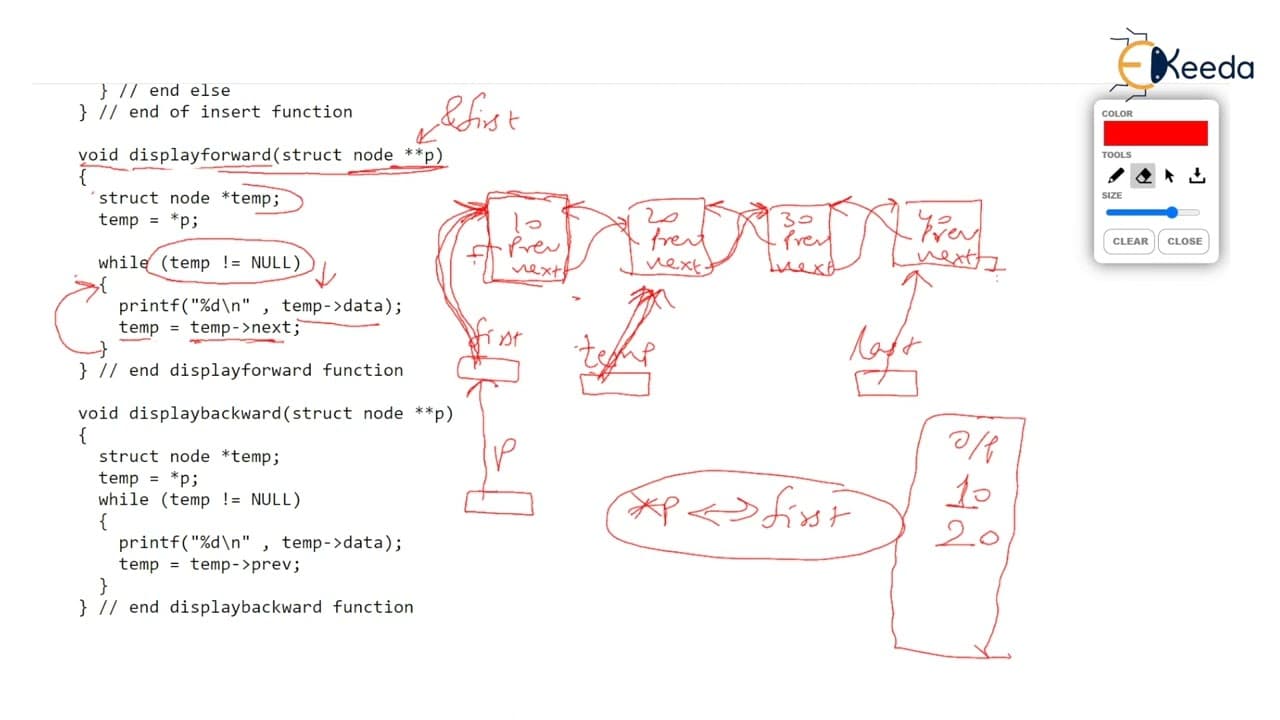
This video explains how to create a display forward function for a doubly linked list and demonstrates how it works with an example.
Transcript
hello dear students i am sameer velankar i welcome all of you to this second video on programming a doubly linked list now in the previous video we saw about insert node function and i hope you have gone through that insert node very well where we inserted four nodes storing 10 20 30 40. now our aim in this video is that we want to display the list... Read More
Key Insights
- 👂 The display forward function for a doubly linked list takes the address of the first pointer and prints the data of each node in the list.
- 👂 A temporary pointer is used to traverse the list, starting from the first node.
- ❤️🩹 The while loop in the function continues until the temporary pointer reaches the end of the list (null).
- ▶️ The display forward function can be used to display the doubly linked list in forward order.
- 😥 The function is implemented by checking the validity of the temporary pointer and updating it to point to the next node in each iteration.
- 👂 It is important to handle the case of an empty list when using the display forward function.
- 👂 Understanding the concepts of pointers and linked lists is crucial for effectively coding and comprehending the implementation of the display forward function.
Install to Summarize YouTube Videos and Get Transcripts
Explore YouTube Video Summarizer or Get YouTube Transcript Extractor
Questions & Answers
Q: How does the display forward function work for a doubly linked list?
The display forward function takes the address of the first pointer and starts printing the data of each node from the first node. It uses a temporary pointer to traverse the list and a while loop to iterate through the nodes until it reaches the end of the list.
Q: What is the purpose of the temporary pointer in the display forward function?
The temporary pointer is used to traverse the doubly linked list. It starts at the first node and moves to the next node by following the "next" pointers. This allows the function to print the data of each node in the list.
Q: How does the while loop in the display forward function work?
The while loop in the display forward function checks if the temporary pointer is not equal to null. If it's not null, it means there are still nodes in the list, and the loop continues. Inside the loop, the data of the current node is printed, and the temporary pointer is updated to point to the next node.
Q: How does the display forward function handle an empty list?
If the doubly linked list is empty (the first pointer is null), the display forward function will not enter the while loop and will simply end without printing anything.
Summary & Key Takeaways
-
The video introduces the display forward function for a doubly linked list and explains that it can be used to display the list in forward order.
-
The function takes the address of the first pointer as a parameter and starts printing the nodes from the first node.
-
A temporary pointer is declared and initialized to the first node, then a while loop is used to iterate through the list and print the data of each node.
Read in Other Languages (beta)
Share This Summary 📚
Summarize YouTube Videos and Get Video Transcripts with 1-Click
Try YouTube Summary with ChatGPT & Claude or YouTube Transcript Generator
Explore More Summaries from Ekeeda 📚



Summarize YouTube Videos and Get Video Transcripts with 1-Click
Try YouTube Summary with ChatGPT & Claude or YouTube Transcript Generator