Representation of Noise in Circuit with Example - Amplifier Fundamentals
TL;DR
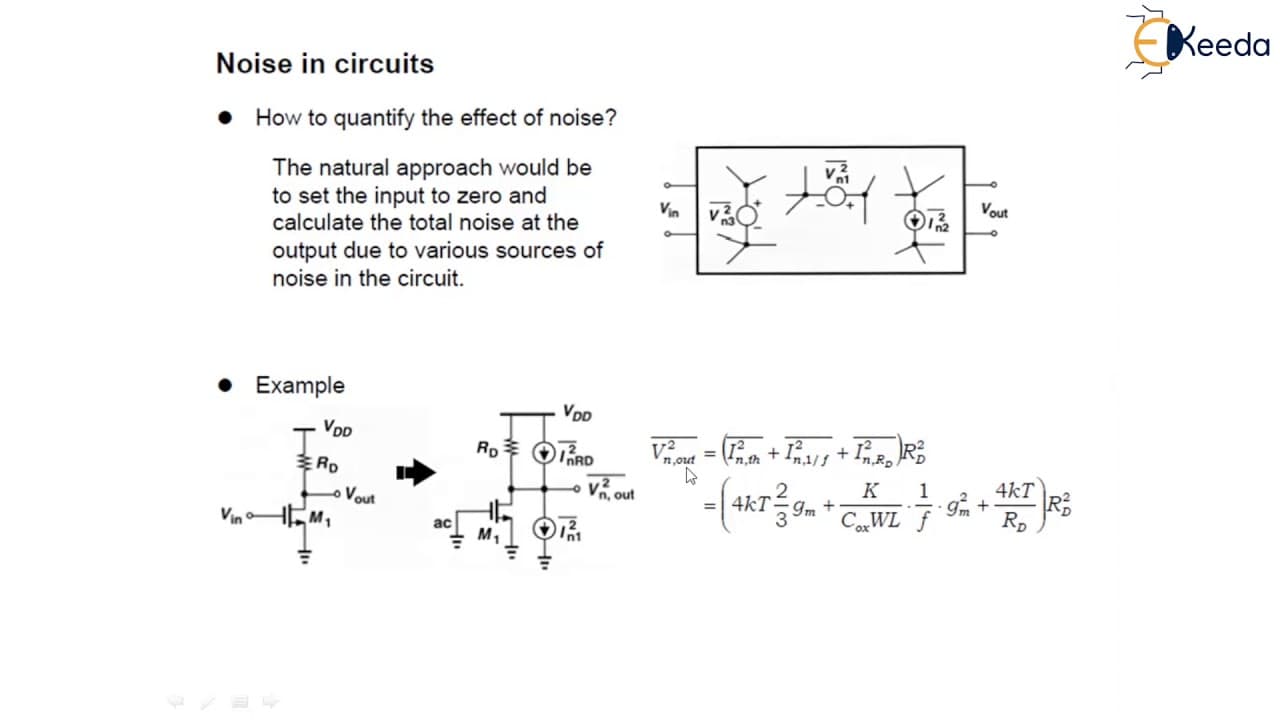
This lecture discusses the representation of noise in circuits, specifically focusing on the total output noise voltage of a common source stage. Thermal noise, flicker noise, and resistance noise are considered in the calculation.
Transcript
hello everyone in this lecture we will study about representation of noise in circuit with an example now how can we represent noise in surface to quantify the effect of noise the input would be set to 0 and calculate the total noise at the output due to the various sources of noise in the circuit this is the natural approach we can use now let us ... Read More
Key Insights
- 😫 Noise in circuits can be represented and quantified by setting the input to zero and calculating the total noise at the output.
- ℹ️ Thermal noise and flicker noise are two common sources of noise in circuits, modeled using current sources and resistors.
- ⚡ The output noise voltage per unit bandwidth is determined by multiplying the spectrum of the transfer function by the squared magnitude.
- 🔠 The input referred noise voltage represents the smallest input segment that the circuit can detect with an acceptable signal-to-noise ratio.
- 🔠 The input referred noise voltage is a fictitious quantity that cannot be directly measured at the input of the circuit.
- ⚡ The example used in the lecture focuses on calculating the total output noise voltage of a common source stage.
- ℹ️ The lecture highlights the importance of identifying noise sources and finding the appropriate transfer function for accurate noise representation.
Install to Summarize YouTube Videos and Get Transcripts
Explore YouTube Video Summarizer or Get YouTube Transcript Extractor
Questions & Answers
Q: How can noise in circuits be represented and quantified?
Noise in circuits can be represented by setting the input to zero and calculating the total noise at the output. Various sources of noise in the circuit are considered, and their effects are quantified using mathematical equations.
Q: What are the sources of noise considered in the example?
The example discusses two types of noise: thermal noise and flicker noise. These are modeled using current sources and resistors. The thermal noise equation involves temperature, conductance, and resistance, while the flicker noise equation includes parameters like gate length and frequency.
Q: How is the output noise voltage per unit bandwidth calculated?
The output noise voltage per unit bandwidth is calculated by multiplying the spectrum of the transfer function by the squared magnitude and adding the results. Thermal noise, flicker noise, and resistance noise are all considered in this calculation.
Q: What is the significance of the input referred noise voltage?
The input referred noise voltage indicates how small an input the circuit can detect with an acceptable signal-to-noise ratio. It represents the smallest input segment that the circuit can detect.
Summary & Key Takeaways
-
This lecture explores the quantification of noise in circuits and introduces an example of finding the total output noise voltage of a common source stage.
-
The lecture emphasizes the identification of noise sources and the calculation of the transfer function and spectrum to determine the output noise.
-
Thermal noise, flicker noise, and resistance noise are modeled using current sources and resistors, with their respective equations provided.
Read in Other Languages (beta)
Share This Summary 📚
Summarize YouTube Videos and Get Video Transcripts with 1-Click
Try YouTube Summary with ChatGPT & Claude or YouTube Transcript Generator
Explore More Summaries from Ekeeda 📚




Summarize YouTube Videos and Get Video Transcripts with 1-Click
Try YouTube Summary with ChatGPT & Claude or YouTube Transcript Generator