Least squares examples | Alternate coordinate systems (bases) | Linear Algebra | Khan Academy
TL;DR
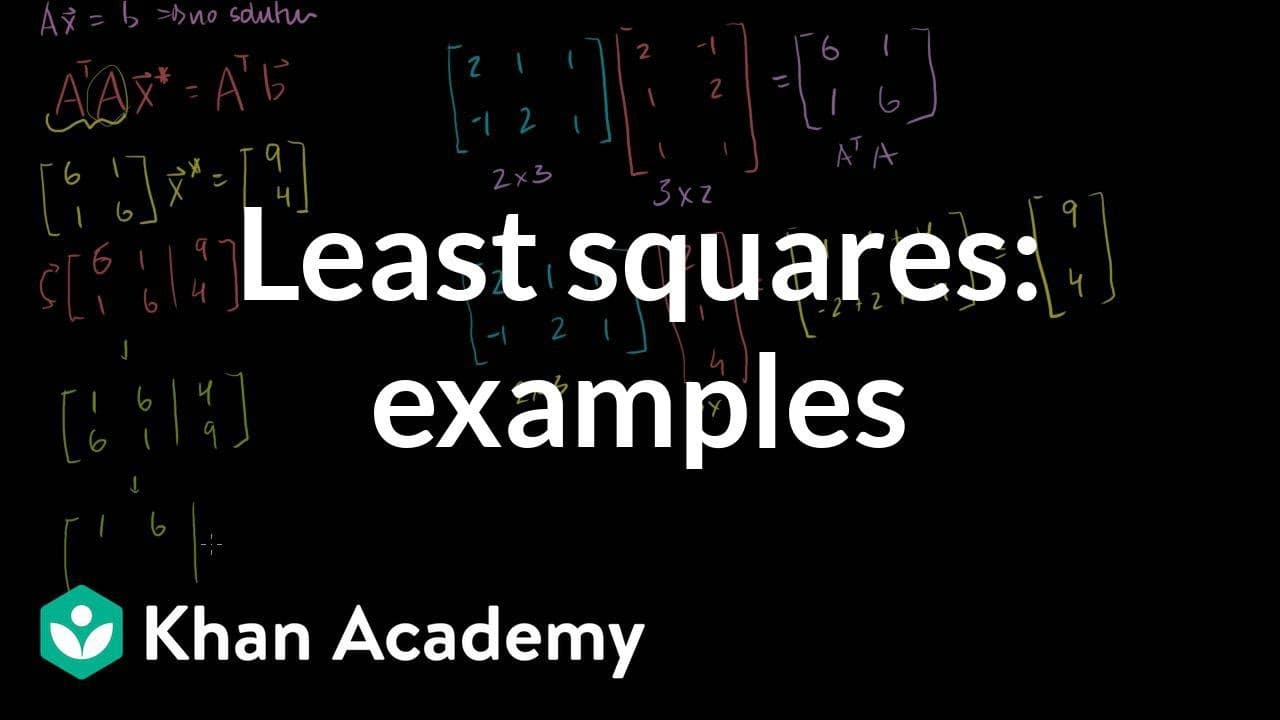
This video explains how to find the intersection of three lines and introduces the concept of a least squares solution to a system with no solution.
Transcript
So I've got three lines in R2, and I want to find their intersection. So the first one is 2x minus y is equal to 2, the second one is x plus 2y is equal to 1, and the third one is x plus y is equal to 4. So let's first just graph these, just to have a visual representation of what we're trying to do. So I like writing my lines in y equals mx plus b... Read More
Key Insights
- 🤗 Graphing equations can provide a visual representation of the problem at hand.
- 🫥 The inability of three lines to intersect at a single point indicates an overdetermined or overconstrained system.
- 📽️ The least squares solution provides an approximation that minimizes the difference between projected and original values.
- ✖️ The least squares solution can be obtained by multiplying the transpose of the coefficient matrix by the original matrix equation.
Install to Summarize YouTube Videos and Get Transcripts
Explore YouTube Video Summarizer or Get YouTube Transcript Extractor
Questions & Answers
Q: Why is there no intersection point for the three lines?
The three lines do not intersect at a single point because they only intersect with the other two lines individually, but not with each other.
Q: What is the purpose of the least squares solution?
The least squares solution finds the closest approximation to a solution by minimizing the distance between the projected values and the original values. It helps in situations where there is no exact solution to a system of equations.
Q: How is the least squares solution obtained?
The least squares solution is obtained by multiplying the transpose of the coefficient matrix by the original matrix equation. This results in a new equation that can be solved to find an approximation of the solution.
Q: What is the significance of finding the least squares solution?
The least squares solution allows us to get as close as possible to finding a solution, even when no exact solution exists. It is particularly useful in situations where we need to estimate values based on limited or inconsistent data.
Summary & Key Takeaways
-
The video demonstrates how to graph three equations and find their intersection points.
-
It is shown that the three lines do not intersect at a single point, indicating no solution to the system.
-
The concept of least squares solution is introduced as a way to find the closest approximation to a solution by minimizing the distance between the projected values and the original values.
Read in Other Languages (beta)
Share This Summary 📚
Summarize YouTube Videos and Get Video Transcripts with 1-Click
Try YouTube Summary with ChatGPT & Claude or YouTube Transcript Generator
Explore More Summaries from Khan Academy 📚



Summarize YouTube Videos and Get Video Transcripts with 1-Click
Try YouTube Summary with ChatGPT & Claude or YouTube Transcript Generator