Closed Loop Systems
TL;DR
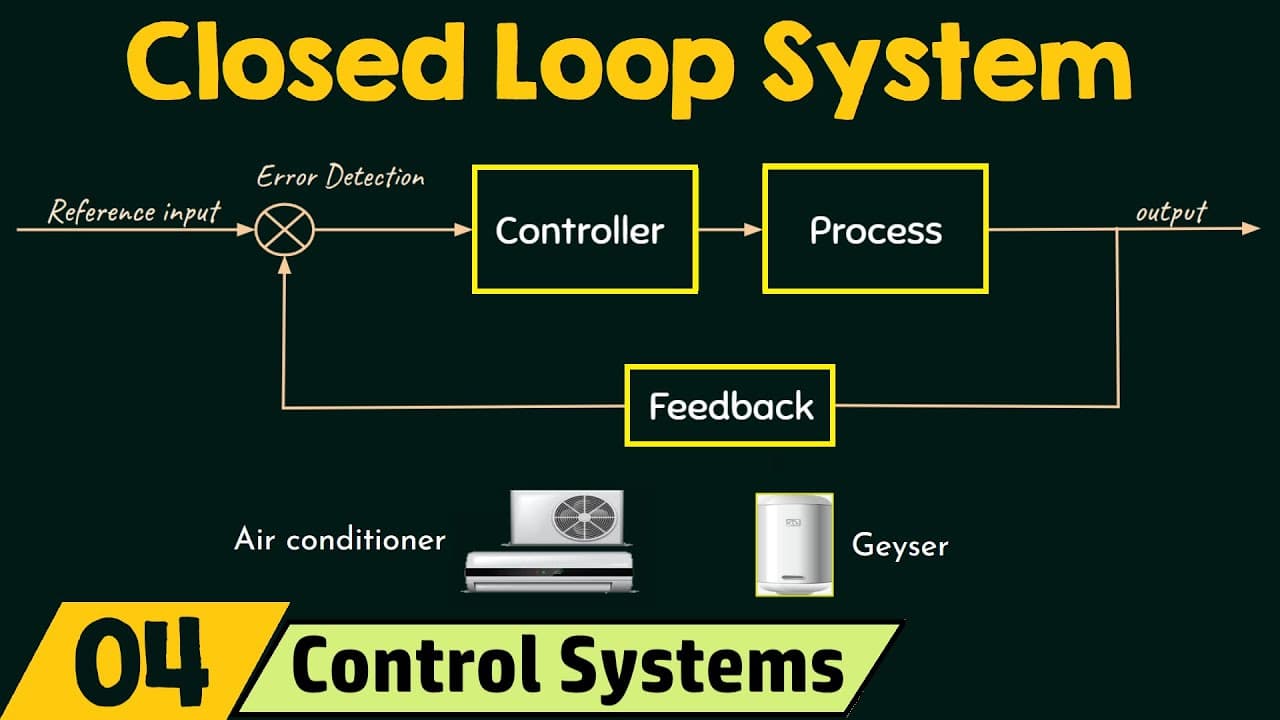
Closed-loop systems overcome the disadvantages of open-loop systems by measuring and continuously adjusting the output, making them more reliable and accurate.
Transcript
hello everyone and welcome back to the next lecture of control systems in this lecture we will discuss the closed loop systems in the previous lecture we discussed about the open loop systems and we also had discussion on some of the disadvantages of using the open loop systems and we all know that the open loop systems are not reliable because the... Read More
Key Insights
- 🏢 Open loop systems are not reliable and are unable to handle disturbances, leading to potential heating, or lack thereof, in the immersion water heater example given.
- ⚙️ In closed loop systems, the output is continuously measured and fed back to the input to determine the error with respect to the desired output. This feedback compensates for disturbances and improves system accuracy.
- ❄️ An air conditioner and a geezer (water heater) are examples of closed-loop systems that continuously monitor the temperature and adjust accordingly to maintain the desired temperature.
- 📊 The accuracy of closed-loop systems is higher than that of open loop systems because they can handle disturbances. Closed-loop systems are therefore more reliable.
- 🔢 Open-loop systems are easier to design and have simpler circuitry without a feedback factor, while closed-loop systems require additional feedback and have more complex circuitry.
- 💰 Open-loop systems are generally less expensive compared to closed-loop systems, which are more costly due to their additional complexity.
- 🔄 Feedback is the distinguishing factor between open-loop and closed-loop systems. Open-loop systems lack feedback, while closed-loop systems utilize feedback for enhanced performance and accuracy.
- 📖 In the next lecture, the Laplace transform will be reviewed, as it plays an important role in control systems, and the course will explore types of feedback and the transfer function of a control system.
Install to Summarize YouTube Videos and Get Transcripts
Explore YouTube Video Summarizer or Get YouTube Transcript Extractor
Questions & Answers
Q: How do closed-loop systems overcome the disadvantages of open-loop systems?
Closed-loop systems use feedback to continuously measure the output and adjust the input, ensuring the desired output is maintained. This compensates for disturbance and improves the accuracy of the system.
Q: Why are open-loop systems less reliable compared to closed-loop systems?
Open-loop systems lack feedback, making them unable to handle disturbance and adjust to reach the desired output. This results in lower reliability as they cannot accurately maintain the desired output.
Q: What is the major difference in design between open-loop and closed-loop systems?
Open-loop systems have simpler circuitry and do not involve a feedback factor, making them easier to design. In contrast, closed-loop systems have complex circuitry and an additional feedback factor, making their design more complicated.
Q: What distinguishes open-loop systems from closed-loop systems?
The presence of feedback is the distinguishing factor between open-loop and closed-loop systems. Feedback is absent in open-loop systems and present in closed-loop systems, allowing for continuous measurement and adjustment of the output.
Summary & Key Takeaways
-
Open-loop systems lack the ability to handle disturbance and do not know when to stop or reach the desired output.
-
Closed-loop systems measure the output continuously using feedback and adjust the input accordingly to maintain the desired output.
-
Closed-loop systems, such as air conditioners and water heaters, are more reliable and accurate compared to open-loop systems.
Read in Other Languages (beta)
Share This Summary 📚
Summarize YouTube Videos and Get Video Transcripts with 1-Click
Try YouTube Summary with ChatGPT & Claude or YouTube Transcript Generator
Explore More Summaries from Neso Academy 📚
Summarize YouTube Videos and Get Video Transcripts with 1-Click
Try YouTube Summary with ChatGPT & Claude or YouTube Transcript Generator