Stanford CS330: Deep Multi-task & Meta Learning I 2021 I Lecture 14
TL;DR
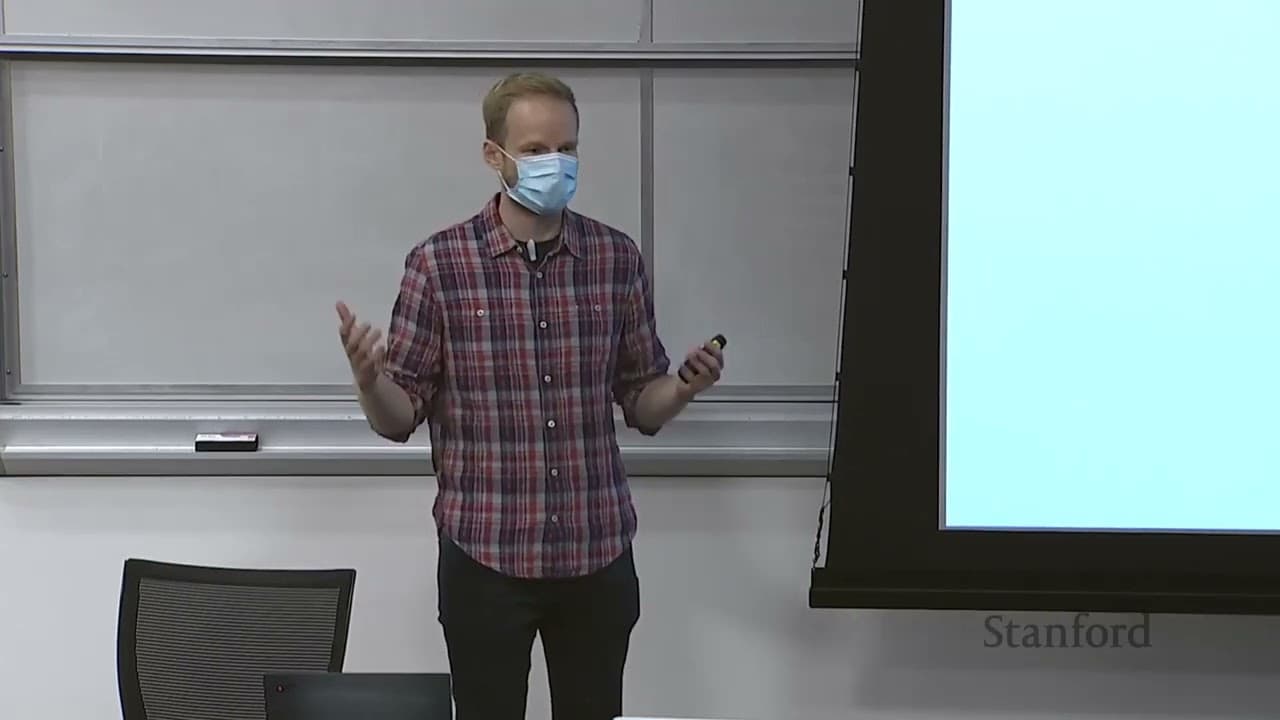
This analysis explores the concept of skill discovery in reinforcement learning and the importance of controllable behavior. It discusses how soft Q-learning and max-entropy reinforcement learning can be used to discover diverse and useful skills. The analysis also introduces an algorithm that optimizes predictability of future states given the current state and skill, resulting in more controllable skills.
Transcript
all right hi everyone uh welcome to cs330 and uh today we'll be talking about hurricane Colorado and skill Discovery um these are quite exciting topics some of them are a little bit out there so please ask questions if if something is unclear but first a few reminders so the homework for the optional one is due on Monday and then on Wednesday we ha... Read More
Key Insights
- 🍦 Soft Q-learning introduces stochasticity in policies to prevent premature commitment to sub-optimal solutions and improve exploration.
- ❓ Max-entropy reinforcement learning encourages exploration and fine-tuning capabilities by promoting diversity in actions while optimizing for rewards.
- 🪡 The "Diversity Is All You Need" approach focuses on learning skills that are both novel and predictable, making them more useful for task completion.
- 💁 Conditional mutual information can be used to optimize skill predictability, resulting in more useful and controllable behaviors.
Install to Summarize YouTube Videos and Get Transcripts
Explore YouTube Video Summarizer or Get YouTube Transcript Extractor
Questions & Answers
Q: How does soft Q-learning prevent early commitment to sub-optimal solutions?
Soft Q-learning introduces stochasticity by using a soft Max function instead of a strict Max function, allowing policies to explore different actions rather than focusing solely on the highest Q-value action.
Q: How can skills be discovered without explicitly specifying tasks?
By using max-entropy reinforcement learning, agents can be deployed in an environment to explore and discover a wide range of behaviors on their own, without the need for task specifications. Skills can emerge naturally through exploration.
Q: How does the "Diversity Is All You Need" approach optimize for skill predictability?
The approach maximizes conditional mutual information between future and current states given the skill. This objective encourages the learning of skills that have predictable outcomes, making them more useful in achieving desired behaviors.
Q: Can the skills discovered through these algorithms be fine-tuned for specific tasks?
Yes, fine-tuning can be achieved by training additional policies on top of the learned skills, conditioning them on specific tasks or objectives. This allows for further optimization and control over the behaviors exhibited by the agent.
Summary & Key Takeaways
-
Soft Q-learning is a technique that introduces stochasticity in policies to prevent early commitment to sub-optimal solutions, resulting in more exploration and robustness.
-
Max-entropy reinforcement learning incorporates an additional entropy term to encourage diversity in actions while optimizing for rewards. It improves exploration and fine-tuning capabilities.
-
The "Diversity Is All You Need" approach focuses on learning skills that are both novel and predictable, resulting in skills that are more useful for task completion.
-
By conditioning policies on skill variables, skills can be discovered and controlled to achieve desired behaviors.
Read in Other Languages (beta)
Share This Summary 📚
Summarize YouTube Videos and Get Video Transcripts with 1-Click
Try YouTube Summary with ChatGPT & Claude or YouTube Transcript Generator
Explore More Summaries from Stanford Online 📚

Summarize YouTube Videos and Get Video Transcripts with 1-Click
Try YouTube Summary with ChatGPT & Claude or YouTube Transcript Generator