Analyzing dependent probability | Probability and Statistics | Khan Academy
TL;DR
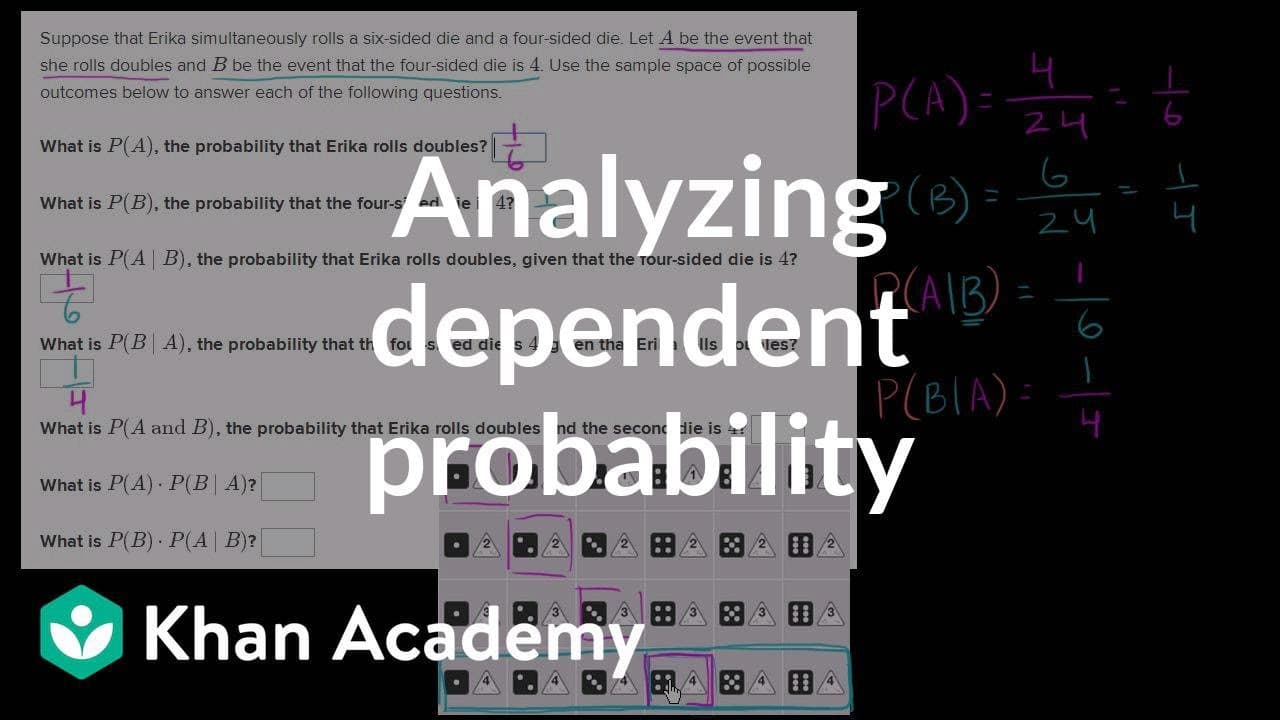
The video explains how to calculate the probability of rolling doubles and the probability of a specific outcome on a 4-sided die.
Transcript
Voiceover:Suppose that Erika simultaneously rolls a 6-sided die and a 4-sided die. Let A be the event that she rolls doubles, let me write this, A be the event that she rolls doubles and B be the event that the 4-sided die is a 4. Use the sample space of possible outcomes below to answer each of the following questions. Fair enough. What is probabi... Read More
Key Insights
- #️⃣ The probability of an event occurring can be calculated by dividing the number of desired outcomes by the total number of equally likely outcomes.
- 👻 Conditional probability allows us to calculate the probability of an event happening given that another event has already occurred.
- 🟰 The joint probability of two events occurring is equal to the product of their individual probabilities, given that they are independent events.
Install to Summarize YouTube Videos and Get Transcripts
Explore YouTube Video Summarizer or Get YouTube Transcript Extractor
Questions & Answers
Q: How do you calculate the probability of rolling doubles?
To calculate the probability of rolling doubles, divide the number of outcomes where both dice show the same number by the total number of equally likely outcomes. In this case, there are 4 possible outcomes of rolling doubles out of 24 equally likely outcomes, resulting in a probability of 1/6.
Q: What is the probability of rolling a 4 on a 4-sided die?
The probability of rolling a 4 on a 4-sided die is 1/4. Since there is only 1 outcome where the 4-sided die shows a 4 out of 4 equally likely outcomes, the probability is 1/4.
Q: How do you calculate the probability of rolling doubles given that the 4-sided die is a 4?
Assuming the 4-sided die is a 4, the probability of rolling doubles is 1/6. This is because the only way to roll doubles is if the 6-sided die also shows a 4. Therefore, out of 6 equally likely outcomes when the 4-sided die is a 4, only 1 involves rolling doubles.
Q: What is the probability of the 4-sided die being a 4 given that Erika rolls doubles?
If Erika rolls doubles, the probability of the 4-sided die being a 4 is 1/4. This is because the only way to roll doubles is if the 4-sided die also shows a 4. Out of 4 equally likely outcomes when doubles occur, only 1 involves the 4-sided die being a 4.
Summary & Key Takeaways
-
The video discusses how to calculate the probability of rolling doubles using two dice.
-
It also explains how to determine the probability of rolling a specific number on a 4-sided die.
-
The concept of conditional probability is introduced, illustrating how to calculate the probability of rolling doubles given that the 4-sided die is a 4.
-
The video concludes by exploring the relationship between the probabilities of A and B being true, and the joint probability of both A and B being true.
Read in Other Languages (beta)
Share This Summary 📚
Summarize YouTube Videos and Get Video Transcripts with 1-Click
Try YouTube Summary with ChatGPT & Claude or YouTube Transcript Generator
Explore More Summaries from Khan Academy 📚



Summarize YouTube Videos and Get Video Transcripts with 1-Click
Try YouTube Summary with ChatGPT & Claude or YouTube Transcript Generator