Gravitation (part 2) | Centripetal force and gravitation | Physics | Khan Academy
TL;DR
The force of gravity between two objects depends on both their mass and the distance between them.
Transcript
Welcome back. So I was trying to rush and finish a problem in the last two minutes of the video, and I realize that's just bad teaching, because I end up rushing. So this is the problem we were going to work on, and you'll see a lot of these. They just want you to become familiar with the variables in Newton's law of gravitation. So I said that the... Read More
Key Insights
- 💆 The force of gravity between objects depends on both their mass and the distance between them.
- 💪 Objects on the surface of smaller planets experience stronger gravitational forces due to their proximity to the center of mass.
- 🥺 Higher density of an object can lead to a stronger gravitational force, even if its mass is smaller.
- 🟰 The formula for gravitational force reflects the symmetry of gravity, with both objects exerting equal and opposite forces on each other.
- 👾 Gravity between two people in space would be relatively weak compared to other forms of attraction between them.
Install to Summarize YouTube Videos and Get Transcripts
Explore YouTube Video Summarizer or Get YouTube Transcript Extractor
Questions & Answers
Q: What factors determine the force of gravity between two objects?
The force of gravity is determined by both the mass of the objects and the distance between their centers of mass. Greater mass and shorter distances result in stronger gravitational forces.
Q: Why is the force on an object on the surface of a smaller planet stronger than the force on Earth?
The force is stronger because the object is closer to the center of mass of the smaller planet. Additionally, the smaller planet's higher density contributes to the stronger force.
Q: How does the formula for gravitational force reflect the symmetric nature of gravity?
The formula shows that objects exert equal and opposite forces on each other. Earth pulls on an object with a certain force, and the object pulls back on Earth with an equal force. Both objects are attracted to their combined center of mass.
Q: How does gravity between two people floating in space compare to their gravitational attraction to Earth?
Two people floating in space would experience a small gravitational attraction towards each other. However, other forms of attraction, such as electromagnetic forces, would likely be stronger between them.
Summary & Key Takeaways
-
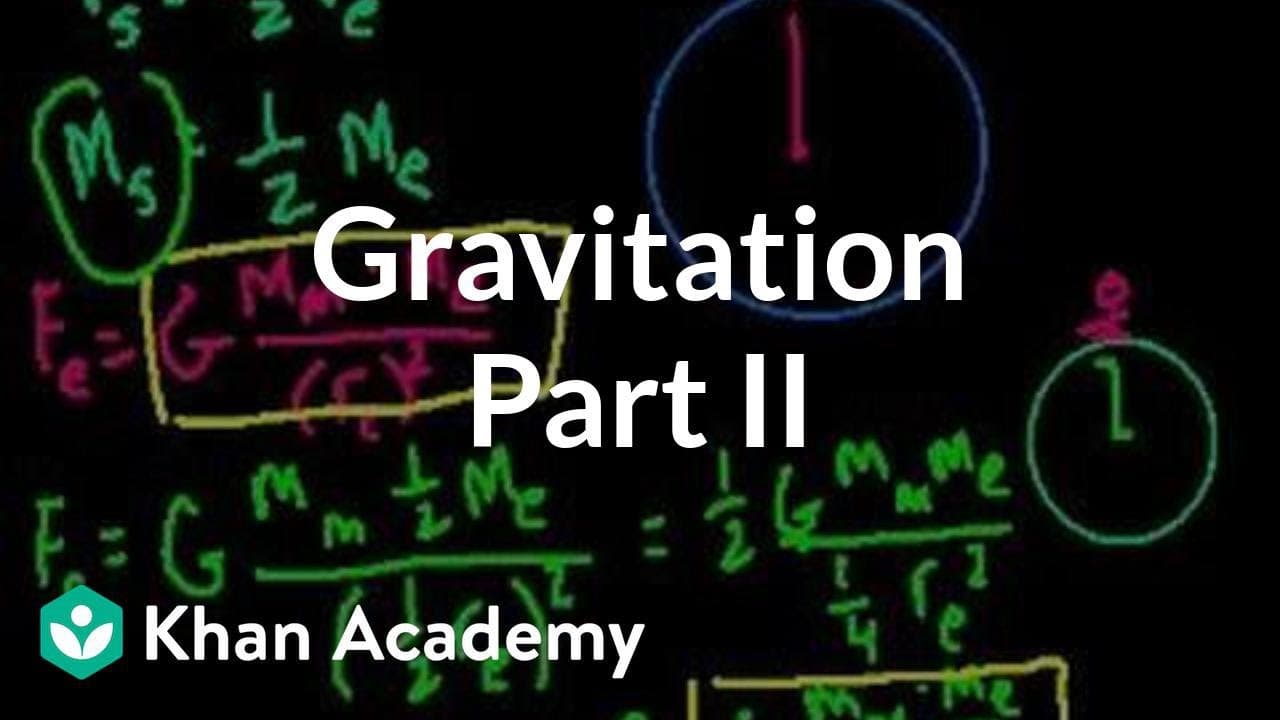
This video explores Newton's Law of Gravitation using the example of two planets, one being Earth and the other a smaller planet with half the radius and mass of Earth.
-
The force on an object on the surface of the smaller planet is found to be twice as strong as the force on Earth, even though it has less mass.
-
The video highlights that both mass and distance play a significant role in the force of gravity between objects.
Read in Other Languages (beta)
Share This Summary 📚
Summarize YouTube Videos and Get Video Transcripts with 1-Click
Try YouTube Summary with ChatGPT & Claude or YouTube Transcript Generator
Explore More Summaries from Khan Academy 📚



Summarize YouTube Videos and Get Video Transcripts with 1-Click
Try YouTube Summary with ChatGPT & Claude or YouTube Transcript Generator