How To Balance Nuclear Equations In Chemistry
TL;DR
Learn how to balance nuclear equations by understanding atomic numbers, mass numbers, and using the periodic table.
Transcript
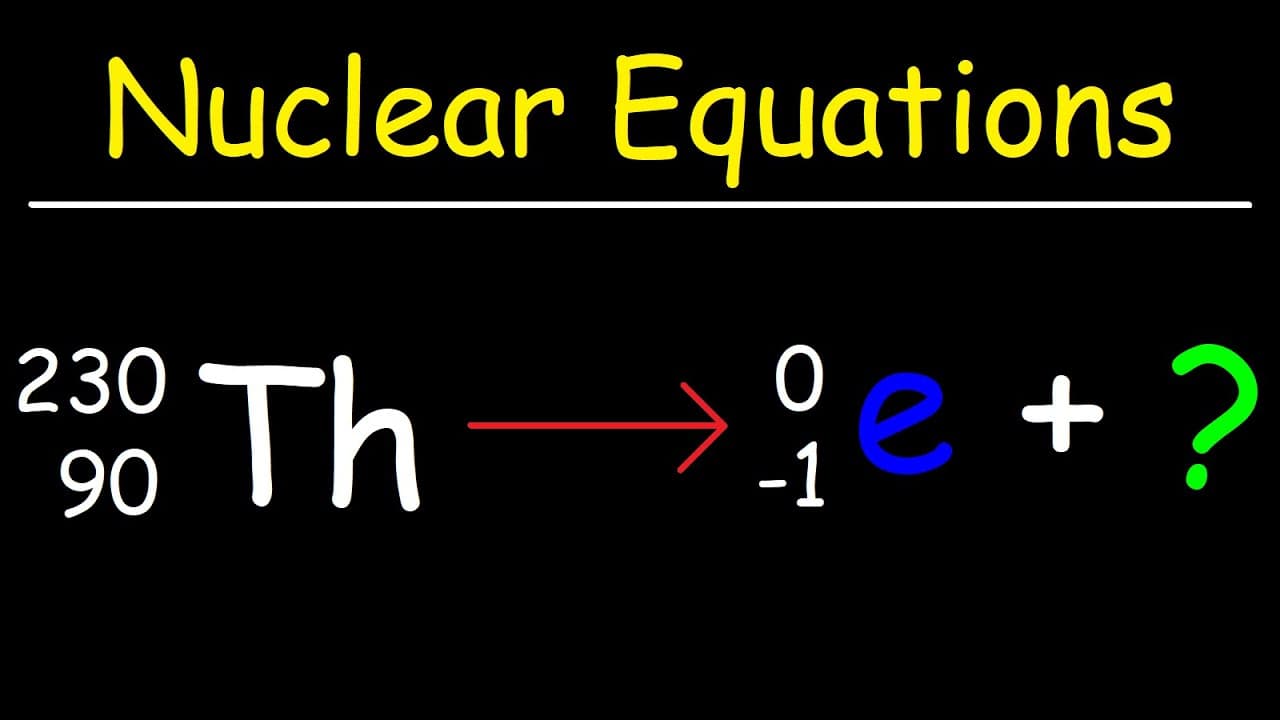
in this video we're going to talk about how to balance nuclear equations so in this example problem we have an isotope of carbon carbon 14 undergoing beta decay which means that it's emitting a beta particle or an electron what is the missing element in this reaction in order to do that we need to make sure that this reaction is completely balanced... Read More
Key Insights
- 🙃 Balancing nuclear equations involves ensuring the mass numbers and nuclear charges are the same on both sides.
- #️⃣ The atomic number always identifies the element, even if the mass number varies.
- 🎟️ Different types of nuclear reactions, such as beta decay and electron capture, have specific characteristics and produce different missing elements.
- 🫀 The periodic table is a valuable tool for identifying elements based on their atomic numbers.
- 🎟️ Nuclear equations can have multiple missing elements, each of which can be determined individually.
Install to Summarize YouTube Videos and Get Transcripts
Explore YouTube Video Summarizer or Get YouTube Transcript Extractor
Questions & Answers
Q: What is the key to balancing nuclear equations?
The key is to ensure that the mass numbers and nuclear charges are the same on both sides of the equation.
Q: How can the missing element be identified?
By using the atomic number, which remains constant for each element, the missing element can be determined by referencing the periodic table.
Q: Does the mass number always remain the same for an element?
No, the mass number may vary for different elements or even for the same element, but the atomic number remains constant.
Q: What is beta decay?
Beta decay is a nuclear reaction where an isotope emits a beta particle or an electron.
Q: In the example with thorium-230, what is the missing element?
The missing element is radium, with a mass number of 226 and an atomic number of 88.
Q: What happens during electron capture?
During electron capture, the nucleus captures an inner core electron, producing a gamma particle and a new element. In the example with mercury-201, it becomes gold-201.
Q: Can nuclear equations have multiple missing elements?
Yes, nuclear equations can have multiple missing elements, but each missing element can be identified individually by balancing the equation and referencing the periodic table.
Q: How can the missing element be determined in the example with uranium-238 and carbon?
By balancing the equation and using the given information on mass numbers and atomic numbers, the missing element is identified as californium, with a mass number of 244 and an atomic number of 98.
Summary & Key Takeaways
-
The video explains how to balance nuclear equations, using the example of carbon-14 undergoing beta decay to identify the missing element as nitrogen.
-
It demonstrates the process of balancing equations by ensuring the mass and nuclear charge are the same on both sides.
-
Additional examples are given to further illustrate the process, showcasing different types of nuclear reactions and how to identify the missing element.
Read in Other Languages (beta)
Share This Summary 📚
Summarize YouTube Videos and Get Video Transcripts with 1-Click
Try YouTube Summary with ChatGPT & Claude or YouTube Transcript Generator
Explore More Summaries from The Organic Chemistry Tutor 📚




Summarize YouTube Videos and Get Video Transcripts with 1-Click
Try YouTube Summary with ChatGPT & Claude or YouTube Transcript Generator