Learn Vietnamese: 10 Beginner Vietnamese Videos You Must Watch
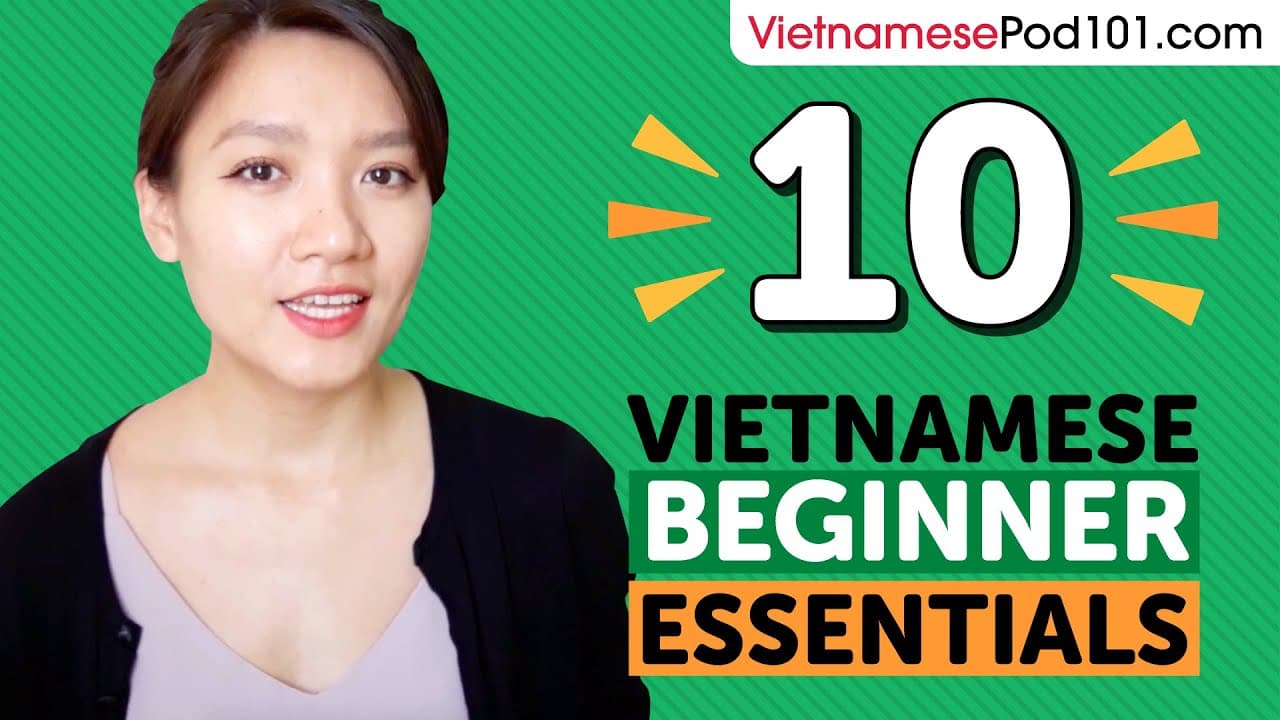
TL;DR
Learn basic Vietnamese phrases and numbers quickly.
Transcript
want to speak real Vietnamese from your first lesson sign up for your free lifetime account at Vietnamese pod101.com hi everybody I'm Zao welcome to Vietnamese part 101.com the fastest easiest and most fun way to learn Vietnamese in the last lesson we learned the phrase excuse me do you speak English we mentioned the word sinhoi which means excuse ... Read More
Key Insights
- The phrase 'sin chao' is a versatile greeting used for both formal and informal situations, applicable at any time of day.
- Vietnamese numbers from 1 to 10 are crucial for basic communication, with number 0 being 'không'.
- When apologizing in Vietnamese, 'sin loi' is used for general apologies, while 'sin hoi' is used when asking questions.
- Vietnamese uses a complex system of pronouns based on gender, age, and relationship closeness, affecting how you address others.
- To ask 'Do you speak English?' in Vietnamese, you can say 'ban co biet noi tieng Anh khong?'
- When discussing prices, Vietnamese typically use large numbers due to currency conversion, e.g., 40,000 dong for $2.
- Vietnamese culture places significance on numbers, with 6 and 8 being considered lucky as they symbolize happiness and wealth.
- Vietnamese greetings can be made more formal by adding 'sin' before 'chao' or using specific pronouns for the listener.
Install to Summarize YouTube Videos and Get Transcripts
Explore YouTube Video Summarizer or Get YouTube Transcript Extractor
Questions & Answers
Q: What is the general greeting in Vietnamese?
The general greeting in Vietnamese is 'sin chao,' which means 'hi' or 'hello.' It is used in both formal and informal situations and can be used at any time of the day. Vietnamese people do not typically use time-specific greetings like 'good morning' or 'good evening.'
Q: How do you apologize in Vietnamese?
In Vietnamese, 'sin hoi' is used when asking questions or to politely get someone's attention, while 'sin loi' is used for general apologies. These phrases can be adjusted with pronouns based on the listener's gender, age, and the relationship to the speaker, but using 'sin loi' generally is safe in any situation.
Q: How do you ask if someone speaks English in Vietnamese?
To ask if someone speaks English in Vietnamese, you say 'ban co biet noi tieng Anh khong?' This literally translates to 'Do you know how to speak English?' The word 'khong' at the end is a question particle that turns the sentence into a yes-no question.
Q: What is the significance of numbers in Vietnamese culture?
In Vietnamese culture, numbers are believed to have specific meanings. Numbers 6 and 8 are particularly popular as they are associated with happiness and wealth. People often choose phone numbers or license plates containing these numbers, sometimes paying a premium for them, due to their positive connotations.
Q: How do you express prices in Vietnamese?
In Vietnamese, prices are expressed by stating the number followed by 'nghin,' which means 'thousand,' as the currency value is typically high due to the exchange rate. For instance, 40,000 dong would be expressed as 'bon muoi nghin.' The currency 'dong' is often omitted in spoken language.
Q: What is the structure for introducing oneself in Vietnamese?
To introduce oneself in Vietnamese, you can use 'Xin chao, toi la [Name]' for a general introduction, which means 'Hi, I am [Name].' For a more formal introduction, 'Xin chao, ten toi la [Name]' is used, which translates to 'Hello, my name is [Name].' The phrase 'rat vui duoc gap ban' means 'nice to meet you.'
Q: How do you count from 1 to 10 in Vietnamese?
Counting from 1 to 10 in Vietnamese is as follows: 1 - 'mot', 2 - 'hai', 3 - 'ba', 4 - 'bon', 5 - 'nam', 6 - 'sau', 7 - 'bay', 8 - 'tam', 9 - 'chin', and 10 - 'muoi'. These numbers form the basis for constructing larger numbers in Vietnamese.
Q: What is the importance of pronouns in Vietnamese?
Pronouns in Vietnamese are crucial as they vary according to the gender, age, and relationship between the speaker and the listener. This system reflects the cultural emphasis on respect and familiarity. Using the correct pronoun is important for polite and appropriate communication.
Summary & Key Takeaways
-
The video provides a basic introduction to Vietnamese, teaching essential phrases such as greetings, apologies, and how to ask if someone speaks English. It emphasizes the importance of correct pronunciation and cultural nuances in communication.
-
Viewers learn Vietnamese numbers from 1 to 100, with particular attention to pronunciation changes in compound numbers. The video also explains how to express prices in Vietnamese, a useful skill for shopping and transactions.
-
The tutorial highlights the significance of pronouns in Vietnamese, which vary based on the listener's age, gender, and relationship to the speaker. This complexity underlines the cultural importance of respect and familiarity in Vietnamese interactions.
Read in Other Languages (beta)
Share This Summary 📚
Summarize YouTube Videos and Get Video Transcripts with 1-Click
Try YouTube Summary with ChatGPT & Claude or YouTube Transcript Generator
Explore More Summaries from Learn Vietnamese with VietnamesePod101.com 📚





Summarize YouTube Videos and Get Video Transcripts with 1-Click
Try YouTube Summary with ChatGPT & Claude or YouTube Transcript Generator