What Are Total, Marginal, and Average Product in Economics?
TL;DR
Total product refers to the overall output produced by labor, while marginal product measures the additional output generated by each extra worker. Average product is calculated by dividing total product by the number of workers. Understanding these concepts, especially the diminishing marginal returns, helps in optimizing labor and maximizing productivity.
Transcript
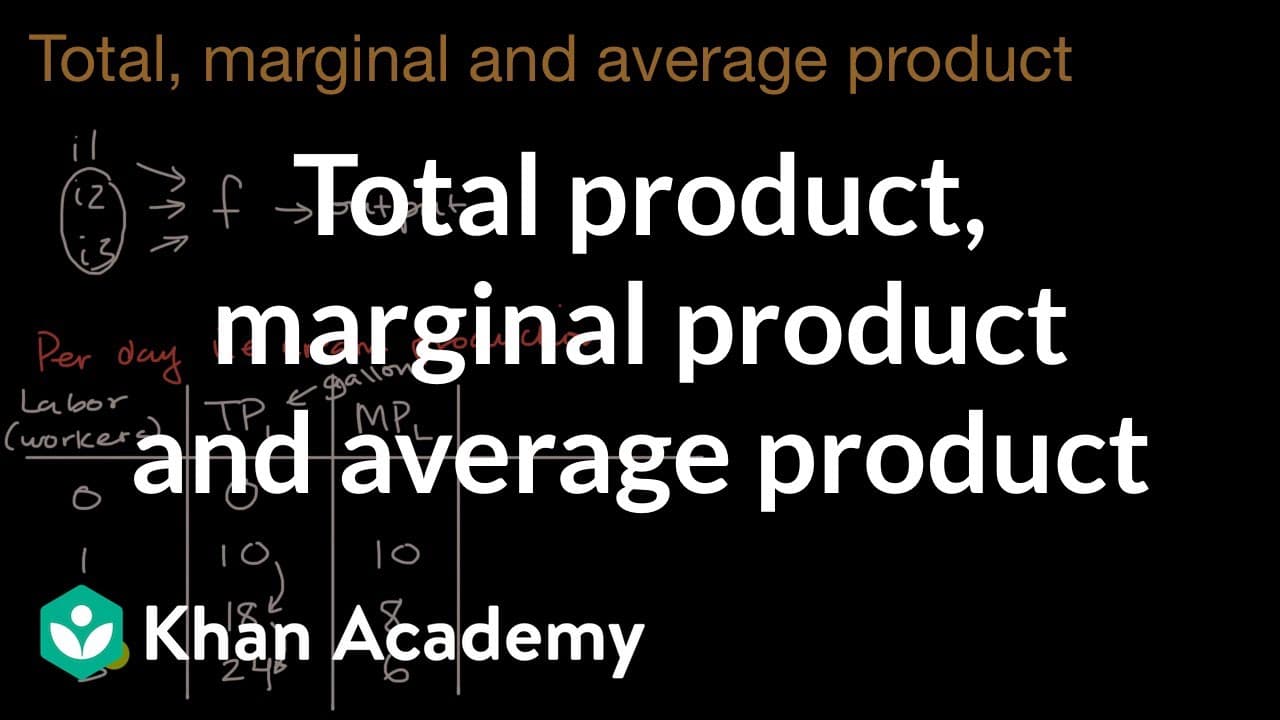
- [Instructor] In previous videos, we introduced the idea of a production function that takes in a bunch of inputs. Let's call this input one, input two, input three. And that based on how much of these various inputs you have, your production function can give you your output. In this video, we're going to constrain all of the inputs but one, to r... Read More
Key Insights
- 🍦 The video explores the relationship between input (labor) and output (ice cream production) in a single-variable scenario.
- 🧑⚕️ The concept of marginal product helps understand the additional output gained from hiring more workers.
- 🥺 Diminishing marginal returns occur when adding more workers leads to a smaller increase in output.
- 🧑⚕️ The average product of labor offers an average measurement of output per worker.
- ❓ Total product, marginal product, and average product can be graphically represented on a curve.
- 🛀 The slope of the curve indicates the marginal product, with a decreasing slope showing diminishing marginal returns.
- 👨💼 Understanding these concepts can help businesses optimize the number of workers and maximize output.
Install to Summarize YouTube Videos and Get Transcripts
Explore YouTube Video Summarizer or Get YouTube Transcript Extractor
Questions & Answers
Q: What is a production function?
A production function is a mathematical representation of how inputs (such as labor and capital) are combined to produce output. It shows the relationship between inputs and output.
Q: How is the marginal product of labor calculated?
The marginal product of labor is calculated by determining the additional output generated by adding one more unit of labor. It measures the increase in output resulting from hiring one more worker.
Q: Why does the marginal product of labor often decrease as more workers are added?
The marginal product of labor typically decreases because of factors like limited space and resources. As more workers are added, there may be diminishing returns, where each additional worker contributes less to the overall output.
Q: How is average product of labor calculated?
Average product of labor is calculated by dividing the total output by the number of workers. It represents the average amount of output produced per worker.
Summary & Key Takeaways
-
The video discusses the relationship between inputs and output in a production function, focusing on how output varies with one input.
-
It presents a table showing the number of workers and the corresponding ice cream production for each scenario.
-
The concepts of marginal product of labor and average product of labor are introduced, along with the idea of diminishing marginal returns.
Read in Other Languages (beta)
Share This Summary 📚
Summarize YouTube Videos and Get Video Transcripts with 1-Click
Try YouTube Summary with ChatGPT & Claude or YouTube Transcript Generator
Explore More Summaries from Khan Academy 📚



Summarize YouTube Videos and Get Video Transcripts with 1-Click
Try YouTube Summary with ChatGPT & Claude or YouTube Transcript Generator