How to Determine If Two Vectors Are Parallel or Orthogonal
TL;DR
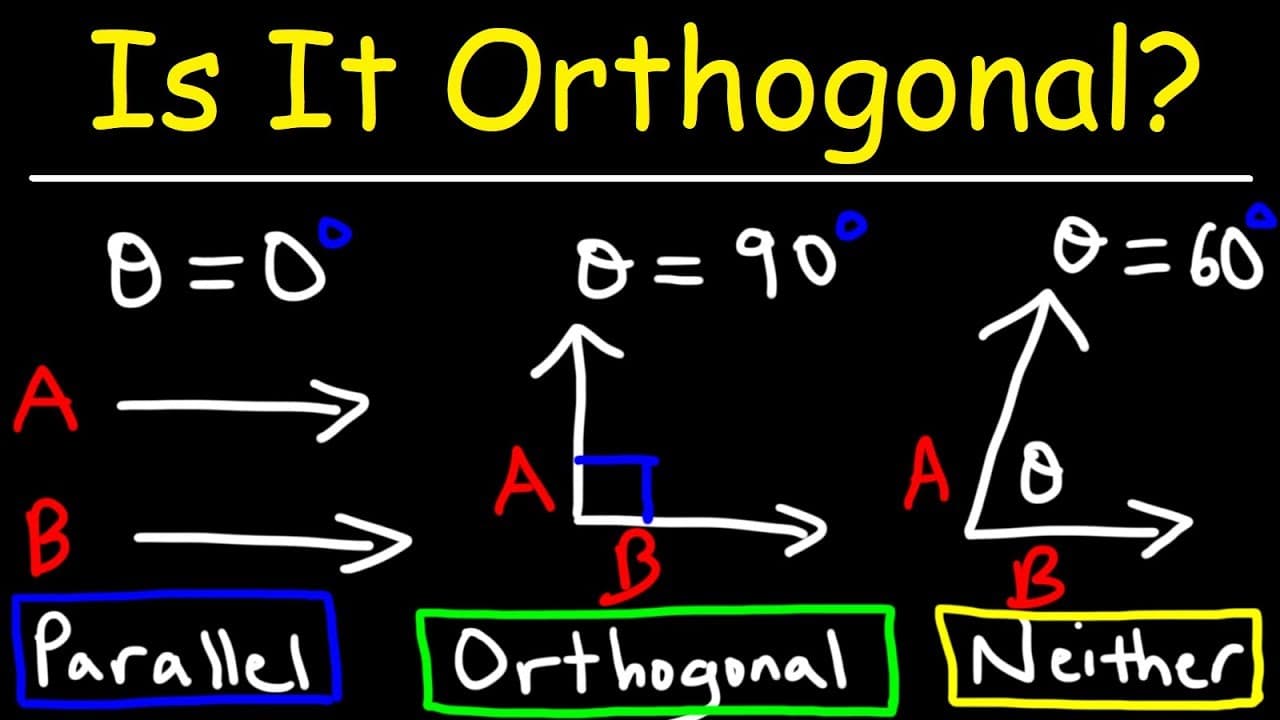
Two vectors are parallel if they never intersect and have the same slope. They are orthogonal if they meet at right angles, which can be verified if their dot product equals zero. If neither condition is met, the vectors are classified as neither parallel nor orthogonal.
Transcript
so how do you tell if two vectors are orthogonal parallel or neither well first let's get a visual representation of what those words mean when two vectors are parallel they never intersect and so the angle between them is zero degrees now granted you can have two vectors a and b that go in opposite directions and so the angle will be 180. in this ... Read More
Key Insights
- ❓ Parallel vectors never intersect and have the same slope.
- 🫥 Orthogonal vectors meet at right angles or have a dot product of zero.
- ❣️ The slope of a vector can be determined by dividing the y component by the x component.
- 🫥 The dot product of two vectors is calculated by multiplying their corresponding components and summing the results.
- ❎ The magnitude of a vector can be found by taking the square root of the sum of the squares of its components.
- 🔺 Perpendicular vectors have an angle of 90 degrees or pi/2 radians.
- ❓ Two vectors cannot be both parallel and orthogonal.
Install to Summarize YouTube Videos and Get Transcripts
Explore YouTube Video Summarizer or Get YouTube Transcript Extractor
Questions & Answers
Q: What does it mean for two vectors to be parallel?
Two vectors are parallel if they never intersect and have the same slope. They can go in the same or opposite directions.
Q: How can you determine if two vectors are orthogonal?
Two vectors are orthogonal if they meet at right angles or have a dot product of zero. The angle between them is 90 degrees or pi/2 radians.
Q: Can two vectors be both parallel and orthogonal?
No, two vectors cannot be both parallel and orthogonal. Parallel vectors have the same slope, while orthogonal vectors meet at right angles.
Q: What is the significance of the dot product in determining if vectors are orthogonal?
If the dot product of two vectors is zero, it means they are orthogonal. The dot product is the sum of the products of their corresponding components.
Q: How can you find the angle between two vectors to determine if they are parallel?
You can use the formula: angle = arccos(dot product / (magnitude of vector A * magnitude of vector B)). If the angle is 0 degrees, the vectors are parallel.
Q: How can you determine if two vectors are perpendicular without finding their slopes or dot product?
If the angle between two vectors is 90 degrees, they are perpendicular. You can use the angle formula or visually observe if they meet at a right angle.
Summary & Key Takeaways
-
When two vectors are parallel, they never intersect and have the same slope.
-
Two vectors are orthogonal if they meet at right angles or have a dot product of zero.
-
If the slopes of two vectors are not equal and they are not negative reciprocals of each other, they are neither parallel nor orthogonal.
Read in Other Languages (beta)
Share This Summary 📚
Summarize YouTube Videos and Get Video Transcripts with 1-Click
Try YouTube Summary with ChatGPT & Claude or YouTube Transcript Generator
Explore More Summaries from The Organic Chemistry Tutor 📚


Summarize YouTube Videos and Get Video Transcripts with 1-Click
Try YouTube Summary with ChatGPT & Claude or YouTube Transcript Generator