How Does XGBoost Build Trees for Classification?
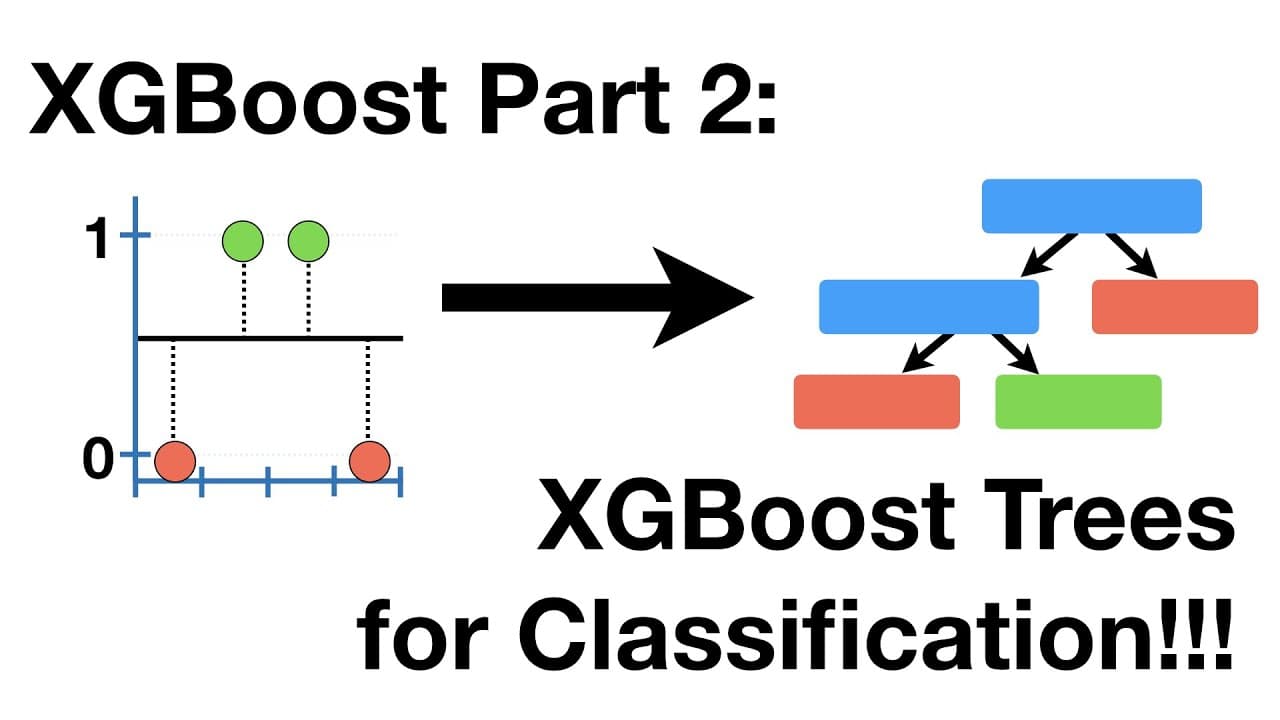
TL;DR
XGBoost builds trees for classification by calculating similarity scores and gain to determine optimal splits in the training data. The initial prediction starts at a 50% probability, and through an iterative process, trees are pruned based on a complexity parameter, gamma. The output values for the leaves are based on the sum of residuals adjusted for previous predictions and a regularization parameter, lambda, which affects sensitivity to outliers.
Transcript
classification it's not a vacation it's not a sensation but it's cool step quest hello I'm Josh stormer and welcome to stack quest today we're gonna talk about XG boost part 2 XG Boost trees for classification note this stack quest assumes that you are already familiar with the main ideas of how XG boost does regression and at least the main ideas ... Read More
Key Insights
- 🌲 XG Boost trees for classification involve calculating similarity scores and gain to determine tree splits.
- 🤙 Pruning is done by comparing gain values to a user-defined complexity parameter called gamma.
- 🍹 Output values for the leaves are determined based on the sum of residuals and the sum of the previous probability times 1 minus the previous probability.
- ❓ Lambda, the regularization parameter, reduces the sensitivity of predictions to individual observations in classification.
- 🍀 The minimum number of residuals in each leaf is determined by the cover metric.
- 🌲 XG Boost trees are built iteratively until the residuals are small or the maximum number of trees is reached.
- 😫 XG Boost can be used for large and complicated data sets.
Install to Summarize YouTube Videos and Get Transcripts
Explore YouTube Video Summarizer or Get YouTube Transcript Extractor
Questions & Answers
Q: What is the initial prediction in XG Boost for drug effectiveness?
The initial prediction is a 0.5 probability that the drug is effective, regardless of the dosage.
Q: What are the main steps involved in building XG Boost trees for classification?
The main steps include calculating similarity scores, splitting the data based on thresholds, pruning the tree using a complexity parameter, and determining output values for the leaves.
Q: How does XG Boost handle regularization in classification?
XG Boost uses a regularization parameter called lambda to reduce the similarity scores and output values for individual observations, resulting in more pruning of the tree.
Q: What is the minimum number of residuals in each leaf determined by in XG Boost for classification?
The minimum number of residuals in each leaf is determined by a metric called cover, which is the denominator of the similarity score minus lambda.
Summary & Key Takeaways
-
XG Boost is an extreme machine learning algorithm used for regression and classification with simple and easy-to-understand parts.
-
The initial prediction in XG Boost is 0.5 probability for drug effectiveness.
-
XG Boost trees for classification involve calculating similarity scores, splitting the data, pruning the tree, and determining output values for the leaves.
Read in Other Languages (beta)
Share This Summary 📚
Summarize YouTube Videos and Get Video Transcripts with 1-Click
Try YouTube Summary with ChatGPT & Claude or YouTube Transcript Generator
Explore More Summaries from StatQuest with Josh Starmer 📚

Summarize YouTube Videos and Get Video Transcripts with 1-Click
Try YouTube Summary with ChatGPT & Claude or YouTube Transcript Generator