What Is Perlin Noise and How Is It Used in Code?
TL;DR
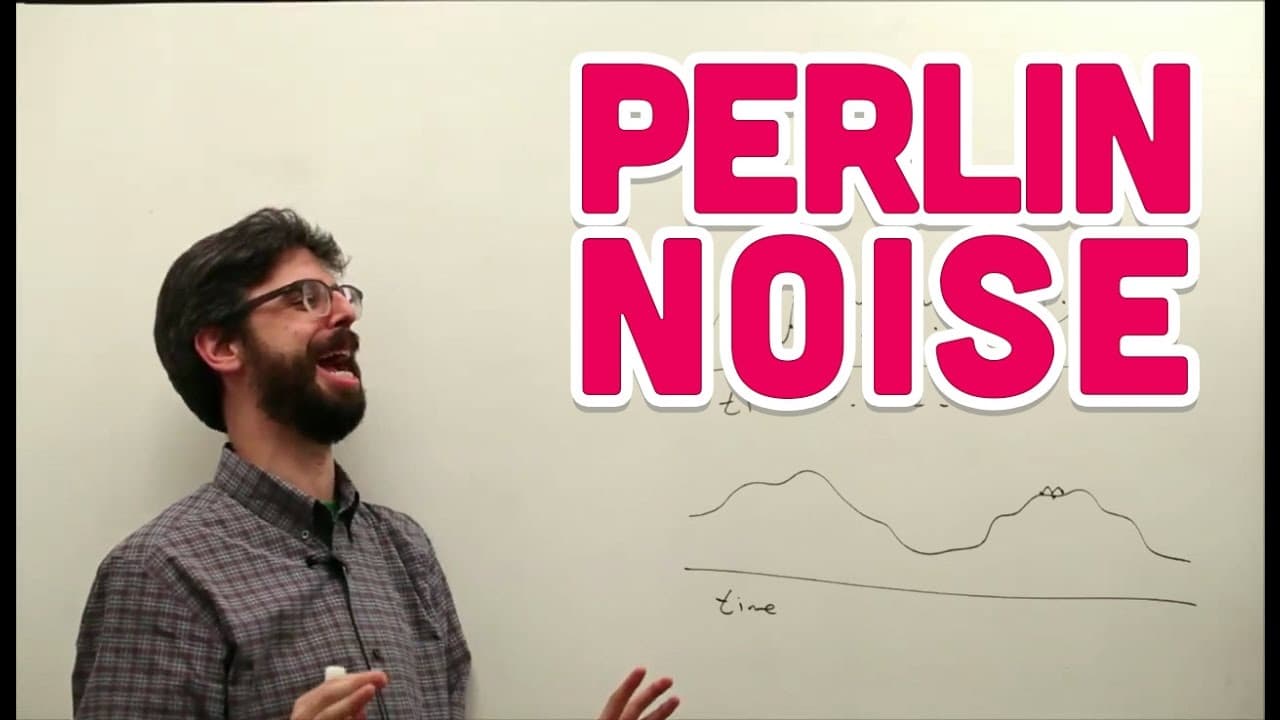
Perlin noise is a technique for generating smooth randomness in code, creating a more organic feel in animations and simulations. Unlike typical random numbers, Perlin noise values change gradually over time, allowing for fluid and natural motion. It's particularly effective for procedural textures in 3D modeling and can be extended to two-dimensional space for diverse applications.
Transcript
okay uh here we are again we are at a very exciting moment we are so close so close to finishing with this introductory section where I have no I feel like I'm not really in control and maybe I'm screwing this all up but uh soon we're going to be getting to vectors and vectors is a place where I think we'll feel comfortable and we'll sort of be on ... Read More
Key Insights
- 👻 Perlin noise is a powerful concept that allows for the creation of smooth randomness in code.
- 💻 It was originally developed for generating procedural textures for 3D models in computer graphics.
- 🙂 Perlin noise values change slightly over time, resulting in a more natural and organic feel in animations and simulations.
- 🖐️ Time plays a significant role in Perlin noise, as it determines the sequence of values generated.
- ❓ Perlin noise can be used to create smooth and randomized movements, sizes, and colors for objects in animations and simulations.
- #️⃣ It can be used as an alternative to random numbers when a more natural and continuous variation is desired.
- 👻 Perlin noise can be extended to two-dimensional space, allowing for the creation of procedural textures and flows in animations.
Install to Summarize YouTube Videos and Get Transcripts
Explore YouTube Video Summarizer or Get YouTube Transcript Extractor
Questions & Answers
Q: What is the purpose of Perlin noise in coding?
Perlin noise is used to create smooth randomness in code, which can be applied to animations and simulations to give them a more natural and organic feel.
Q: How does Perlin noise differ from random numbers?
Random numbers have no relationship to each other, while Perlin noise values change slightly over time, creating a smooth and continuous sequence of numbers.
Q: Who developed Perlin noise?
Perlin noise was developed by Ken Perlin, a professor at NYU's computer science department, known for his work in computer graphics, including his contribution to the film Tron.
Q: How can Perlin noise be used in Processing?
In Processing, Perlin noise can be used to generate values for various properties in animations and simulations, such as the position, size, or color of objects, providing a more natural and randomized appearance.
Summary & Key Takeaways
-
Perlin noise is a concept developed by Ken Perlin to create procedural textures for 3D models in computer graphics.
-
Unlike random numbers, Perlin noise values change slightly over time, resulting in a smooth and organic appearance.
-
Using Perlin noise in code allows for the creation of animations and simulations with a more natural quality.
Read in Other Languages (beta)
Share This Summary 📚
Summarize YouTube Videos and Get Video Transcripts with 1-Click
Try YouTube Summary with ChatGPT & Claude or YouTube Transcript Generator
Explore More Summaries from The Coding Train 📚


Summarize YouTube Videos and Get Video Transcripts with 1-Click
Try YouTube Summary with ChatGPT & Claude or YouTube Transcript Generator