Stare decisis and precedent in the Supreme Court | US government and civics | Khan Academy
TL;DR
The United States Supreme Court plays a unique role in the government, interpreting laws and ruling on their constitutionality, while considering precedent and following the principle of stare decisis.
Transcript
- [Instructor] As we have talked about in many videos, the United States Supreme Court has a very different role than the executive or the legislative branches. The executive branch of course runs the government. The legislative branch, they make the laws and set the budgets. And then the Supreme Court can rule that a law is unconstitutional, or it... Read More
Key Insights
- 🇺🇸 The United States Supreme Court functions separately from the executive and legislative branches, with its role being the interpretation and constitutionality of laws.
- 🦮 Stare decisis and precedent are essential principles guiding the Supreme Court's decision-making process.
- 👨⚖️ The objectivity of justices is limited by their individual perspectives and experiences, introducing a degree of subjectivity into their rulings.
Install to Summarize YouTube Videos and Get Transcripts
Explore YouTube Video Summarizer or Get YouTube Transcript Extractor
Questions & Answers
Q: What sets the United States Supreme Court apart from the executive and legislative branches?
Unlike the executive branch, which governs, and the legislative branch, which creates laws, the Supreme Court interprets laws and rules on their constitutionality.
Q: What is the principle of stare decisis?
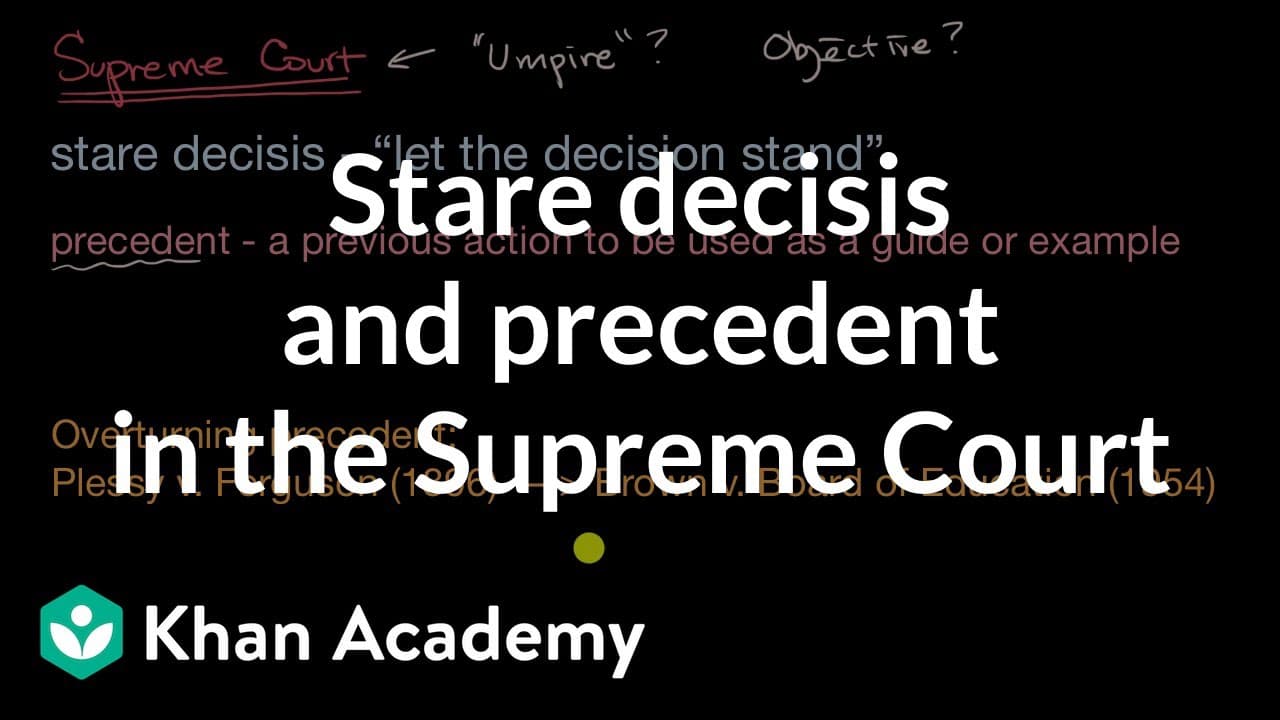
Stare decisis, meaning "let the decision stand" in Latin, is the principle the Supreme Court follows, using previous decisions as examples for similar cases.
Q: How does precedent influence Supreme Court decisions?
Precedent refers to previous rulings by the Supreme Court, which serve as examples or guides for present cases. Justices consider precedents when making their decisions.
Q: What role do politics play in the Supreme Court and its decisions?
The executive branch appoints Supreme Court justices, and changes in politics can have long-term effects on the court. Political shifts can influence appointments and subsequent rulings.
Summary & Key Takeaways
-
The Supreme Court has a distinct role separate from the executive and legislative branches, making decisions based on interpretation and constitutionality.
-
Stare decisis and precedent guide the Supreme Court's decision-making process, relying on previous rulings as examples for similar cases.
-
Despite striving for objectivity, the subjectivity of justices' views and experiences affects their decisions, and political changes can lead to shifts in the court's direction.
Read in Other Languages (beta)
Share This Summary 📚
Summarize YouTube Videos and Get Video Transcripts with 1-Click
Try YouTube Summary with ChatGPT & Claude or YouTube Transcript Generator
Explore More Summaries from Khan Academy 📚



Summarize YouTube Videos and Get Video Transcripts with 1-Click
Try YouTube Summary with ChatGPT & Claude or YouTube Transcript Generator