Streamline Function and Velocity Potential Function in Cylindrical Coordinate - Fluid Mechanics 1
TL;DR
The content explains the relationship between velocity potential and streamline functions in a cylindrical coordinate system, and how they are used to determine rotational and irrotational flows.
Transcript
so we have studied what is velocity potential function and streamline function now we are going to study the same thing in cylindrical coordinate system so let us study about velocity potential function in cylindrical coordinates now velocity potential function is given as phi now in cylindrical coordinate okay that is r comma theta comma z we have... Read More
Key Insights
- 🆘 The velocity potential function in cylindrical coordinates helps calculate the radial and tangential velocities.
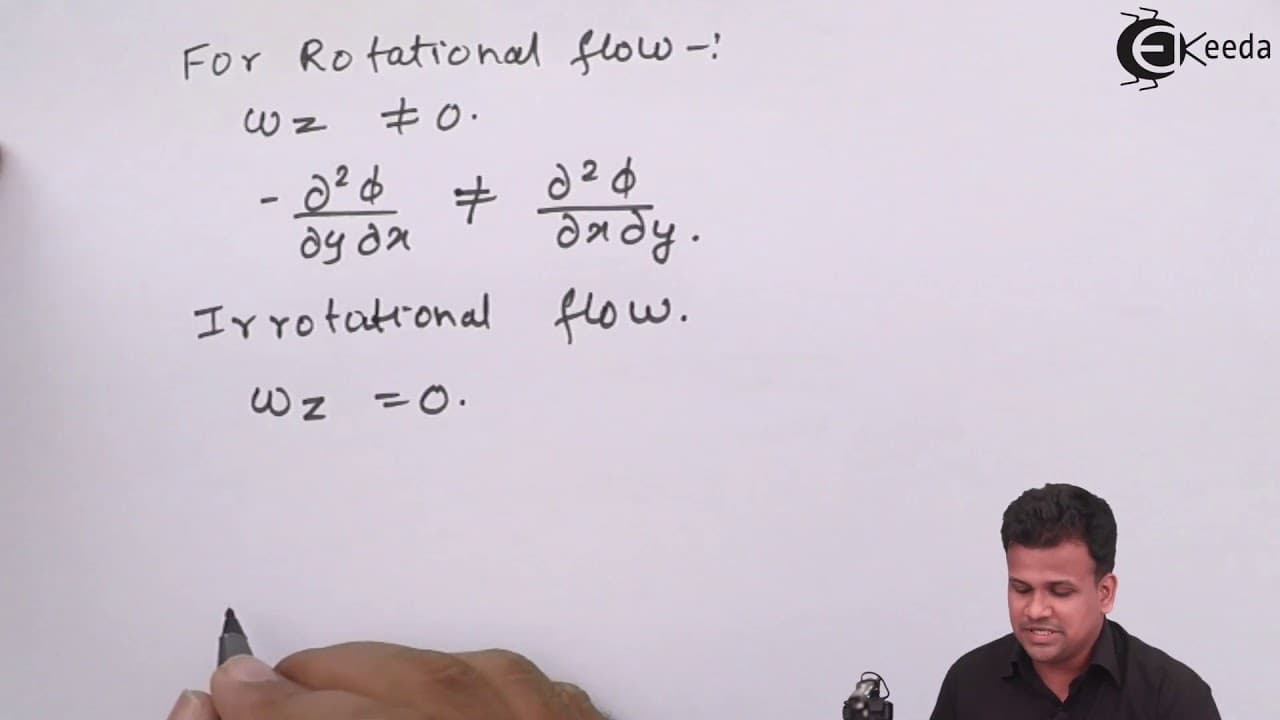
- 🤪 The omega z equation can determine if a flow is rotational or irrotational based on the value of omega z.
- ❓ The streamline function describes the radial and tangential velocities in cylindrical coordinates.
- 🤪 The conditions for rotational and irrotational flows can be determined by analyzing the omega z equation and the derivative of the streamline function.
Install to Summarize YouTube Videos and Get Transcripts
Explore YouTube Video Summarizer or Get YouTube Transcript Extractor
Questions & Answers
Q: What is the velocity potential function in cylindrical coordinates?
The velocity potential function, phi, in cylindrical coordinates is used to calculate the velocity components in the radial (u_r) and tangential (u_theta) directions.
Q: How can we determine if a flow is rotational or irrotational?
The omega z equation can be used to determine rotational or irrotational flow. If omega z is not equal to zero, the flow is rotational. If omega z is equal to zero, the flow is irrotational.
Q: What is the relationship between the velocity potential function and the omega z equation?
The derivative of the velocity potential function with respect to theta gives the value of r multiplied by u_theta, which is used in the omega z equation to determine rotational flow.
Q: How is the streamline function defined in cylindrical coordinates?
The streamline function, psi, in cylindrical coordinates is defined as the derivative of phi with respect to r for the tangential velocity (u_theta), and the derivative of phi with respect to theta multiplied by 1/r for the radial velocity (u_r).
Q: What conditions need to be satisfied for a rotational flow with respect to the streamline function?
For rotational flow, the condition is that the derivative of psi with respect to x squared should not be equal to the derivative of psi with respect to y squared, as given by the omega z equation.
Q: How can the streamline function and velocity potential function be used in fluid mechanics?
The streamline function and velocity potential function provide valuable information about the flow properties and can help analyze rotational and irrotational flows in fluid mechanics.
Summary & Key Takeaways
-
The velocity potential function, denoted as phi, can be used to calculate the velocity components in the radial and tangential directions in cylindrical coordinates.
-
The rotational flow of a fluid can be determined using the omega z equation, which involves differentiating the velocity potential function.
-
The streamline function, denoted as psi, provides information about the radial and tangential velocities in cylindrical coordinates.
-
The conditions for rotational and irrotational flows can be determined by analyzing the omega z equation and the derivative of the streamline function.
Read in Other Languages (beta)
Share This Summary 📚
Summarize YouTube Videos and Get Video Transcripts with 1-Click
Try YouTube Summary with ChatGPT & Claude or YouTube Transcript Generator
Explore More Summaries from Ekeeda 📚



Summarize YouTube Videos and Get Video Transcripts with 1-Click
Try YouTube Summary with ChatGPT & Claude or YouTube Transcript Generator