Parabolic mirrors and real images | Geometric optics | Physics | Khan Academy
TL;DR
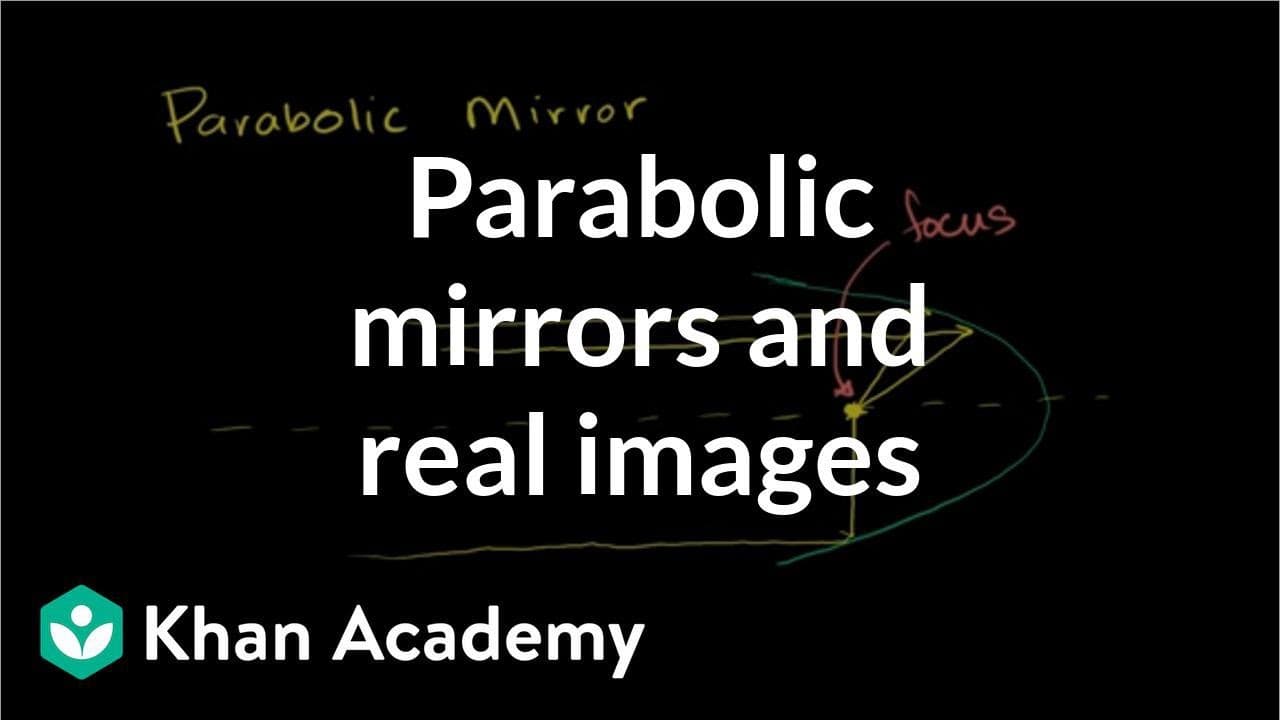
Parabolic mirrors are mirrors in the shape of a parabola that can focus parallel light rays to a single point, making them useful for concentrating energy or directing light.
Transcript
In this video, I want to expose you to a special class of mirrors called parabolic mirrors. Or sometimes called parabolic reflectors. And what's neat about parabolic mirrors-- and I'll draw a cross section of one right here. And if you're familiar with the algebra, they are essentially-- the cross section, especially, is in the shape of a parabola.... Read More
Key Insights
- 🙂 Parabolic mirrors have a cross section in the shape of a parabola and can focus parallel light rays to a single point.
- 🚨 They are used in solar energy collection to concentrate the sun's rays and in car headlights to direct light beams.
- ☄️ Parabolic mirrors can create real images that can be projected onto screens, unlike virtual images that appear to come from a different location.
Install to Summarize YouTube Videos and Get Transcripts
Explore YouTube Video Summarizer or Get YouTube Transcript Extractor
Questions & Answers
Q: How are parabolic mirrors different from other types of mirrors?
Parabolic mirrors have a cross section in the shape of a parabola, which allows them to focus parallel light rays to a single point. This is different from other mirrors, such as flat mirrors or spherical mirrors, which do not have this focusing ability.
Q: Why are parabolic mirrors used in solar energy collection?
Parabolic mirrors are used in solar energy collection because they can concentrate the sun's rays to a focal point. This allows for efficient energy capture and can be used, for example, to heat up a water pipe or generate electricity.
Q: How are parabolic mirrors used in car headlights?
Parabolic mirrors are used in car headlights to direct the light beams in a specific direction. By placing the light source at the focal point of the parabolic mirror, the reflected light is emitted parallel to the mirror's principal axis, allowing for optimal illumination of the road.
Q: What is the difference between a real image and a virtual image?
A real image is an image that can be projected onto a screen and is formed by converging light rays. In the case of parabolic mirrors, the converging light rays create a real image. In contrast, a virtual image is created by diverging light rays and appears as if it is coming from a different location than the actual object.
Summary & Key Takeaways
-
Parabolic mirrors have a cross section in the shape of a parabola and are capable of focusing parallel light rays to a single point.
-
They can be used as solar energy collectors by reflecting the sun's rays to a focal point, where the energy can be concentrated.
-
Parabolic mirrors are also commonly used in car headlights to direct the light beams in a specific direction, increasing their usefulness.
Read in Other Languages (beta)
Share This Summary 📚
Summarize YouTube Videos and Get Video Transcripts with 1-Click
Try YouTube Summary with ChatGPT & Claude or YouTube Transcript Generator
Explore More Summaries from Khan Academy 📚



Summarize YouTube Videos and Get Video Transcripts with 1-Click
Try YouTube Summary with ChatGPT & Claude or YouTube Transcript Generator