VMware - Virtualization - Cloud Computing and Services
TL;DR
VMware is a widely used virtualization technology that enables full virtualization of x86 architectures, providing the best isolation and security for virtual machines.
Transcript
hello friends today we are going to learn about the topic virtualization technology VMware in which we are going to learn about its architecture advantages disadvantages etc VMware technologies what is VMware or virtualization technology see in full virtualization primary Hardware is replicated and made available to the guest operating system which... Read More
Key Insights
- 📁 VMware provides full virtualization for x86 architectures through a combination of direct execution and binary translation.
- 👻 Binary translation allows for the best isolation and security for virtual machines, but it comes with time-consuming runtime processes and performance overhead.
- 🔒 VMware's virtualization products include networking, security, management tools, software-defined data center software, and storage software.
- 👻 VMware's NSX enables virtualization of network components, allowing administrators to develop, deploy, and configure virtual networks through software.
- 👻 NSX also offers network function virtualization, allowing functions like firewall and load balancer to run in the virtualization software stack.
- 🛟 VMware vSphere is the suite of virtualization products that includes ESXi, vCenter server, vSphere client, and vMotion.
- 👻 VMware Cloud on AWS allows customers to run vSphere hosts with V San and NSX in an Amazon datacenter while managing them with familiar VMware tools.
Install to Summarize YouTube Videos and Get Transcripts
Explore YouTube Video Summarizer or Get YouTube Transcript Extractor
Questions & Answers
Q: What is the key concept behind VMware's full virtualization?
The key concept is to provide a virtualization layer between the physical hardware and guest operating systems, allowing for seamless execution of applications without modifying the underlying hardware.
Q: How does VMware enable full virtualization on x86 architectures?
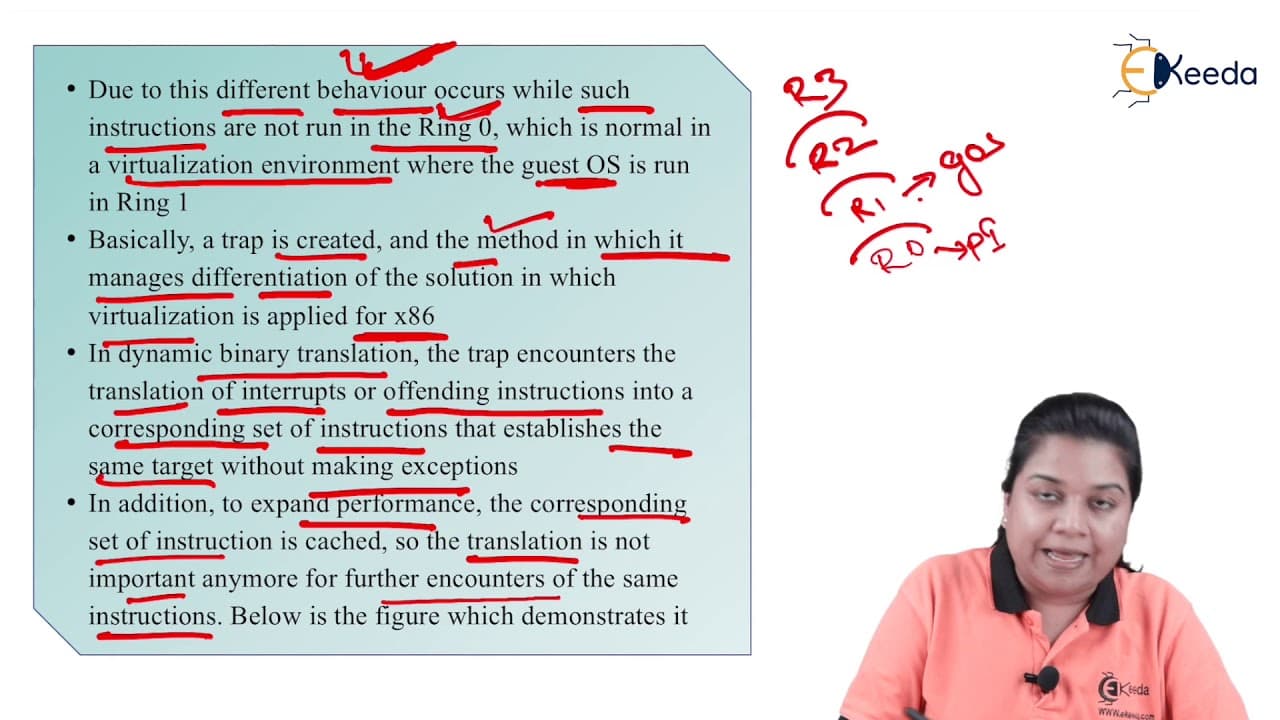
VMware utilizes a combination of direct execution for non-sensitive instructions and binary translation for sensitive instructions or hardware traps to enable full virtualization on x86 architectures.
Q: What are the advantages of using binary translation in VMware?
Binary translation allows for the best isolation and security for virtual machines, as multiple guest operating systems can execute concurrently on the same hardware without the need for hardware or operating system assistance.
Q: What are the disadvantages of using binary translation in VMware?
Binary translation is time-consuming and incurs a large performance overhead. It also requires a code cache, which increases memory utilization and hardware costs.
Summary & Key Takeaways
-
VMware uses full virtualization to replicate and make hardware available to guest operating systems, allowing users to execute anything in a virtual machine.
-
Full virtualization is achieved through direct execution for non-sensitive instructions and binary translation for sensitive instructions or hardware traps.
-
VMware is widely used for x86 architectures and has been made possible by the introduction of hardware-assisted virtualization.
Read in Other Languages (beta)
Share This Summary 📚
Summarize YouTube Videos and Get Video Transcripts with 1-Click
Try YouTube Summary with ChatGPT & Claude or YouTube Transcript Generator
Explore More Summaries from Ekeeda 📚





Summarize YouTube Videos and Get Video Transcripts with 1-Click
Try YouTube Summary with ChatGPT & Claude or YouTube Transcript Generator