Rent control and deadweight loss | Microeconomics | Khan Academy
TL;DR
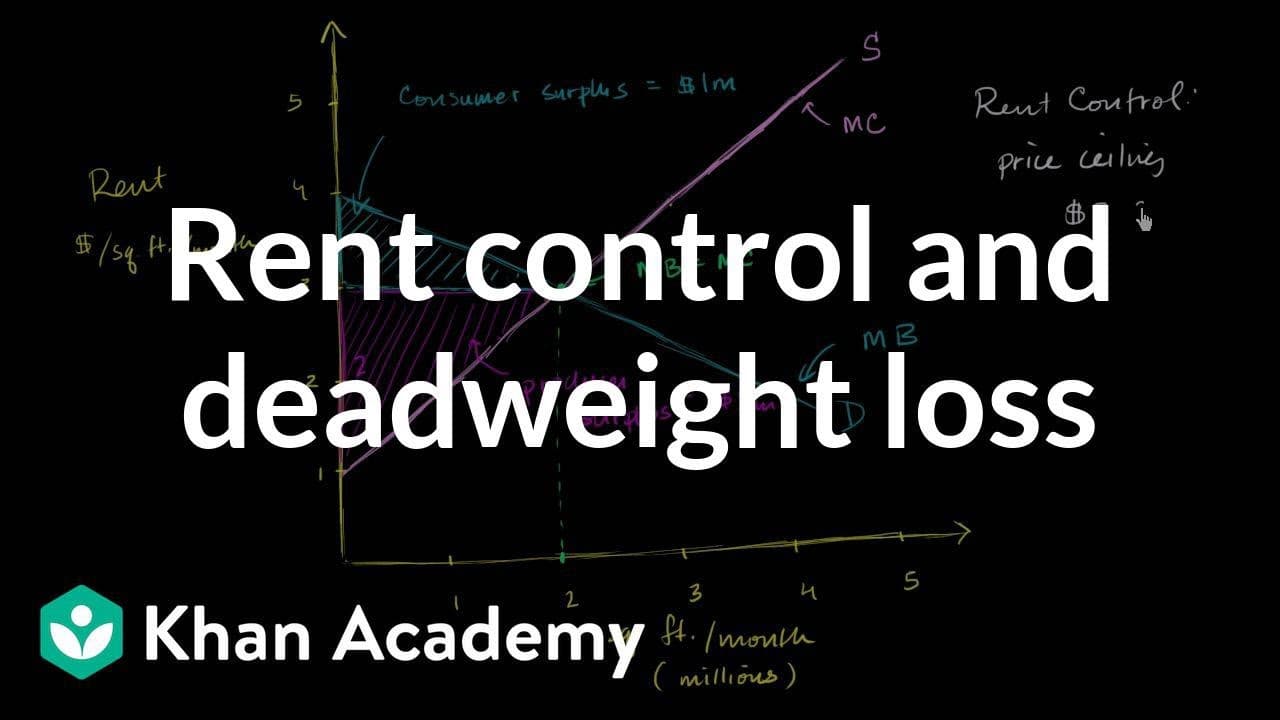
This video explains how rent control affects the market for real estate, analyzing the concepts of consumer surplus, producer surplus, and deadweight loss.
Transcript
Voiceover: Let's think about the market for real estate in a given city. Here on the vertical axis I have plotted rent in terms of dollars per square foot per month. Here on the horizontal axis, is essentially the quantity of square foot square foot per month available in millions. This is 1 million, 2 million, 3 million, 4 million, 5 million. Here... Read More
Key Insights
- 🦶 The demand curve can be interpreted as the marginal benefit curve, showing the incremental benefit of each additional square foot of real estate.
- 🇨🇷 The supply curve can be interpreted as the marginal cost curve, indicating the incremental cost of each additional square foot of real estate.
- 🉐 Consumer surplus is the additional benefit gained by consumers paying a price lower than their willingness to pay, while producer surplus is the additional profit gained by suppliers selling at a price higher than their cost of production.
- 🌸 Deadweight loss is the loss of total surplus that occurs when price controls, such as rent control, are imposed on the market.
- 🥺 Rent control reduces producer surplus and can lead to a decrease in the quantity of real estate supplied.
- 🌸 Rent control may increase consumer surplus in the short term, but it results in a deadweight loss and overall loss of total surplus in the market.
- 🧑🏭 The impact of rent control on total surplus depends on various factors and can vary in different market conditions.
Install to Summarize YouTube Videos and Get Transcripts
Explore YouTube Video Summarizer or Get YouTube Transcript Extractor
Questions & Answers
Q: How does the demand curve relate to the marginal benefit curve?
In the video, the demand curve is viewed as the marginal benefit curve because it shows the incremental benefit received by consumers for each additional square foot of real estate. The marginal benefit is high for the first unit and decreases with each additional unit.
Q: What is the significance of the supply curve as the marginal cost curve?
The supply curve represents the marginal cost to suppliers/landlords for each additional square foot of real estate. It shows that the cost of producing the first unit is low, which creates an incentive for suppliers to enter the market. As production continues, the marginal cost increases.
Q: How does the equilibrium rent and quantity occur in the market?
The equilibrium occurs when the marginal benefit equals the marginal cost. At this point, suppliers produce a quantity of 2 million square feet per month at a price of $3 per square foot per month. This reflects the balance between what consumers are willing to pay and what suppliers are willing to produce.
Q: What is consumer surplus and producer surplus?
Consumer surplus refers to the additional benefit consumers receive by paying a price lower than what they are willing to pay. Producer surplus, on the other hand, represents the additional profit gained by suppliers by selling at a price higher than their cost of production.
Summary & Key Takeaways
-
The video discusses the market for real estate in a city, showing how the demand and supply curves determine the equilibrium price and quantity.
-
It explains how the demand curve represents the marginal benefit curve and the supply curve represents the marginal cost curve.
-
The video then explores the concept of consumer surplus, producer surplus, and deadweight loss in the context of rent control.
Read in Other Languages (beta)
Share This Summary 📚
Summarize YouTube Videos and Get Video Transcripts with 1-Click
Try YouTube Summary with ChatGPT & Claude or YouTube Transcript Generator
Explore More Summaries from Khan Academy 📚



Summarize YouTube Videos and Get Video Transcripts with 1-Click
Try YouTube Summary with ChatGPT & Claude or YouTube Transcript Generator