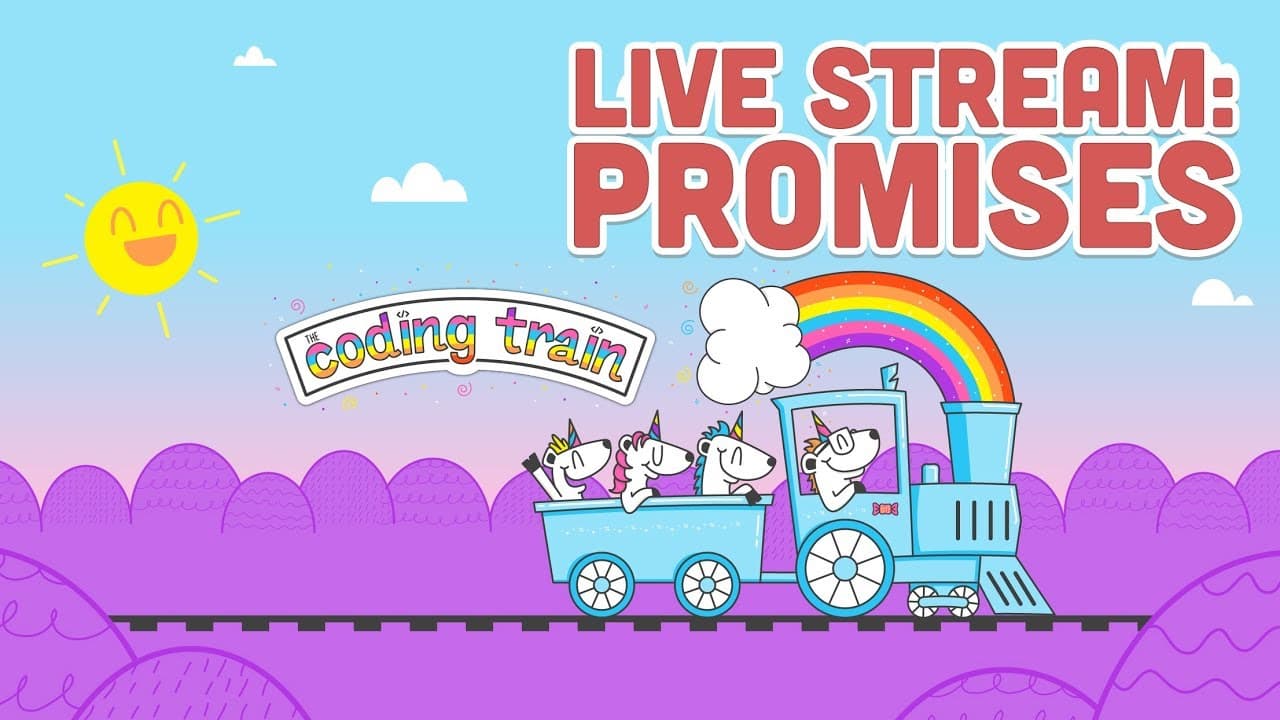
Live Stream #137.1: Promises in JavaScript - Part 1
TL;DR
Learn how to use JavaScript promises to handle asynchronous tasks more effectively.
Transcript
good morning whoo-hoo it's the go-to screen on a I'd no idea what day of the week is it Wednesday I'm standing here with my green screen and my laptops and my train whistle and my markers and my tape and my bell I'm peering over here to see if the chat is saying hello to me so let's see if the computer is actually available for us to look at I was ... Read More
Key Insights
- 💨 Promises simplify asynchronous coding by providing a structured way to handle callbacks.
- ❓ Promises have three states: pending, fulfilled, and rejected.
- 👻 Chaining promises with then() and catch() allows for sequential handling of asynchronous operations.
Install to Summarize YouTube Videos and Get Transcripts
Explore YouTube Video Summarizer or Get YouTube Transcript Extractor
Questions & Answers
Q: What are promises in JavaScript?
Promises are objects in JavaScript that represent the eventual completion (or failure) of an asynchronous operation. They simplify handling asynchronous code by providing a clean and structured way to handle callbacks.
Q: How do promises work?
Promises work by using the then() method to handle resolved promises (when the operation is successful) and the catch() method to handle rejected promises (when the operation fails). Promises can be chained together to handle multiple asynchronous operations.
Q: What are the benefits of using promises in JavaScript?
Promises provide a more organized and readable way to handle asynchronous code. They reduce callback nesting and make it easier to reason about the flow of asynchronous operations. Promises also provide a consistent and reliable way to handle errors.
Q: How can promises be used to handle multiple asynchronous operations?
Promises.all() can be used to handle multiple promises simultaneously. It takes an array of promises and returns a new promise that is fulfilled when all the promises in the array are fulfilled, or rejected if any of the promises are rejected.
Summary & Key Takeaways
-
JavaScript promises are objects that represent the eventual completion or failure of an asynchronous operation.
-
Promises have three states: pending, fulfilled, and rejected.
-
Promises simplify asynchronous code, reducing callback nesting and improving code organization.
Read in Other Languages (beta)
Share This Summary 📚
Summarize YouTube Videos and Get Video Transcripts with 1-Click
Try YouTube Summary with ChatGPT & Claude or YouTube Transcript Generator
Explore More Summaries from The Coding Train 📚





Summarize YouTube Videos and Get Video Transcripts with 1-Click
Try YouTube Summary with ChatGPT & Claude or YouTube Transcript Generator