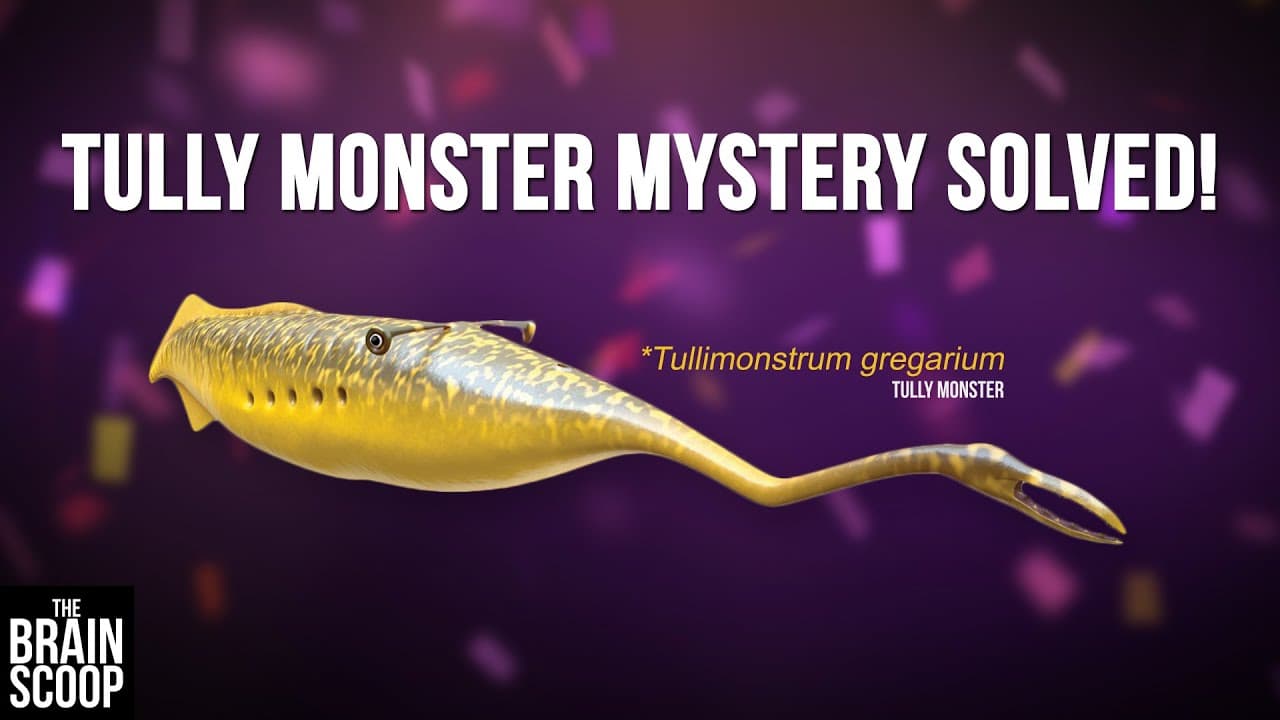
Tully monster mystery SOLVED!
TL;DR
The Tully monster, Illinois' state fossil, has been determined to be a vertebrate after years of confusion and debate.
Transcript
Hey, we're here with Paul We're gonna bust some nodules. We are back with Scott in the...invertebrate paleontology collections here at The Field Museum. Hi I'm Scott Lidgard I'm a Associate Curator of Fossil invertebrates here. So Scott, you're one of co-author on this paper that was published in Nature about a months ago, Right! Saying that... The... Read More
Key Insights
- 👹 The Tully monster's classification as a vertebrate provides insight into the evolution and diversity of ancient creatures.
- 👹 The fragmented nature of the Tully monster specimens made it challenging to fully understand its anatomy and behavior.
- ❓ The discovery highlights the importance of continuously studying and reinterpreting fossils to expand scientific knowledge.
- 👹 The Tully monster's uniqueness and the intrigue surrounding its classification contributed to its popularity and widespread attention.
- ❓ Paleontologists used various techniques, including splitting hardened nodules, to reveal fossils and study them more effectively.
- 😉 The scarcity of Tully monster fossils makes finding one comparable to winning the lottery.
- 👹 The research on the Tully monster exemplifies the ongoing nature of scientific inquiry and the significance of collaboration between experts.
Install to Summarize YouTube Videos and Get Transcripts
Explore YouTube Video Summarizer or Get YouTube Transcript Extractor
Questions & Answers
Q: Why was it difficult for scientists to determine the classification of the Tully monster?
The Tully monster's unusual appearance and a lack of complete, preserved specimens made it challenging to place it within a specific animal group.
Q: How did researchers differentiate the muscle bands in the Tully monster from those of annelid worms?
The separation of muscle bands in the Tully monster fossils extended to the margin of the outside fossil, indicating a different kind of segmentation from annelid worms.
Q: What was the significance of the dark and light bands in the Tully monster's body?
The dark band was interpreted as the notochord, a precursor to the backbone, while the light band was re-interpreted as the digestive tract.
Q: Why did the discovery of the Tully monster's classification gain so much attention?
The Tully monster is a state fossil and the mystery surrounding its identity captured the imagination of people interested in understanding past worlds.
Summary & Key Takeaways
-
The Tully monster, a strange-looking creature, has confounded scientists due to its unique combination of characteristics.
-
The fossilized specimens of the Tully monster are often preserved as fragments, making it difficult to study the complete organism.
-
Researchers used various clues, such as muscle bands and the presence of a notochord, to determine that the Tully monster is a vertebrate.
Read in Other Languages (beta)
Share This Summary 📚
Summarize YouTube Videos and Get Video Transcripts with 1-Click
Try YouTube Summary with ChatGPT & Claude or YouTube Transcript Generator
Explore More Summaries from thebrainscoop 📚




Summarize YouTube Videos and Get Video Transcripts with 1-Click
Try YouTube Summary with ChatGPT & Claude or YouTube Transcript Generator