Facilitated diffusion | Membranes and transport | Biology | Khan Academy
TL;DR
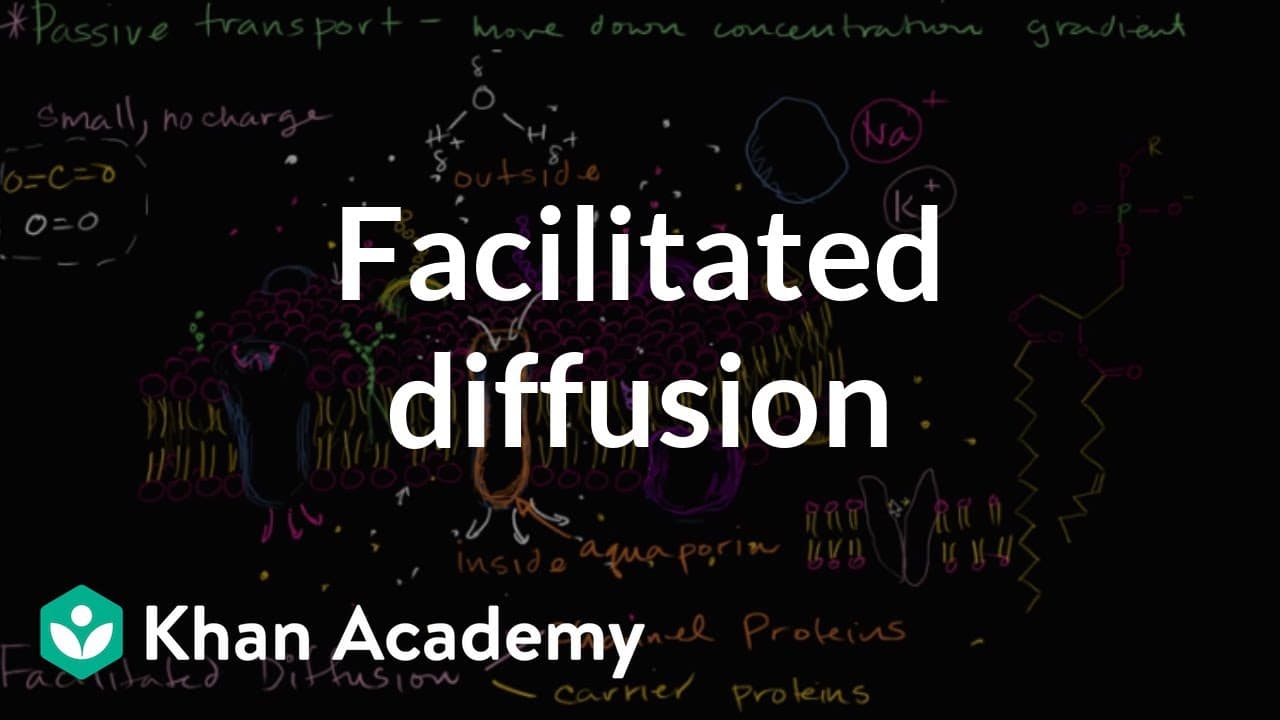
Facilitated diffusion is a type of passive transport that uses channel proteins and carrier proteins to help molecules move down their concentration gradient.
Transcript
- In the first video on passive transport we talked about the most passive of passive transports and that is simple diffusion. And we talked about how small non-charged, non-polar molecules would actually have the easiest time. Things like carbon dioxide or molecular oxygen, would have the easiest time diffusing through the cellular membrane. They'... Read More
Key Insights
- 😒 Passive transport involves the movement of molecules down their concentration gradient without the use of energy.
- 🅰️ Facilitated diffusion is a type of passive transport that utilizes channel proteins and carrier proteins.
- 🧑🏭 Channel proteins act as tunnels for specific molecules, while carrier proteins can change shape to transport molecules across the membrane.
- 📡 Facilitated diffusion is particularly important in processes like osmosis and signal transmission in nerve cells.
- 🚱 Small non-charged, non-polar molecules have an easier time diffusing through the membrane compared to charged particles.
- 🖐️ Channel proteins and carrier proteins play crucial roles in ensuring the smooth and efficient movement of molecules across the cellular membrane.
- 💦 The study of carrier proteins is still ongoing, and researchers are working to fully understand their mechanisms.
Install to Summarize YouTube Videos and Get Transcripts
Explore YouTube Video Summarizer or Get YouTube Transcript Extractor
Questions & Answers
Q: How do small non-charged, non-polar molecules like carbon dioxide diffuse through the cellular membrane?
Small non-charged, non-polar molecules can easily diffuse through the cellular membrane due to their small size and lack of charge or polarity. They can pass through the gaps in the membrane without interacting with the hydrophilic heads or hydrophobic tails.
Q: What are channel proteins and how do they facilitate facilitated diffusion?
Channel proteins are specialized proteins that act as tunnels through the cellular membrane. They allow specific molecules, such as water or ions, to move down their concentration gradient without interacting much with the membrane. An example is aquaporin, a channel protein for water.
Q: How do carrier proteins facilitate facilitated diffusion?
Carrier proteins can change shape to transport molecules across the membrane. When there is a higher concentration of a molecule above the membrane, the carrier protein attaches to the molecule and changes shape to bring it into the cell. The molecule is then released inside the cell.
Q: How is facilitated diffusion different from simple diffusion?
Facilitated diffusion involves the use of channel proteins or carrier proteins to assist in the movement of molecules down their concentration gradient. Simple diffusion, on the other hand, does not require any proteins and relies solely on the properties of the molecules and the concentration gradient.
Summary & Key Takeaways
-
The first video discussed simple diffusion, where small non-charged, non-polar molecules can easily diffuse through the cellular membrane.
-
Facilitated diffusion involves the use of channel proteins and carrier proteins to make passive transport easier for molecules like water and ions.
-
Channel proteins act as tunnels for specific molecules, while carrier proteins can change shape to transport molecules across the membrane.
Read in Other Languages (beta)
Share This Summary 📚
Summarize YouTube Videos and Get Video Transcripts with 1-Click
Try YouTube Summary with ChatGPT & Claude or YouTube Transcript Generator
Explore More Summaries from Khan Academy 📚



Summarize YouTube Videos and Get Video Transcripts with 1-Click
Try YouTube Summary with ChatGPT & Claude or YouTube Transcript Generator