How Do Olympic Divers Create Minimal Splash?
TL;DR
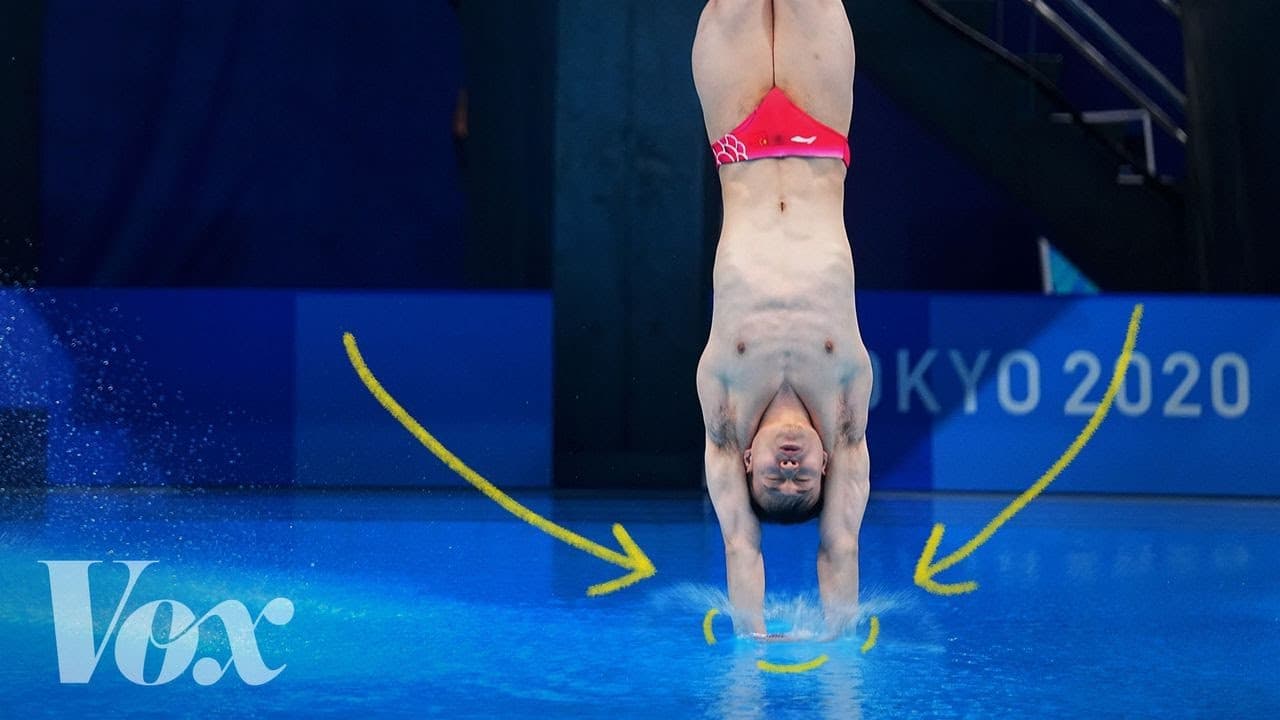
Olympic divers minimize splash by using the 'rip entry' technique, which involves specific hand positioning to break the water surface smoothly. Additionally, they employ underwater swim movements and pikes to control air cavities, resulting in smaller bubbles that cause less splash. This technique is crucial for achieving high scores, as judges consider splash size in their overall impression of the dive.
Transcript
If there’s one thing people know about competitive diving It’s that the splash is important The perfect dive will have the smallest splash, like this highest scoring Olympic dive ever by Matthew Mitcham from 2008. But it’s not just this that determines the splash... ...it’s what happens underwater. To figure out how Olympic divers get such small sp... Read More
Key Insights
- Olympic divers aim for minimal splash, which is a key factor in scoring high points during competitions.
- The perfect dive involves three components: above water position, underwater swim, and underwater pike.
- Divers must achieve enough height, distance, and angular momentum to execute a dive successfully.
- The 'rip entry' technique, involving specific hand positioning, is crucial for minimizing splash upon water entry.
- Splashes occur in two parts: the initial unavoidable splash and the secondary splash caused by air cavities.
- Underwater techniques such as the swim and somersault help break air cavities into smaller bubbles, reducing splash.
- Judges use splash size as a subjective factor to influence scores under the category of overall impression.
- While minimizing splash is not the main goal of diving, it serves as an indicator of a well-executed dive.
Install to Summarize YouTube Videos and Get Transcripts
Explore YouTube Video Summarizer or Get YouTube Transcript Extractor
Questions & Answers
Q: What are the key components of a perfect dive?
A perfect dive is composed of three key components: the above water position, the underwater swim, and the underwater pike. These elements work together to ensure that divers have the necessary height, distance, and momentum to execute their dives effectively while minimizing splash.
Q: Why is the rip entry technique important in diving?
The rip entry technique is crucial in diving as it allows divers to break through the water with minimal disturbance. By interlocking their thumbs and extending their arms, divers create a needlelike line that minimizes the initial splash upon water entry, which is a significant factor in achieving higher scores.
Q: How do divers minimize the second part of the splash?
Divers minimize the second part of the splash, known as the Worthington jet, through underwater techniques. By swimming their hands out to the side and performing an underwater somersault, they break the air cavity into smaller bubbles, reducing the splash when these bubbles rise to the surface.
Q: What role does splash size play in diving scores?
Splash size plays a subjective role in diving scores as judges use it to impact the overall impression category. While not officially part of the FINA rule book, a smaller splash often indicates a well-executed dive and can lead to higher scores, serving as punctuation to a job well done.
Q: How do divers achieve the necessary momentum for a dive?
Divers achieve the necessary momentum for a dive by pushing off the board with enough height, distance, and angular momentum. This preparation allows them to execute complex movements like somersaults and twists in the air, setting them up for a precise entry into the water with minimal splash.
Q: What causes the initial splash in diving?
The initial splash in diving is caused by the displacement of water as the diver's body enters the pool. This displacement pushes water down and out, creating a radial jet that shoots up at 20-30 times the speed of the impact, forming the unavoidable first part of the splash.
Q: How do judges assess the overall impression in diving?
Judges assess the overall impression in diving by considering technical elements and the aesthetic quality of the dive, including splash size. Although splash size is not explicitly mentioned in the FINA rule book, it influences scores as part of the subjective evaluation of the dive's execution.
Q: What is the significance of the underwater pike in diving?
The underwater pike is significant in diving as it helps trap air and delay its return to the surface, reducing the size of the splash. This technique involves creating an underwater somersault that disperses air, breaking larger bubbles into smaller ones, contributing to a cleaner, less splashy finish.
Summary & Key Takeaways
-
Olympic divers focus on creating minimal splash to achieve high scores, employing techniques like the rip entry and underwater swim. These methods help control splash size, which judges consider in their scoring, although it's not officially part of the FINA rule book.
-
The dive's success relies on three main components: above water position, underwater swim, and underwater pike. These elements ensure divers have the necessary height, distance, and momentum to execute their dives effectively and minimize splash.
-
The rip entry technique involves specific hand positioning to break through the water with minimal disturbance. This, combined with underwater techniques, helps control the size of the splash, making it a key aspect of competitive diving.
Read in Other Languages (beta)
Share This Summary 📚
Summarize YouTube Videos and Get Video Transcripts with 1-Click
Try YouTube Summary with ChatGPT & Claude or YouTube Transcript Generator
Explore More Summaries from Vox 📚



Summarize YouTube Videos and Get Video Transcripts with 1-Click
Try YouTube Summary with ChatGPT & Claude or YouTube Transcript Generator