What Are Conduction, Convection, and Radiation in Fire?
TL;DR
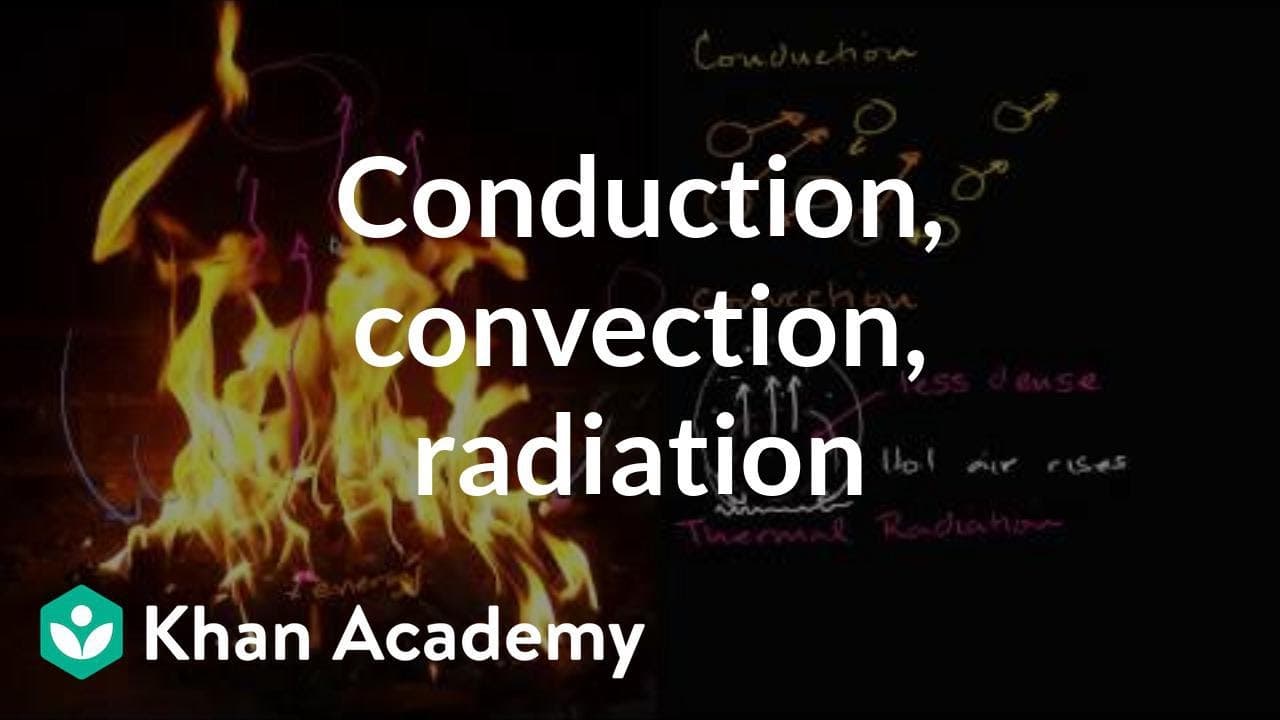
Conduction, convection, and radiation are the three fundamental mechanisms of heat transfer in fire. Conduction transfers kinetic energy through collisions between molecules, convection involves hot air rising while cooler air descends, and thermal radiation emits energy as electromagnetic waves, which is perceived as warmth and visible light.
Transcript
- When we observe what we call fire we have this combustion reaction going on and then we see these flames what we're really observing are the three forms of thermal energy transfer. We're observing conduction, conduction, convection, convection, convection, and thermal radiation all at the same time. So I'll do this, thermal, thermal radiation, th... Read More
Key Insights
- ❤️🔥 Fire involves three forms of thermal energy transfer: conduction, convection, and thermal radiation.
- 🥵 Convection in a fire is the result of hot air rising and cooler air moving down to be heated up.
- ❤️🔥 Combustion reactions in a fire release a significant amount of energy.
- 🙂 Thermal radiation emitted by fire is responsible for visible light and the feeling of warmth.
- ❤️🔥 Conduction occurs in a fire as neighboring molecules transfer energy through collisions.
- 👱 Fire appears to move upwards due to hot air rising and cooler air filling the space.
- ❤️🔥 Conduction, convection, and thermal radiation all contribute to the transfer of thermal energy in a fire.
Install to Summarize YouTube Videos and Get Transcripts
Explore YouTube Video Summarizer or Get YouTube Transcript Extractor
Questions & Answers
Q: What is the main source of energy in a fire?
The main source of energy in a fire is the combustion reaction, where carbon molecules react with oxygen to produce carbon dioxide, water, and a significant amount of energy.
Q: How does conduction work in a fire?
Conduction in a fire occurs when molecules with higher kinetic energy transfer some of that energy to molecules with lower kinetic energy through collisions, causing them to gain energy and increase in temperature.
Q: Why does hot air rise in a fire?
Hot air in a fire is less dense than cooler air, causing it to rise. This movement creates space for cooler air to come down and be heated up again, resulting in convection.
Q: How does thermal radiation contribute to the transfer of energy in a fire?
Thermal radiation occurs when charged particles in molecules are accelerated through collisions, releasing electromagnetic radiation. This radiation is what we perceive as visible light and heat in a fire.
Summary & Key Takeaways
-
Fire is the result of a combustion reaction, which releases a significant amount of energy.
-
Conduction occurs in a fire as neighboring molecules transfer kinetic energy through collisions.
-
Convection is another form of heat transfer in fire, where hot air rises and cooler air moves down to be heated up.
Read in Other Languages (beta)
Share This Summary 📚
Summarize YouTube Videos and Get Video Transcripts with 1-Click
Try YouTube Summary with ChatGPT & Claude or YouTube Transcript Generator
Explore More Summaries from Khan Academy 📚




Summarize YouTube Videos and Get Video Transcripts with 1-Click
Try YouTube Summary with ChatGPT & Claude or YouTube Transcript Generator