Aggregate production function and economic growth | APⓇ Macroeconomics | Khan Academy
TL;DR
Increasing factors of production such as labor, capital, and technology can lead to higher aggregate production and productivity.
Transcript
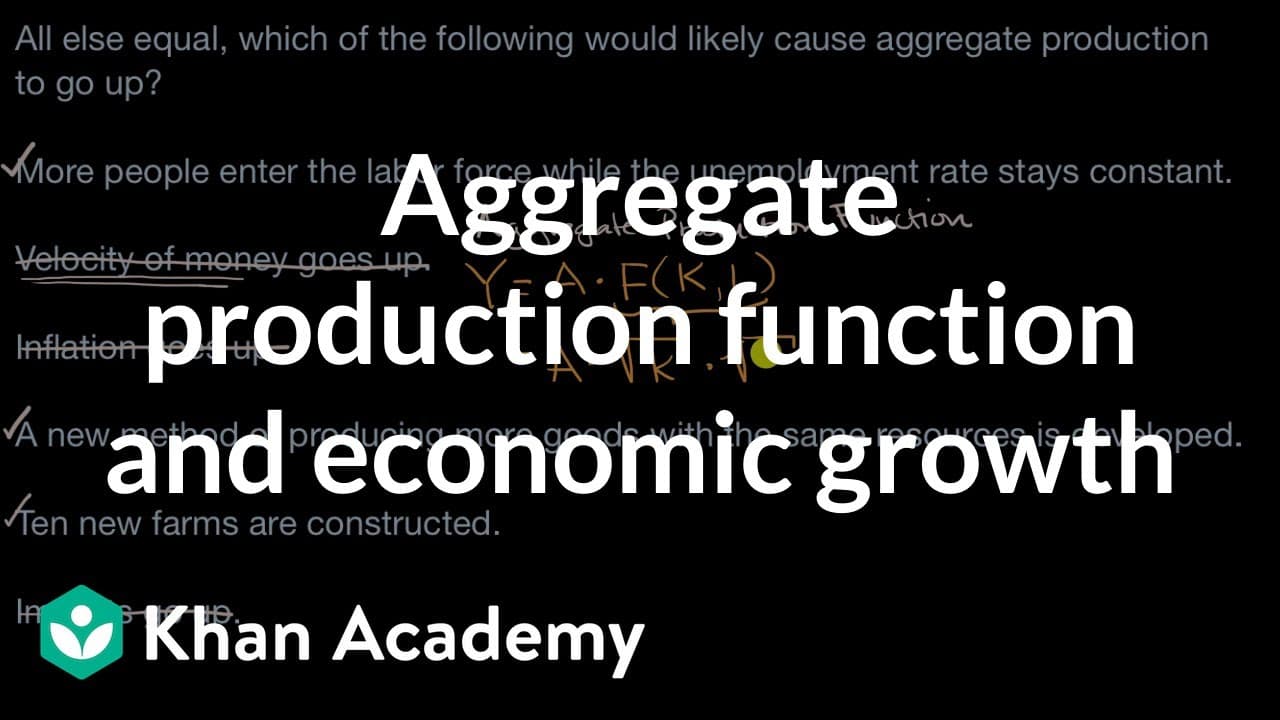
- [Instructor] So we are posed with the question, All else equal, which of the following would likely cause aggregate production to go up? Pause this video, and see which of these you think would do that. All right, now let's work through this together. This first one says, More people enter the labor force while the unemployment rate stays constan... Read More
Key Insights
- 🔬 Labor is an essential factor of production, and an increase in the labor force can lead to higher aggregate production.
- 🤑 The velocity of money does not directly impact aggregate production, as it does not affect the quantity of goods produced or the technology and capital used.
- 🥺 Inflation and higher prices do not necessarily lead to increased aggregate production.
- 👶 The development of new methods for production and the construction of additional farms can enhance aggregate production.
- 🧑🏭 Increasing factors of production, including labor, capital, and technology, can boost aggregate production and productivity.
- 🔬 The Aggregate Production Function demonstrates how technology, capital, and labor contribute to aggregate output.
- 🧑🏭 It is important to consider diminishing marginal returns when analyzing the impact of increasing factors of production on aggregate production.
Install to Summarize YouTube Videos and Get Transcripts
Explore YouTube Video Summarizer or Get YouTube Transcript Extractor
Questions & Answers
Q: How does an increase in labor force impact aggregate production?
When the labor force expands while the unemployment rate remains constant, the absolute number of people working increases. This can lead to higher aggregate production as long as other factors like technology and capital remain constant.
Q: Why does an increase in the velocity of money not affect output?
An increase in the velocity of money signifies more transactions, but it does not directly impact the quantity of goods produced or the level of technology and capital. Therefore, it does not result in higher aggregate production.
Q: Does higher inflation always lead to increased aggregate production?
No, higher inflation does not necessarily indicate higher aggregate production. Inflation can occur even when the economy is shrinking, and the same amount of goods and services are being produced.
Q: How can the development of new production methods affect aggregate production?
The development of new methods to produce more goods with the same resources, such as improved technology, can significantly increase aggregate production. This is because it enhances productivity and efficiency in the production process.
Summary & Key Takeaways
-
More people entering the labor force while unemployment rate remains constant can increase aggregate production as the number of workers increases.
-
An increase in the velocity of money does not directly impact output since it does not affect the number of goods produced or the technology and capital used.
-
Inflation going up does not necessarily result in higher aggregate production as it can occur even when the economy is shrinking.
-
The development of a new method for producing more goods with the same resources can significantly increase aggregate production.
-
Constructing new farms and increasing imports can also contribute to higher output.
Read in Other Languages (beta)
Share This Summary 📚
Summarize YouTube Videos and Get Video Transcripts with 1-Click
Try YouTube Summary with ChatGPT & Claude or YouTube Transcript Generator
Explore More Summaries from Khan Academy 📚



Summarize YouTube Videos and Get Video Transcripts with 1-Click
Try YouTube Summary with ChatGPT & Claude or YouTube Transcript Generator