Introduction to long division | Multiplication and division | Arithmetic | Khan Academy
TL;DR
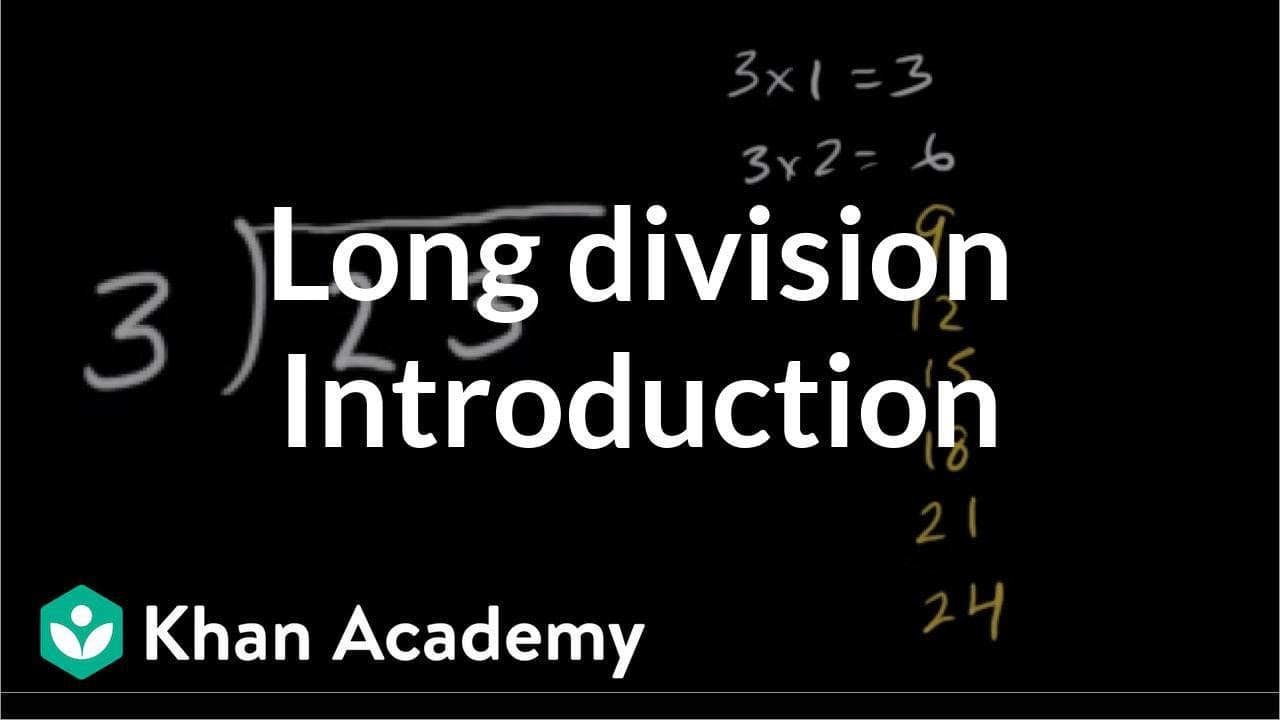
Learn how to divide larger numbers by using your knowledge of multiplication tables.
Transcript
Let's now see if we can divide into larger numbers. And just as a starting point, in order to divide into larger numbers, you at least need to know your multiplication tables from the 1-multiplication tables all the way to, at least, the 10-multiplication. So all the way up to 10 times 10, which you know is 100. And then, starting at 1 times 1 and ... Read More
Key Insights
- ⌛ Knowing multiplication tables up to at least 10 times 10 is crucial for performing division operations quickly.
- ➗ Division problems can be solved using the relationship between the divisor, dividend, and remainder.
- 🌥️ Dividing larger numbers requires finding the largest multiple of the divisor that fits into the dividend.
Install to Summarize YouTube Videos and Get Transcripts
Explore YouTube Video Summarizer or Get YouTube Transcript Extractor
Questions & Answers
Q: How can knowledge of multiplication tables help with division?
Knowing multiplication tables helps to quickly find the quotient of a division problem by recognizing the relationship between the divisor and the dividend.
Q: What do you do when the division problem doesn't fit into the multiplication tables?
When the division problem doesn't fit into the multiplication tables, you find the largest multiple of the divisor that fits into the dividend and subtract the remainder to get the final result.
Q: Can division problems have remainders?
Yes, division problems can have remainders. When there is a remainder, it means that the divisor doesn't go into the dividend evenly.
Q: Why is it important to understand division?
Understanding division is important for solving real-life problems, sharing and dividing quantities into equal parts, and finding the missing value in multiplication or division equations.
Summary & Key Takeaways
-
To divide into larger numbers, it is necessary to know multiplication tables from 1 to at least 10 times 10.
-
Division problems can be solved quickly by using multiplication tables. For example, if you want to divide 25 by 5, you can quickly know that 5 goes into 25 five times.
-
Division problems that don't fit into multiplication tables can be solved by finding the largest multiple of the divisor that fits into the dividend. The remainder is then subtracted to get the final result.
Read in Other Languages (beta)
Share This Summary 📚
Summarize YouTube Videos and Get Video Transcripts with 1-Click
Try YouTube Summary with ChatGPT & Claude or YouTube Transcript Generator
Explore More Summaries from Khan Academy 📚



Summarize YouTube Videos and Get Video Transcripts with 1-Click
Try YouTube Summary with ChatGPT & Claude or YouTube Transcript Generator