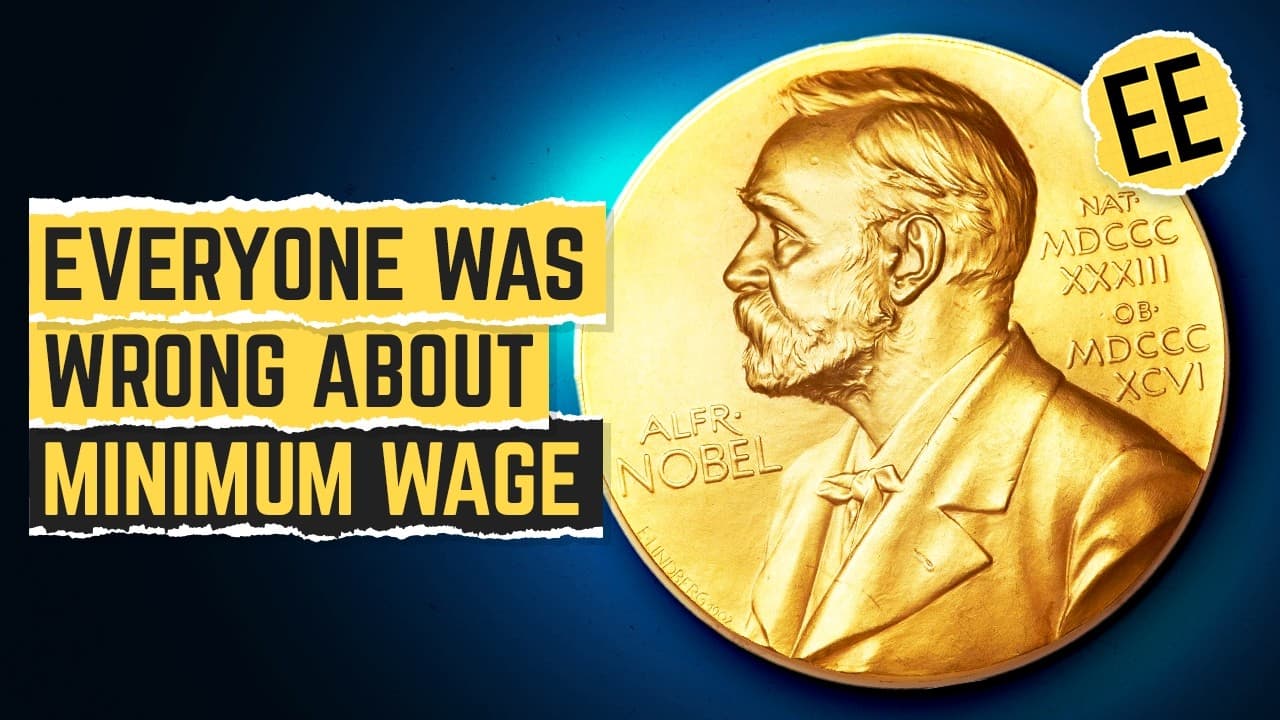
The 2021 Nobel Prize in Economics, Explained
TL;DR
2021 Nobel Prize awarded for groundbreaking work in labor economics and causal analysis.
Transcript
The 2021 Sveriges Riksbank Prize in Economic Sciences in Memory of Alfred Nobel was awarded to these three gentlemen, David Card, for his empirical contributions to labour economics, as well as Joshua Angrist & Guido Imbens for their methodological contributions to the analysis of causal relationships. causal relationships, not casual relationships... Read More
Key Insights
- The 2021 Nobel Prize in Economics was awarded to David Card, Joshua Angrist, and Guido Imbens for their contributions to labor economics and causal analysis.
- David Card's research challenged the traditional view that raising the minimum wage reduces employment, showing no negative impact in a real-world study.
- The Royal Swedish Academy of Sciences has been focusing on awarding economic research with practical applications in modern economies.
- Joshua Angrist and Guido Imbens developed methodologies to better analyze causal relationships, addressing the issue of correlation versus causation in economic research.
- The Nobel Prize in Economics, although not originally part of Alfred Nobel's will, was established by the Central Bank of Sweden in 1968 to honor significant contributions to the field.
- The prize money for the Nobel in Economics is substantial, but often recipients are already well-off and may donate the funds.
- Instrumental Variables Estimation, used by Angrist, allows economists to identify causal relationships by controlling for hidden variables.
- The work of the 2021 laureates is expected to influence labor laws, immigration policies, and economic research methodologies in the future.
Install to Summarize YouTube Videos and Get Transcripts
Explore YouTube Video Summarizer or Get YouTube Transcript Extractor
Questions & Answers
Q: What did David Card's research reveal about minimum wage and employment?
David Card's research, particularly his 1994 study, revealed that increasing the minimum wage did not lead to reduced employment, as traditionally believed. By analyzing fast-food workers in New Jersey, he found that employment actually increased relative to Pennsylvania, where the minimum wage remained unchanged. This challenged the conventional economic theory that higher wages reduce demand for labor.
Q: How did the work of Angrist and Imbens contribute to economic research?
Angrist and Imbens developed methodologies for better analyzing causal relationships in economic data, addressing the issue of correlation versus causation. Their work, particularly in Instrumental Variables Estimation, allows economists to isolate causal effects by controlling for hidden variables, leading to more accurate and reliable economic research outcomes.
Q: Why is the Nobel Prize in Economics not part of the original Nobel Prizes?
The Nobel Prize in Economics was not part of Alfred Nobel's original will, which established prizes for physics, chemistry, medicine, literature, and peace. Economics was added later in 1968 by the Central Bank of Sweden, recognizing its importance as a separate academic discipline with significant potential to contribute to humanity's well-being.
Q: What is the significance of the Instrumental Variables Estimation method?
Instrumental Variables Estimation is significant because it helps economists identify causal relationships between variables by controlling for hidden factors that could affect both the independent and dependent variables. This method is crucial in distinguishing true causation from mere correlation, leading to more reliable economic insights and policy recommendations.
Q: How do the Nobel Prize winners' contributions impact real-world policies?
The contributions of the 2021 Nobel Prize winners are expected to impact real-world policies by providing evidence-based insights into labor market dynamics and improving the methodological rigor of economic research. Their work can inform labor laws, minimum wage policies, and immigration strategies, ensuring they are grounded in empirical evidence rather than theoretical assumptions.
Q: What was the economic context during the creation of the Nobel Prize in Economics?
The Nobel Prize in Economics was established during a period when economics was gaining recognition as a crucial academic discipline. The mid-20th century saw significant economic challenges, such as the Great Depression, which highlighted the importance of economic research and policy in addressing global issues. The prize was created to honor significant contributions that could improve economic understanding and practice.
Q: Why is there a focus on practical applications in awarding the Nobel Prize in Economics?
There is a focus on practical applications in awarding the Nobel Prize in Economics to ensure that the recognized research has real-world relevance and can address contemporary economic challenges. This approach highlights the importance of empirical evidence and practical solutions in economic research, moving beyond theoretical models to impact policy and practice meaningfully.
Q: How does the Nobel Prize in Economics influence the field of economics?
The Nobel Prize in Economics influences the field by recognizing and promoting significant research that advances economic understanding and addresses practical challenges. It sets a benchmark for quality and impact in economic research, encouraging scholars to pursue innovative and empirically grounded work that can inform policy and improve economic outcomes globally.
Summary & Key Takeaways
-
The 2021 Nobel Prize in Economics recognized David Card for his empirical work in labor economics, which challenged the traditional view on the effects of minimum wage increases on employment. His research demonstrated that raising the minimum wage did not necessarily lead to reduced employment, using real-world data from New Jersey fast-food workers.
-
Joshua Angrist and Guido Imbens were awarded for their methodological contributions to causal analysis in economics, addressing the long-standing issue of distinguishing correlation from causation. Their work has provided economists with tools to better understand and analyze complex economic relationships using real-world data.
-
The Nobel Prize in Economics, established by the Central Bank of Sweden in 1968, highlights significant contributions with practical implications for modern economies. The 2021 laureates' work is expected to influence future economic policies and research methodologies, particularly in the areas of labor laws and immigration.
Read in Other Languages (beta)
Share This Summary 📚
Summarize YouTube Videos and Get Video Transcripts with 1-Click
Try YouTube Summary with ChatGPT & Claude or YouTube Transcript Generator
Explore More Summaries from Economics Explained 📚




Summarize YouTube Videos and Get Video Transcripts with 1-Click
Try YouTube Summary with ChatGPT & Claude or YouTube Transcript Generator