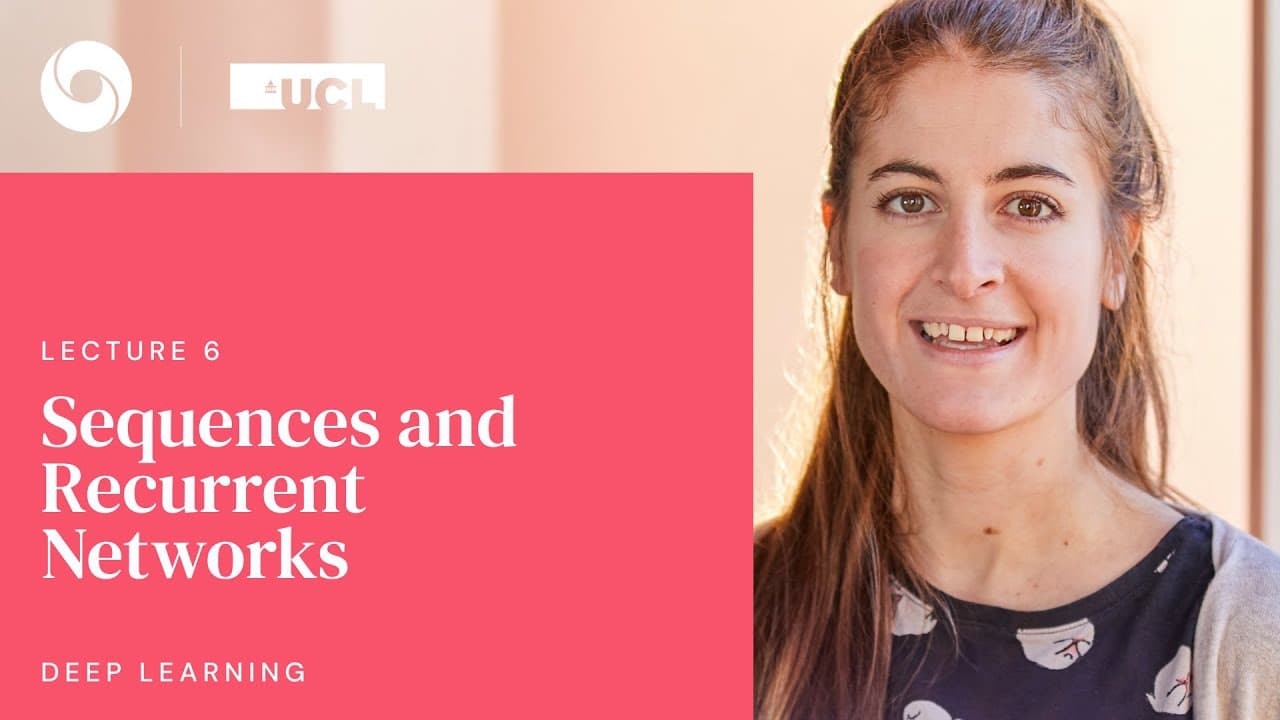
DeepMind x UCL | Deep Learning Lectures | 6/12 | Sequences and Recurrent Networks
TL;DR
Sequential data is crucial in machine learning, presenting unique challenges and necessitating specialized models.
Transcript
today I'm going to be talking to you about sequential data and how much deals with this type of data structure before I begin I'm someone who likes people to understand what I'm talking about so if at some point during the lecture something's not clear or you have a question please raise your hand this can be also a conversation so I should be gett... Read More
Key Insights
- 💄 Sequential data encompasses ordered collections where the arrangement of elements impacts interpretation, making it vital in processes like natural language understanding.
- 🤝 Traditional feed-forward and convolutional models are ineffective at dealing with the inherent variable length of sequential data, necessitating the development of RNN architectures.
- 🍉 RNNs, while capable of processing sequences, are prone to limitations like vanishing gradients, which hinder their ability to remember long-term dependencies efficiently.
- 💁 LSTMs address these challenges with their architecture featuring gates that control information flow, significantly enhancing the network's memory and learning capabilities over extended sequences.
- 🥳 Transformers revolutionize the processing of sequential data by employing self-attention, allowing the model to attend to different parts of the input effectively and facilitating parallel computations.
- 👍 Sequence-to-sequence models leverage an encoder-decoder framework, proving particularly useful in applications like translation, image captioning, and dialogue generation.
- 🧡 The flexibility of sequential models enables their application across a wide range of domains, including audio processing and complex decision-making systems in artificial intelligence.
Install to Summarize YouTube Videos and Get Transcripts
Explore YouTube Video Summarizer or Get YouTube Transcript Extractor
Questions & Answers
Q: What is sequential data, and why is it important in machine learning?
Sequential data consists of ordered collections of elements where the arrangement matters, such as sentences in language. Its importance in machine learning arises from the need to analyze and generate data that follow specific patterns over time, facilitating tasks like language translation and speech recognition.
Q: How do recurrent neural networks (RNNs) address the challenges associated with sequential data?
RNNs are designed to process sequences by maintaining a hidden state that captures information from previous time steps. This allows them to handle variable-length inputs while leveraging the sequential order of the data, making them well-suited for tasks such as language modeling and time series prediction.
Q: What is the main limitation of traditional RNNs when dealing with long sequences?
Traditional RNNs often suffer from the vanishing gradient problem, where gradients diminish during backpropagation through time, causing them to struggle in learning dependencies over long sequences. This limits their ability to retain information from earlier parts of the sequence, affecting their performance on tasks requiring long-term context.
Q: How do long short-term memory networks (LSTMs) overcome the limitations of standard RNNs?
LSTMs use gating mechanisms to regulate the flow of information. They have a cell state that maintains long-term information and gates for input, output, and forgetting, allowing the model to learn which information to retain or discard. This architecture effectively mitigates the vanishing gradient problem, enabling better handling of long sequences.
Q: What role do transformers play in the context of sequential data processing?
Transformers utilize self-attention mechanisms to weigh the importance of different elements in a sequence, enabling parallel processing of input data. This architecture allows for better contextual understanding across the entire sequence and facilitates the handling of long-range dependencies, outperforming RNNs in many tasks.
Q: Can RNNs be used for tasks outside of text-based applications?
Yes, RNNs can be applied to various sequential data types beyond text, such as time series forecasting, audio signal processing, and even image generation. Their capacity to learn from and generate sequences makes them versatile across multiple domains.
Q: What is the significance of sequence-to-sequence models in machine learning?
Sequence-to-sequence models enable the transformation of one sequence into another, catering to applications like machine translation and image captioning. They leverage encoder-decoder architectures, where the encoder processes the input sequence and the decoder generates the corresponding output, achieving high performance in various tasks.
Q: How do attention mechanisms in transformers improve sequential data processing?
Attention mechanisms in transformers allow the model to dynamically focus on relevant parts of the input sequence when producing outputs. This capability enhances the model's ability to capture dependencies across the sequence, facilitating better contextual understanding and improving performance in language generation and other sequential tasks.
Summary & Key Takeaways
-
Sequential data refers to variable-length collections of elements where the order significantly impacts meaning, such as sentences in language comprehension.
-
Models like feed-forward and convolutional networks are inadequate for handling variable-length sequences, leading to the development of specialized architectures like RNNs and LSTMs.
-
Successful applications of sequential models span various fields, from natural language processing to image generation, demonstrating their importance in processing temporal information.
Read in Other Languages (beta)
Share This Summary 📚
Summarize YouTube Videos and Get Video Transcripts with 1-Click
Try YouTube Summary with ChatGPT & Claude or YouTube Transcript Generator
Explore More Summaries from Google DeepMind 📚

Summarize YouTube Videos and Get Video Transcripts with 1-Click
Try YouTube Summary with ChatGPT & Claude or YouTube Transcript Generator