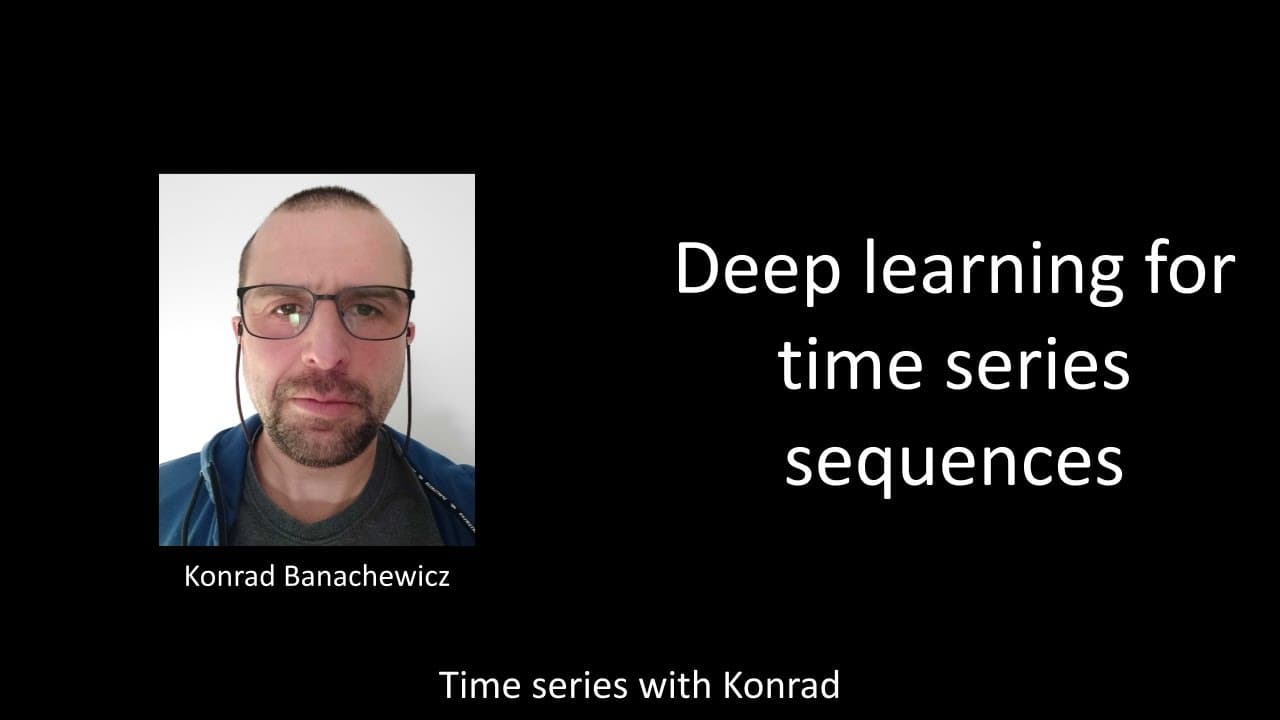
TS-6: Deep learning for time series - sequences
TL;DR
This video discusses the use of deep learning models, specifically RNN, GRU, and LSTM, for time series sequence analysis.
Transcript
hello everyone and welcome to the brand new episode of time series with conrad it has been a month since the last episode i think so the excitement and excitement level and expectations are also quite high from this one right let's hope i can live up to the level of expectation so yeah today we are learning about deep learning and time series seque... Read More
Key Insights
- ⌛ RNNs, GRUs, and LSTMs are commonly used deep learning models for analyzing time series sequences.
- 🍉 RNN models can suffer from vanishing gradients, which can impact their long-term performance.
- 🥺 GRUs and LSTMs have additional gating mechanisms that allow them to retain or discard information, leading to improved performance.
- 🍵 LSTM models can be used for time series forecasting, and they can handle multiple covariates to improve accuracy.
Install to Summarize YouTube Videos and Get Transcripts
Explore YouTube Video Summarizer or Get YouTube Transcript Extractor
Questions & Answers
Q: When should we use RNNs and when should we use transformers?
RNNs are suitable for cases with limited data and weaker hardware, while transformers perform better with large amounts of data and powerful hardware.
Q: What are the limitations of LSTM models?
LSTM models can still suffer from vanishing gradients, which can cause the loss of information over long time horizons.
Q: How do RNNs and LSTM know which information to retain or discard?
RNNs and LSTMs have gating mechanisms that control the flow of information, determining what is relevant and should be passed on.
Q: Can RNN or LSTM models be used to generate probabilistic forecasts?
Yes, probabilistic forecasts can be achieved using methods like bootstrapping or dropout layers to capture different variations in the predictions.
Summary & Key Takeaways
-
The video provides an intro to deep learning and time series sequences, highlighting the importance of RNNs in understanding more complex models like transformers.
-
It explains the concept of RNNs, GRUs, and LSTMs, and how they handle sequential data.
-
The video demonstrates the use of these models in predicting single and multiple steps ahead in time series data.
Read in Other Languages (beta)
Share This Summary 📚
Summarize YouTube Videos and Get Video Transcripts with 1-Click
Try YouTube Summary with ChatGPT & Claude or YouTube Transcript Generator
Explore More Summaries from Abhishek Thakur 📚
Summarize YouTube Videos and Get Video Transcripts with 1-Click
Try YouTube Summary with ChatGPT & Claude or YouTube Transcript Generator