The Scientific Revolution and the Age of Enlightenment | World History | Khan Academy
TL;DR
The Enlightenment challenged traditional beliefs, leading to scientific advancements and a philosophical movement that influenced the American and French Revolutions.
Transcript
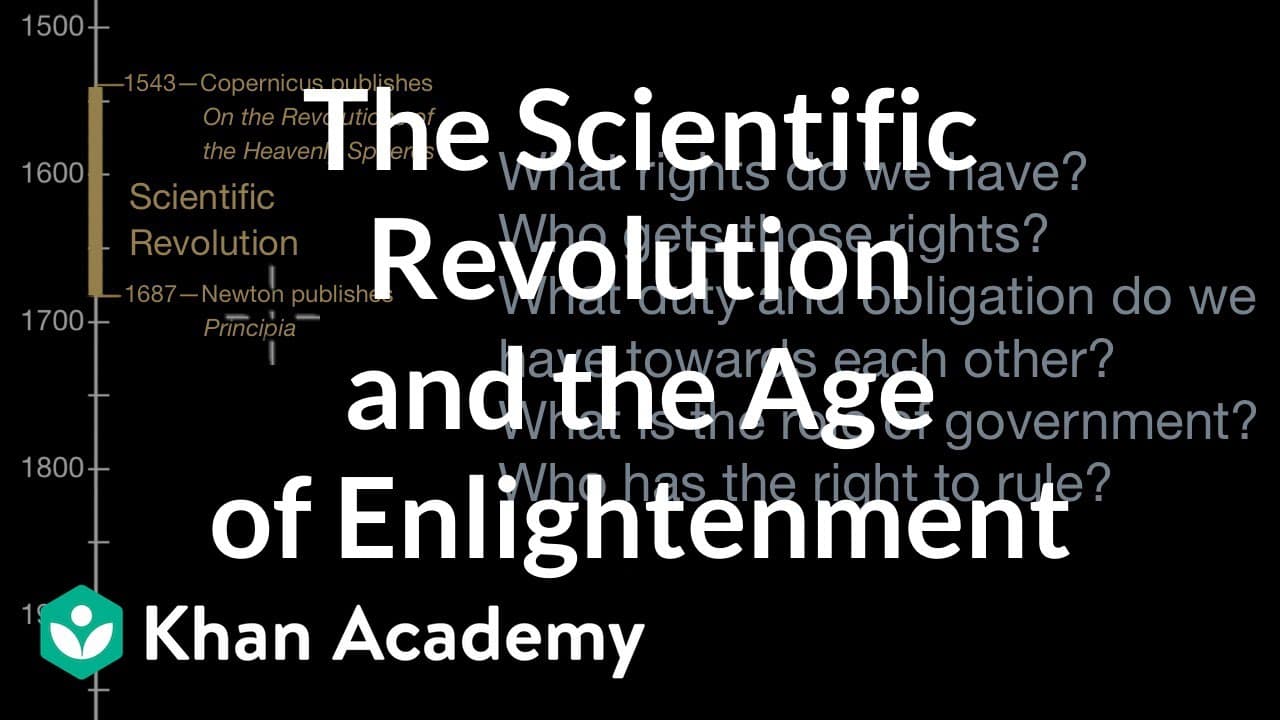
- [Instructor] As we get into the 1500s, the Renaissance has been going on for roughly 200 years. Especially Europe has been rediscovering the knowledge from the Greeks and from the Romans and as they enter into the 16th century, they start to go beyond the knowledge of the Greeks and the Romans. In 1543, Nicolaus Copernicus publishes On the Revolu... Read More
Key Insights
- 🖐️ The Renaissance played a significant role in the rediscovery of ancient knowledge.
- ❓ The scientific revolution challenged existing beliefs about the structure of the universe.
- 🎓 Newton's Principia revolutionized scientific understanding and education.
- 🗯️ The Enlightenment was a philosophical movement that questioned traditional notions of government and human rights.
- 🏈 The ideas of the Enlightenment influenced the American and French Revolutions.
- 💡 The Industrial Revolution amplified the significance of the Enlightenment ideas.
- 🤕 The age of imperialism during the Industrial Revolution contradicted the ideals of the Enlightenment.
Install to Summarize YouTube Videos and Get Transcripts
Explore YouTube Video Summarizer or Get YouTube Transcript Extractor
Questions & Answers
Q: How did Copernicus's publication challenge existing beliefs about the universe?
Copernicus's publication challenged the long-held belief that the Earth was the center of the universe, suggesting instead that the Earth revolved around the sun. This contradicted traditional ideas about the structure of the universe and opened the door to new scientific theories.
Q: What impact did Newton's Principia have on scientific education?
Newton's Principia described the laws of the universe, providing simple principles that explained how most things in the universe could be understood through mathematics. This became the foundation of first-year physics and introductory engineering classes.
Q: What is the Enlightenment and how is it related to the scientific revolution?
The Enlightenment was a philosophical movement that emerged during the scientific revolution. It challenged traditional notions of government, human rights, and the role of individuals in society. The scientific revolution provided new tools and evidence that contributed to the ideas of the Enlightenment.
Q: How did the Enlightenment influence the American and French Revolutions?
The ideas of the Enlightenment, such as life, liberty, and the pursuit of happiness, were cited during the American and French Revolutions. These ideas shaped the ideals of these revolutions and influenced the push for independence and the establishment of new governments.
Summary & Key Takeaways
-
The Renaissance sparked a rediscovery of ancient knowledge, leading to the scientific revolution in the 16th century.
-
Copernicus's publication challenged the idea that the Earth was the center of the universe, marking the beginning of the scientific revolution.
-
Newton's Principia, published in 1687, described the laws of the universe and greatly influenced science and engineering education.
Read in Other Languages (beta)
Share This Summary 📚
Summarize YouTube Videos and Get Video Transcripts with 1-Click
Try YouTube Summary with ChatGPT & Claude or YouTube Transcript Generator
Explore More Summaries from Khan Academy 📚



Summarize YouTube Videos and Get Video Transcripts with 1-Click
Try YouTube Summary with ChatGPT & Claude or YouTube Transcript Generator