How to Determine If a Discrete-Time Signal Is Periodic
TL;DR
To determine if a discrete-time signal is periodic, check if its period can be expressed as a rational number. Use the transformation formula for cosine functions to simplify the analysis, and remember that adding a DC shift does not impact periodicity. The key is that the resulting frequency must be rational for the signal to be categorized as periodic.
Transcript
click the bell icon to get latest videos from akira hello friends and today we are going to solve a new miracle which is based on periodicity of discrete-time signal and the problem is problem number one now what is important basically we want a value of period that is a number of samples value but that value must be in a rational format how to obt... Read More
Key Insights
- 💁 The value of a discrete-time signal's period must be in a rational format.
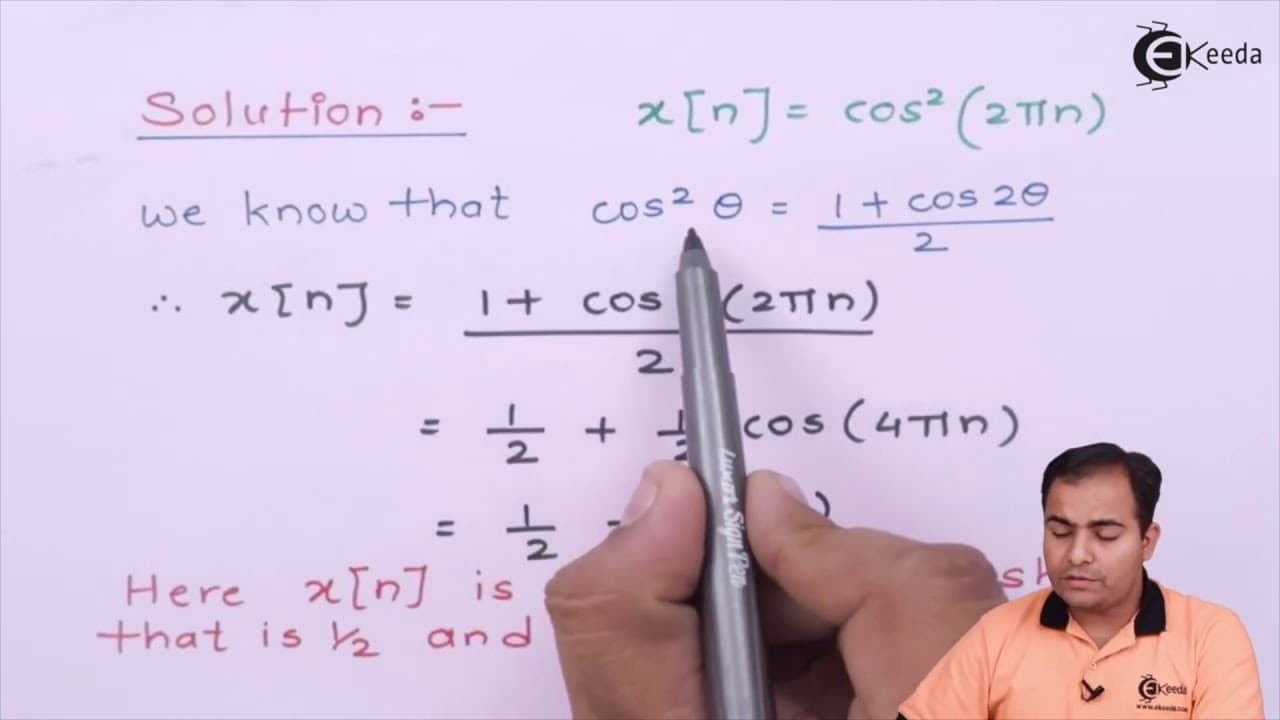
- 🇨🇨 A formula like cos^2θ = 1 + cos(2θ)/2 can be used to transform a given function into cos, simplifying the determination of periodicity.
- 🪜 Adding a DC amplitude or DC shift does not affect the periodicity of a signal.
- ⌛ The periodicity of a discrete-time signal can be determined by examining the obtained frequency, which should be a rational number.
- 🪜 The periodicity of X often remains even after adding a DC shift to X 1 often.
- ⌛ The rationality of a result is important in determining the periodicity of a discrete-time signal.
- 🤪 Periodicity plays a crucial role in various transforms, such as Laplace, z-transform, and Fourier series.
Install to Summarize YouTube Videos and Get Transcripts
Explore YouTube Video Summarizer or Get YouTube Transcript Extractor
Questions & Answers
Q: What is the importance of obtaining the period value of a discrete-time signal in a rational format?
Obtaining the period value in a rational format allows us to determine if the signal is periodic or not accurately. It helps in analyzing other related equations and transforms.
Q: How can we check if a discrete-time signal is periodic?
We can check the periodicity of a signal by transforming it into cos using the formula cos^2θ = 1 + cos(2θ)/2. Then, we analyze the obtained frequency and determine if it is a rational number.
Q: Does adding a DC amplitude or DC shift affect the periodicity of a signal?
No, adding a DC amplitude or shift does not affect the periodicity of a signal. The periodicity is determined solely by the properties of the original signal.
Q: How do we calculate the periodicity of a given discrete-time function signal?
To calculate the periodicity, we transform the function into cos and examine the obtained frequency. If the frequency is a rational number, we conclude that the signal is periodic.
Summary & Key Takeaways
-
Understand the importance of obtaining the value of a discrete-time signal's period in a rational format.
-
Learn how to check if a given discrete-time signal is periodic or not.
-
Use the formula cos^2θ = 1 + cos(2θ)/2 to transform a given function into cos and determine its periodicity.
Read in Other Languages (beta)
Share This Summary 📚
Summarize YouTube Videos and Get Video Transcripts with 1-Click
Try YouTube Summary with ChatGPT & Claude or YouTube Transcript Generator
Explore More Summaries from Ekeeda 📚






Summarize YouTube Videos and Get Video Transcripts with 1-Click
Try YouTube Summary with ChatGPT & Claude or YouTube Transcript Generator