Flow Through Nozzle and Orifice Problem 3 - Compressible Fluid Flow - Fluid Mechanics 1
TL;DR
This video explains how to calculate the maximum flow rate and velocity of compressible fluid flowing through an orifice and nozzle using specific formulas and equations.
Transcript
as we have seen in compressible fluid flow that is the formulas of velocity and mass flow rate maximum velocity and maximum mass flow rate from a reserve wire to a nozzle which is connected to the reservoir and a compressible fluid is flowing from the reservoir to the atmosphere so during this we encounter certain kinds of changes that is change in... Read More
Key Insights
- 💐 The formulas for mass flow rate and velocity are essential in solving problems involving compressible fluid flow through orifices and nozzles.
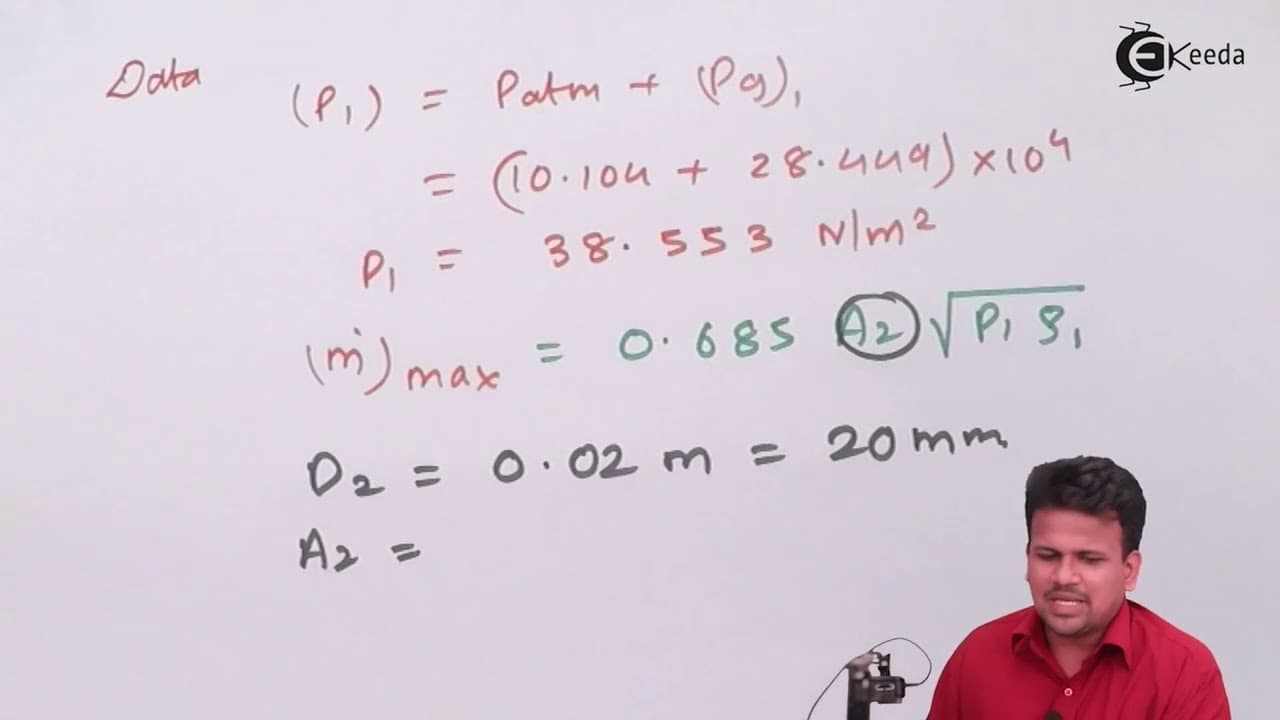
- 🪜 The gauge pressure is obtained by adding the atmospheric pressure to the given gauge pressure value.
- ☠️ The initial pressure and area of the orifice are used to determine the maximum mass flow rate.
- ❓ The initial pressure and density are used to calculate the initial density of the fluid.
- 🥵 The specific heat ratio, initial pressure, and initial density are required to solve for the maximum velocity.
- 🫢 The ideal gas law equation, p1/ρ1 = R * T1, is used to find the initial density of the fluid.
- ☠️ The maximum flow rate and velocity can be calculated using the formulas and equations provided in the video.
Install to Summarize YouTube Videos and Get Transcripts
Explore YouTube Video Summarizer or Get YouTube Transcript Extractor
Questions & Answers
Q: How is the gauge pressure calculated in the given problem?
The gauge pressure (p1) is found by adding the atmospheric pressure (p atmosphere) to the given gauge pressure value (28.44 N/cm²) using the equation p1 = p atmosphere + p gauge 1.
Q: What formula is used to calculate the maximum mass flow rate in compressible fluid flow?
The formula for maximum mass flow rate is 0.685 * A2 * p1 * ρ1, where A2 is the area of the orifice, p1 is the initial pressure, and ρ1 is the initial density.
Q: How is the density (ρ1) calculated in the problem?
The density ρ1 is determined by using the ideal gas law equation, p1/ρ1 = R * T1, where p1 is the initial pressure, R is the specific gas constant, and T1 is the initial temperature.
Q: What is the formula for calculating the maximum velocity (v2)?
The formula for maximum velocity is v2 = √(2 * γ / (γ - 1) * (γ + 1) * p1 / ρ1), where γ is the specific heat ratio.
Summary & Key Takeaways
-
The video discusses the formulas for velocity and mass flow rate in compressible fluid flow through orifices and nozzles.
-
A problem is presented where air flows from a tank to the atmosphere through an orifice.
-
The video provides step-by-step calculations to determine the maximum flow rate of the air.
Read in Other Languages (beta)
Share This Summary 📚
Summarize YouTube Videos and Get Video Transcripts with 1-Click
Try YouTube Summary with ChatGPT & Claude or YouTube Transcript Generator
Explore More Summaries from Ekeeda 📚





Summarize YouTube Videos and Get Video Transcripts with 1-Click
Try YouTube Summary with ChatGPT & Claude or YouTube Transcript Generator