12 Missing angle alternate solution
TL;DR
By using the sum of interior angles of triangles, the value of an unknown angle in a triangle can be determined.
Transcript
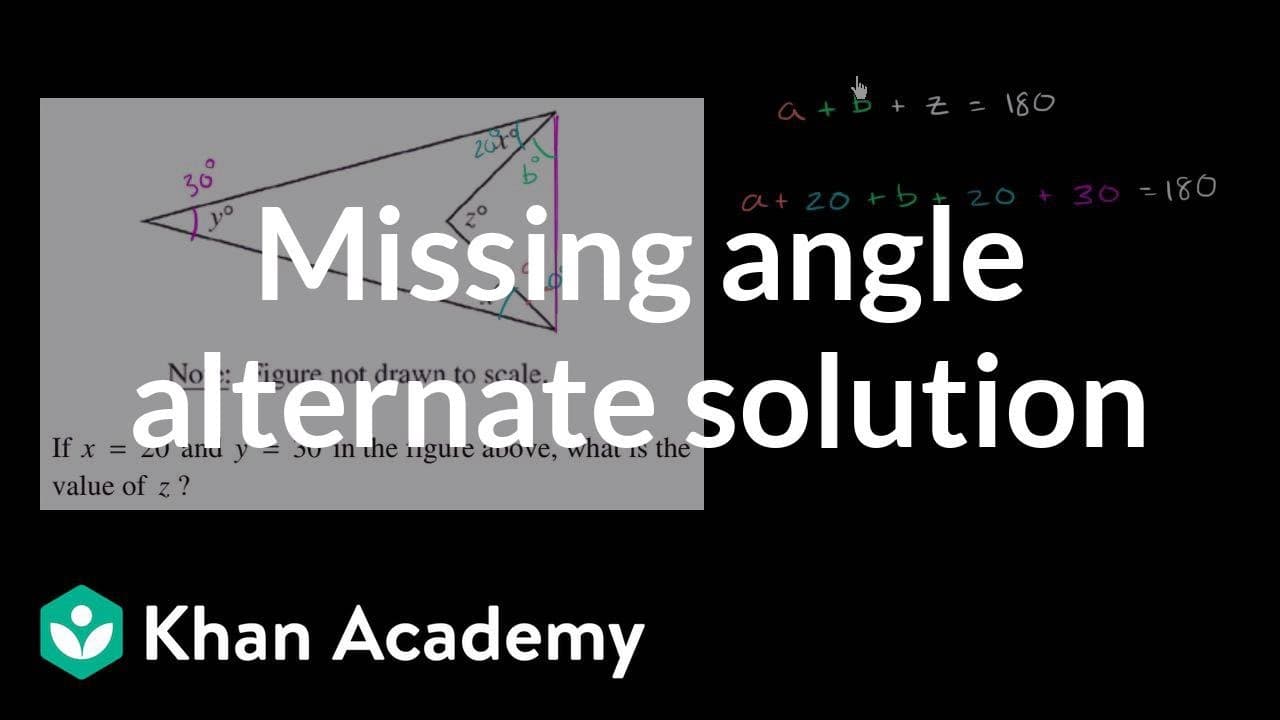
- [Voiceover] So let's go it through another way, 'cause this is a really interesting problem. Let's think about another way that we could have tackled it. So once again, x is equal to 20, so this is a 20 degree angle, And y is equal to 30, so this is a 30 degree angle. What is the value of z? So the last way we did it, we constructed a line right ... Read More
Key Insights
- 🔺 The sum of interior angles of a triangle is always 180 degrees.
- 🔺 By creating a smaller triangle and using the equation mentioned above, the value of an unknown angle can be determined.
- 🔺 The method described in the video provides an alternative approach to solving triangle angle problems.
- 🫥 This method eliminates the need for constructing additional lines in order to find the value of an unknown angle.
- 🔺 The approach discussed in the video is applicable to various types of triangles, regardless of their angles.
- 🔺 It is important to ensure the accuracy of the given angles and the validity of the geometric properties of the triangle when using this method.
- 🔺 The sum of two unknown angles can be solved using the equation and the value of the third unknown angle can be calculated.
Install to Summarize YouTube Videos and Get Transcripts
Explore YouTube Video Summarizer or Get YouTube Transcript Extractor
Questions & Answers
Q: How can the sum of interior angles of a triangle be used to find the value of an unknown angle?
By creating a smaller triangle and using the equation that the interior angles of a triangle add up to 180 degrees, we can solve for the sum of two unknown angles and find the value of the third unknown angle.
Q: What is the advantage of using the method described in the video?
This method provides an alternative approach to finding the value of an unknown angle in a triangle without constructing additional lines, which can simplify the problem-solving process.
Q: Can this method be applied to any type of triangle?
Yes, the method of using the sum of interior angles can be applied to any type of triangle, whether it is acute, obtuse, or right-angled.
Q: Are there any limitations to this method?
This method assumes that the given angles are accurate and that the triangle satisfies the properties of Euclidean geometry. If these assumptions are not met, the method may not provide an accurate result.
Summary & Key Takeaways
-
The video discusses an alternative approach to finding the value of an unknown angle in a triangle by using the sum of interior angles.
-
Instead of constructing a line, the video suggests creating a smaller triangle and using the equation that the interior angles of a triangle add up to 180 degrees.
-
By solving for the sum of two unknown angles, the value of the third unknown angle can be calculated.
Read in Other Languages (beta)
Share This Summary 📚
Summarize YouTube Videos and Get Video Transcripts with 1-Click
Try YouTube Summary with ChatGPT & Claude or YouTube Transcript Generator
Explore More Summaries from Khan Academy 📚



Summarize YouTube Videos and Get Video Transcripts with 1-Click
Try YouTube Summary with ChatGPT & Claude or YouTube Transcript Generator