Economic models | Basic economics concepts | AP Macroeconomics and Microeconomics | Khan Academy
TL;DR
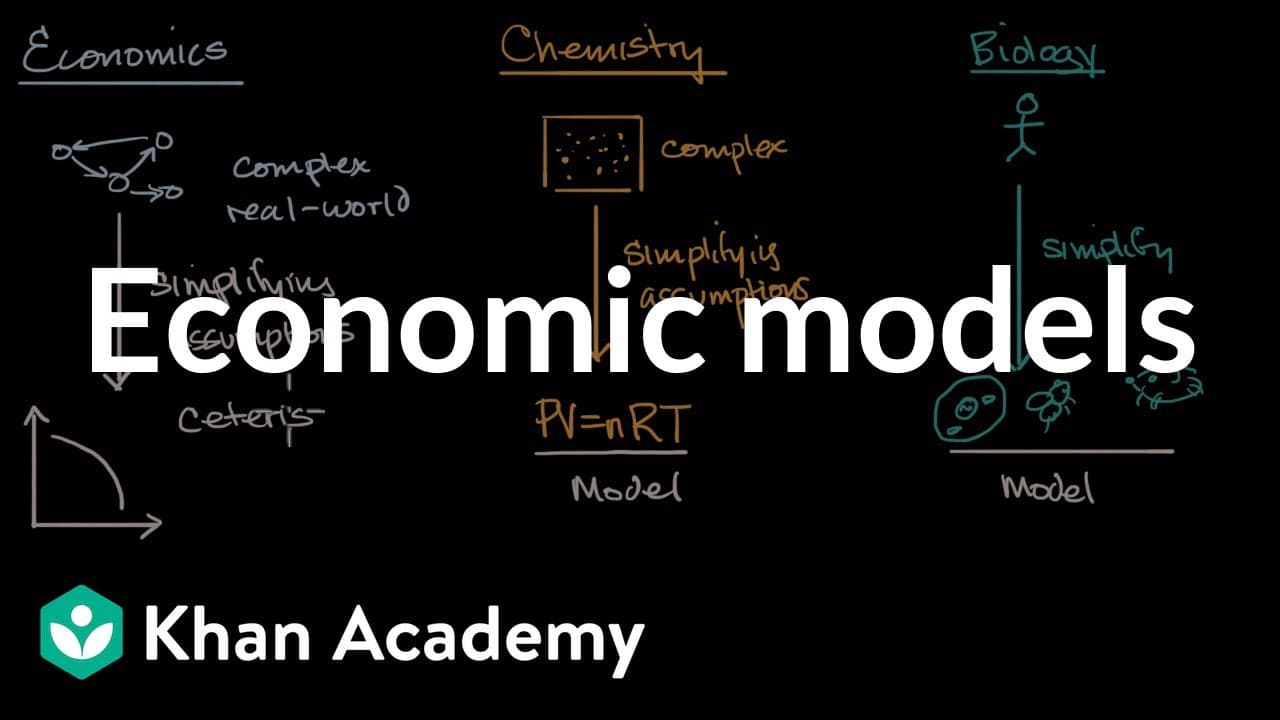
Economic models are valuable tools for understanding complex systems, but they rely on simplifying assumptions and cannot be tested in the same way as other sciences.
Transcript
- When you think about what the field of economics is about, it is quite daunting. An economy is made up of millions or even billions of actors organized in incredibly complex ways. Write down, this is complex real-world and each of the actors, human beings or organizations, these are incredibly complex. A human brain. I can't predict what you're g... Read More
Key Insights
- 🏑 Economics borrows the idea of models from other fields, such as chemistry and biology.
- ❓ Simplifying assumptions are necessary in economic models to understand the complex interactions in an economy.
- ❓ Economic models should be treated as representations of reality and not absolute truths.
Install to Summarize YouTube Videos and Get Transcripts
Explore YouTube Video Summarizer or Get YouTube Transcript Extractor
Questions & Answers
Q: How do economic models borrow ideas from other fields?
Economic models, like models in chemistry and biology, use simplifying assumptions to understand complex systems. They break down the real-world complexity into equations, lines, or charts to gain insights.
Q: Why do economists make simplifying assumptions about actors in an economy?
Economists make assumptions like rational behavior and perfect information to simplify the complex interactions of actors in an economy. While these assumptions are not entirely true, they help in building models for analysis.
Q: How are economic models similar to models in biology?
Just as biologists use simpler organisms to study complex ones, economists make simplifying assumptions about human behavior by studying simpler economic organisms. For example, drug trials are often conducted on mice before experiments on humans.
Q: What are the limitations of testing economic models?
Unlike other sciences, economics cannot conduct experiments in the same controlled manner. It is challenging to test economic models with absolute certainty due to the complexity of economies and ethical concerns.
Summary & Key Takeaways
-
Economics borrows the concept of models from other fields, such as chemistry and biology, to understand complex systems.
-
Models in economics involve simplifying assumptions to make sense of the real-world complexity.
-
Economic models are valuable but should be approached with caution and considered as representations of reality rather than absolute truths.
Read in Other Languages (beta)
Share This Summary 📚
Summarize YouTube Videos and Get Video Transcripts with 1-Click
Try YouTube Summary with ChatGPT & Claude or YouTube Transcript Generator
Explore More Summaries from Khan Academy 📚



Summarize YouTube Videos and Get Video Transcripts with 1-Click
Try YouTube Summary with ChatGPT & Claude or YouTube Transcript Generator