How Do Parabolic Mirrors Form Images Based on Distance?
TL;DR
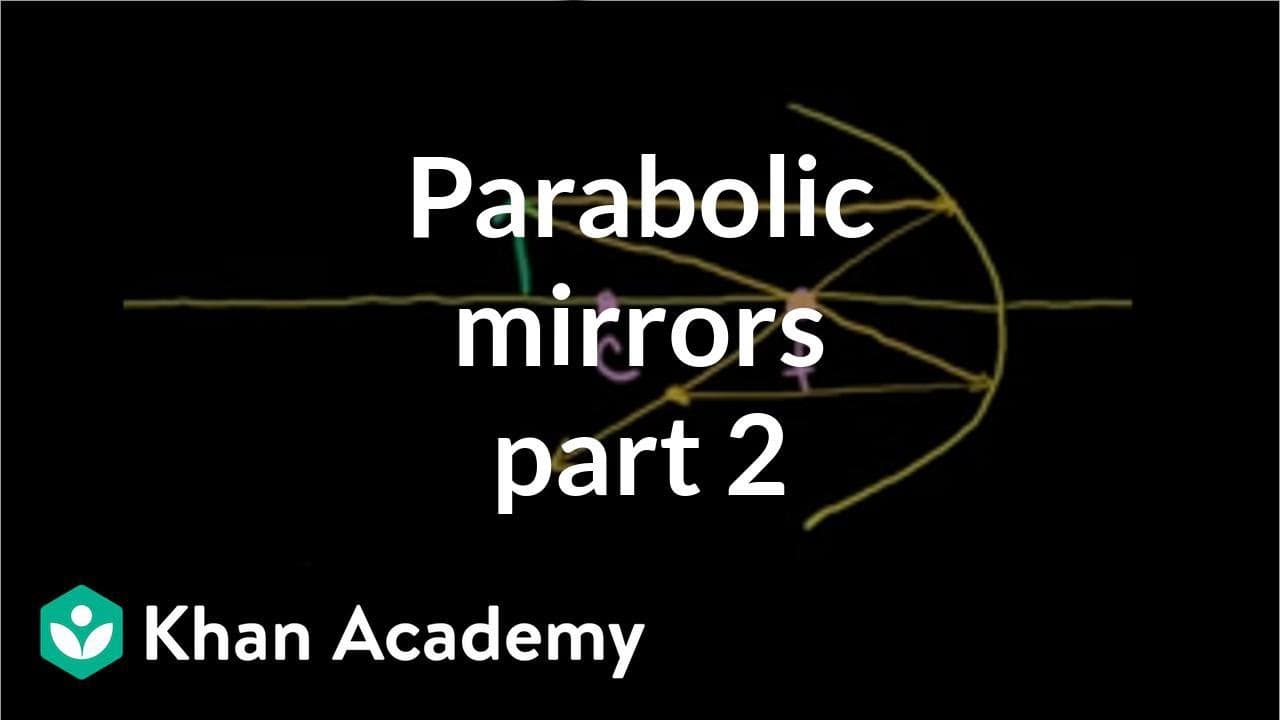
Parabolic mirrors form images according to the object's position relative to the mirror. Objects beyond the center of curvature produce smaller real images, those at the center create same-sized real images, and those between the center and the focal point form larger real images. Objects at the focal point produce no image, but results in a magnified virtual image.
Transcript
Let's draw a bunch of parabolic mirrors. And what I want to do in this video is, do a bunch of examples of objects in front of parabolic mirrors. And think about what the images of those objects will be based on how far those objects are. And besides just giving us a better understanding of parabolic mirrors, this will also, it 'll hopefully also g... Read More
Key Insights
- 🙂 The key to understanding image formation by parabolic mirrors lies in tracing the paths of two specific light rays - one parallel to the principal axis and one through the focus.
- 😥 Objects placed at different positions relative to the parabolic mirror (beyond the center of curvature, at the center of curvature, between the center of curvature and the focal point, or at the focal point) produce different types of images.
- 🙌 The distance and characteristics of the images formed by parabolic mirrors are determined by the reflection of the two key light rays and the convergence or divergence of these rays.
- 🛩️ Objects placed beyond the center of curvature produce real and smaller images, while objects at the center of curvature produce real and same-sized images.
- 😥 Objects between the center of curvature and the focal point create real and larger images, and objects at or closer than the focal point result in no real image formation but a magnified virtual image instead.
- 🙂 Practice and familiarity with tracing the path of light rays will enhance the understanding of image formation by parabolic mirrors.
Install to Summarize YouTube Videos and Get Transcripts
Explore YouTube Video Summarizer or Get YouTube Transcript Extractor
Questions & Answers
Q: How are images formed by parabolic mirrors determined?
Images formed by parabolic mirrors are determined by tracing two key light rays - one parallel to the principal axis and one through the focus - and analyzing their reflections. The point at which these rays converge or appear to diverge determines the location and characteristics of the image.
Q: What happens to the size of the image when an object is placed beyond the center of curvature?
When the object is placed beyond the center of curvature, a real and smaller image is formed by the parabolic mirror. The parallel incident ray reflects through the focus, while the incident ray through the focus reflects parallel to the principal axis, causing the light to converge at a point closer to the mirror than the object.
Q: How does the placement of the object affect the size of the image in front of a parabolic mirror?
The placement of the object determines the size of the image formed by a parabolic mirror. If the object is between the center of curvature and the focal point, the image will be real and larger than the object. If the object is at the center of curvature, the image will be real and the same size as the object. If the object is at the focal point or closer, no real image is formed.
Q: Can parabolic mirrors create virtual images?
Yes, parabolic mirrors can create virtual images. When an object is placed closer than the focal point, the parabolic mirror forms a virtual image that is larger than the object. These virtual images appear to diverge from a point behind the mirror.
Summary & Key Takeaways
-
The video demonstrates examples of objects placed in front of parabolic mirrors and explains how the images of those objects are formed based on their distance from the mirror.
-
By using two key light rays (parallel and through focus), the video simplifies the process of determining the images formed by parabolic mirrors.
-
The video showcases different scenarios, such as objects beyond the center of curvature (forming real and smaller images), objects at the center of curvature (forming real and same-sized images), objects between the center of curvature and the focal point (forming real and larger images), and objects at the focal point (forming no image), providing a comprehensive understanding of image formation.
Read in Other Languages (beta)
Share This Summary 📚
Summarize YouTube Videos and Get Video Transcripts with 1-Click
Try YouTube Summary with ChatGPT & Claude or YouTube Transcript Generator
Explore More Summaries from Khan Academy 📚



Summarize YouTube Videos and Get Video Transcripts with 1-Click
Try YouTube Summary with ChatGPT & Claude or YouTube Transcript Generator