Problems on Derivative Part 1 - Derivatives - Diploma Maths - II
TL;DR
This video provides easy practice problems on finding the derivative using direct formulas and simplification.
Transcript
Click the bell icon to get latest videos from Ekeeda Hello friends in this video we are going to start few easy problems on derivative and we are going to take such three problems so let us start so the first problem we have is 5 divided by DX if Y is equal to X raised to 10 plus 10 raised to X plus e raise to X so we are going to find the derivati... Read More
Key Insights
- 🥳 Differentiating a function with multiple parts requires applying the appropriate formulas for each part separately.
- ❓ Simplifying a function before differentiating can make the process easier.
- 📏 The UV rule is used when two functions are multiplied together, and it involves differentiating each function and combining the results.
- 📏 The derivative of an exponential function is itself, while the derivative of a trigonometric function involves applying the appropriate trigonometric rules.
Install to Summarize YouTube Videos and Get Transcripts
Explore YouTube Video Summarizer or Get YouTube Transcript Extractor
Questions & Answers
Q: What is the first step in finding the derivative of a function using direct formulas?
The first step is to identify the different parts of the function (algebraic, exponential, etc.) and then differentiate each part separately using the corresponding formulas.
Q: How is the second problem solved differently than the first one?
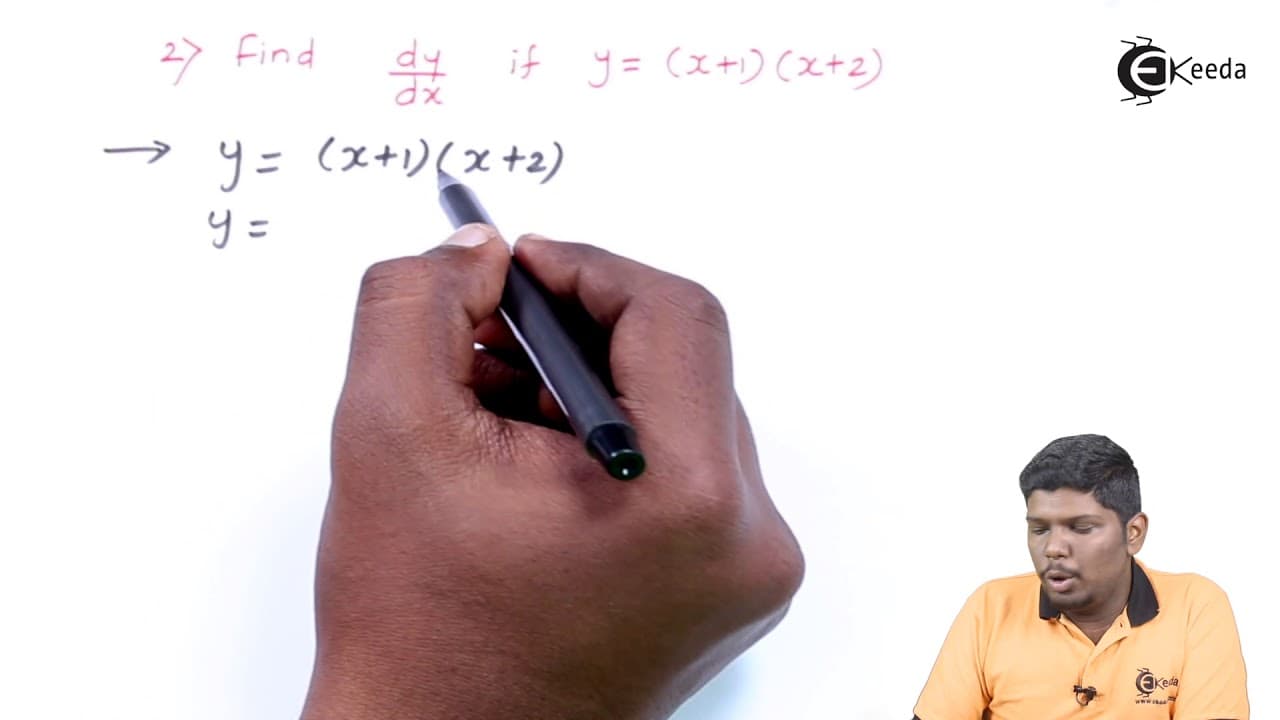
In the second problem, the function is simplified first by multiplying the terms together. Then, the derivative is found by differentiating each term separately, taking into account any constants.
Q: What is the UV rule and when is it used?
The UV rule is used when two functions are multiplied together. It involves differentiating each function separately and then combining the results using the formula: U * dV/dx + V * dU/dx.
Q: Can you explain how the UV rule is applied in the third problem?
In the third problem, the function is split into two parts: e^x and sin(x). Using the UV rule, the derivative is found by multiplying the derivative of each part by the other part and then summing them up.
Summary & Key Takeaways
-
The video starts by explaining the process of finding the derivative of a function using direct formulas and without using the first principle.
-
The first problem involves finding the derivative of a function with three different parts (algebraic, exponential, and exponential), which are differentiated separately using the appropriate formulas.
-
The second problem focuses on simplifying the function before finding its derivative using the UV rule.
-
The third problem introduces the UV rule for finding the derivative of a function with two parts (exponential and trigonometric) that are multiplied together.
Read in Other Languages (beta)
Share This Summary 📚
Summarize YouTube Videos and Get Video Transcripts with 1-Click
Try YouTube Summary with ChatGPT & Claude or YouTube Transcript Generator
Explore More Summaries from Ekeeda 📚






Summarize YouTube Videos and Get Video Transcripts with 1-Click
Try YouTube Summary with ChatGPT & Claude or YouTube Transcript Generator